
John Burke, MD, discusses his editor-in-chief column from the July 2025 issue of Targeted Therapies in Oncology.
John Burke, MD, discusses his editor-in-chief column from the July 2025 issue of Targeted Therapies in Oncology.
John M. Burke, MD, discusses the FDA ODAC's decision on the use of daratumumab in high-risk smoldering multiple myeloma and its implications for clinical practice.
Unpredictable FDA and funding woes delay crucial drug approvals, depriving thousands of patients access to vital treatments for diseases like colon cancer.
Benjamin Schlechter, MD, discusses the safety and efficacy findings from the C-800-01 phase 1 trial evaluating botensilimab and balstilimab in colorectal cancer.

An expert discusses how optimal sequencing of therapies remains unclear in lower-risk MDS, with emerging combination strategies and ongoing trials that may help define the best treatment approaches.
An expert discusses how real-world evidence and patient-reported outcomes support luspatercept’s clinical benefits, while highlighting the high failure rates of ESA therapy in community practice.
Botensilimab/balstilimab (BOT/BAL) synergistically activate and sustain immune attack, offering a promising new strategy for various cancers.
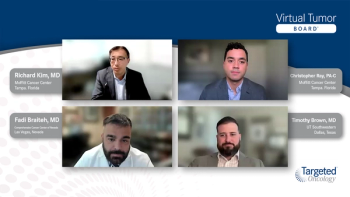
Panelists discuss how implementing combination immunotherapy in clinical practice faces institutional barriers, including formulary approval for retifanlimab and payer authorization challenges. They maintain that published dosing schedules should be followed rather than modifying treatment intervals to address patient access barriers.
Panelists discuss how biomarker development in anal cancer remains limited with PD-L1 status not influencing treatment decisions, although rare targets like HER2, PIK3CA aberrations, and RAS wild-type status for EGFR inhibitors may warrant next-generation sequencing testing for research purposes, while emphasizing honest discussions about palliative treatment goals and quality-of-life balance.
An expert discusses that while CAR T-cell therapy has transformed the treatment landscape for primary refractory diffuse large B-cell lymphoma by outperforming traditional transplant approaches in the second-line setting, timely referral to specialized centers is critical, as misjudged eligibility and nonclinical barriers like geography, caregiver support, and insurance can delay or prevent access to this potentially curative therapy—challenges best addressed through proactive, multidisciplinary coordination.
An expert discusses that this case of a 60-year-old man with primary refractory diffuse large B-cell lymphoma highlights the urgent need for a shift in therapeutic strategy following early relapse after R-CHOP, with CAR T-cell therapy emerging as a preferred option given the poor prognosis of chemo-refractory disease, the patient’s eligibility for intensive treatment, and the critical role of timely referral, coordinated care, and transparent communication to optimize outcomes in high-risk lymphoma.
Benjamin Schlechter, MD, discusses the unmet needs and treatment gaps for patients with colorectal cancer.
Arturo Loaiza-Bonilla, MD, MSEd, discusses the significant advancements and ongoing efforts in integrating artificial intelligence into oncology.
Michael Caligiuri, MD, discusses the modulation of natural killer cells to enhance their ability to detect and destroy tumor cells.
An expert discusses the importance of timely biomarker testing and emerging challenges in treatment sequencing for metastatic triple-negative breast cancer (mTNBC), as first-line use of antibody-drug conjugates (ADCs) raises concerns about cross-resistance and the need for strategic postprogression planning.
An expert discusses the evolving role of biomarker testing in first-line metastatic triple-negative breast cancer (mTNBC), highlighting how PD-L1, BRCA status, and emerging markers such as Trop-2 expression are shaping personalized treatment approaches and guiding the integration of antibody-drug conjugates (ADCs) and immunotherapy.

Pedro C. Barata, MD, MSc, discusses the advantages and disadvantages of darolutamide in metastatic hormone-sensitive prostate cancer.

Rajshekhar Chakraborty, MD, discusses the safety and tolerability of linvoseltamab with carfilzomib when used for the treatment of patients with relapsed/refractory multiple myeloma.
Alicia Morgans, MD, MPH, covers what sets darolutamide apart from other androgen receptor inhibitors.

Jacob E. Berchuck, MD, highlights novel findings pointing to androgen receptor signaling and Wnt pathway activation as key correlates of poor response to therapy.

Following the FDA ODAC's vote against belantamab mafodotin-based combinations in relapsed/refractory multiple myeloma, George Mulligan, PhD, provides insight into the agent's potential path foward.
Alicia Morgans, MD, MPH, discusses the ARANOTE trial.
An expert discusses how long-term follow-up data from the COMMANDS trial demonstrated sustained superiority of luspatercept over ESAs, with an intriguing trend toward improved overall survival that warrants further investigation.
An expert discusses how the EPO-PRETAR trial results showed no significant difference in transfusion dependence between early and late ESA initiation, emphasizing that treatment timing remains an individualized decision.
An expert discusses how radiopharmaceuticals such as radium-223 offer a valuable different mechanism of action in treating advanced prostate cancer, requiring careful patient selection, safety monitoring including complete blood count (CBC) tracking, and practical management of adverse effects such as fatigue and nausea while following radiation safety protocols.

Emiltatug ledadotin demonstrated promising antitumor activity and a manageable safety profile in a phase 1 dose-escalation trial.

Shahzad Raza, MD, discusses the phase 2 RedirecTT-1 study which investigated the combination of talquetamab and teclistamab for treating patients with relapsed/refractory multiple myeloma complicated by extramedullary disease.
Panelists discuss how treatment selection between combination immunotherapy (IO) and chemotherapy alone should favor the FDA-approved carboplatin-paclitaxel-retifanlimab regimen for most patients with metastatic anal cancer, while avoiding checkpoint inhibitors in solid organ transplant recipients and maintaining that different checkpoint inhibitors are not necessarily interchangeable without specific trial data.
Panelists discuss how the PODIUM-303 study demonstrated improved progression-free survival (9.3 vs 7.4 months) and response rates (56% vs 44%) when adding retifanlimab to carboplatin-paclitaxel in first-line metastatic anal cancer, leading to FDA approval despite nonsignificant overall survival results due to 45% crossover in the interim analysis.