
George Mulligan, PhD, previews the FDA's ODAC meeting discussing the application of belantamab mafodotin-based combinations for the treatment of multiple myeloma.
George Mulligan, PhD, previews the FDA's ODAC meeting discussing the application of belantamab mafodotin-based combinations for the treatment of multiple myeloma.

Shahzad Raza, MD, explains the rationale behind the REDIRECTT-1 study.

Theresa Medina, MD, discusses the clinical potential of lifileucel, a tumor-infiltrating lymphocyte therapy, for patients with advanced melanoma.

A study strongly supports stereotactic radiation for up to 20 brain metastases, proving superior to even advanced whole-brain techniques and widely accessible.
The PROGRxN-BCa study, led by Jethro C.C. Kwong, showcases a major advancement in predicting disease progression in non–muscle-invasive bladder cancer through artificial intelligence (AI).
An expert discusses how emerging trial data, particularly from ASCENT-04, are reshaping first-line treatment strategies for PD-L1–positive metastatic triple-negative breast cancer (mTNBC) by demonstrating the potential superiority of antibody-drug conjugates (ADCs) combined with immunotherapy over standard chemotherapy regimens.
An expert discusses how recent clinical advancements and biomarker-driven strategies are reshaping first-line treatment decisions in metastatic triple-negative breast cancer (mTNBC), emphasizing the critical need for early, optimized therapy to improve outcomes in this aggressive disease.
Ayal Aizer, MD, MHS, discusses the findings of a phase 3 study investigating the use of stereotactic radiation vs whole-brain radiation in patients with 5 to 20 brain metastases.

Nicole A. Cipriani, MD, offers guidance for community oncologists regarding the role of BRAF p.V600E testing in patients with papillary thyroid carcinoma.
Breelyn Wilky, MD, explains when patients with gastrointestinal stromal tumor should be referred for clinical trials.
Breelyn Wilky, MD, discusses what key molecular insights in GIST management community oncologists should prioritize today.
Peter M. Voorhees, MD, shares key insights from the 2025 American Society of Clinical Oncology Annual Meeting, specifically in the multiple myeloma space.
Ponatinib improved MRD negativity and safety in Ph+ ALL patients in the PHALLcon study, supporting its role as a potent TKI despite long-term data pending.

A new risk model uses objective clinical data to predict cure or relapse in Hodgkin lymphoma, with future plans to guide treatment and survivorship care.
Peter M. Voorhees, MD, discusses the 5-year follow-up results from the CARTITUDE-1 trial of ciltacabtagene autoleucel for the treatment of relapsed/refractory multiple myeloma.

A panelist notes that while new treatments like luspatercept and imetelstat offer hope beyond traditional erythropoiesis-stimulating agents—which fail in many patients and provide limited response duration—variability in patient response, influenced by factors such as mutation burden, underscores the need for personalized therapies and continued development of agents that can modify disease progression and improve survival in low-risk myelodysplastic syndrome.
A panelist highlights that after initial hemoglobin decline despite dose escalation, further increasing luspatercept dosing led to transfusion independence and hemoglobin improvement, underscoring the critical role of regular monitoring and timely dose adjustments to optimize anemia management in low-risk myelodysplastic syndrome.
An expert discusses how the PEACE III combination of radium-223 and enzalutamide represents an effective treatment option for the limited population of patients who reach first-line metastatic castration-resistant prostate cancer (mCRPC) without prior androgen receptor pathway inhibitor exposure, while other combinations such as radium-223 plus olaparib showed mixed results with concerning toxicity profiles.
A panelist emphasizes that recent real-world retrospective data from 103 first-line luspatercept-treated patients closely align with, and even slightly exceed, COMMANDS trial results—demonstrating significant hemoglobin improvements and transfusion independence—thereby reinforcing luspatercept’s effectiveness and practical value in routine clinical care for erythropoiesis-stimulating agent–naïve, low-risk patients with myelodysplastic syndrome.
An expert discusses how CT scans and bone scans remain the standard imaging approach for most patients with metastatic castration-resistant prostate cancer (mCRPC), whereas prostate-specific membrane antigen (PSMA) PET scans are primarily reserved for selecting patients for specific treatments such as lutetium Lu 177 vipivotide tetraxetan (Pluvicto), though they may offer better sensitivity for detecting soft tissue disease in radium-223 candidates.

Panelist discusses how recent ASCO updates, particularly the SEQUOIA study results, highlight the long-term efficacy of zanubrutinib in high-risk patients and represent the most significant advances in CLL treatment from the meeting.
A panelist highlights that updated COMMANDS trial data demonstrate luspatercept’s robust efficacy in erythropoiesis-stimulating agent–naive patients with low-risk myelodysplastic syndrome—achieving high rates of durable transfusion independence and hemoglobin improvement across subgroups—with emerging evidence suggesting potential long-term survival benefits and a favorable safety profile.
Paolo Ghia, MD, PhD, discusses the takeaways from the final analysis of the phase 2 CAPTIVATE study in CLL.
Andrew Evens, DO, MBA, MSc, discusses a modern way of stratifying risk in patients with early-stage Hodgkin lymphoma.
Peter M. Voorhees, MD, discusses the 5-year follow-up results from the CARTITUDE-1 trial, highlighting the long-term efficacy and durability of ciltacabtagene autoleucel in multiple myeloma.
Panelist discusses how Bruton tyrosine kinase inhibitors fit into real-world practice with community physicians often using monotherapy, while emphasizing the importance of specialist knowledge to optimize combination therapy selection and considering infection risks in different treatment eras.
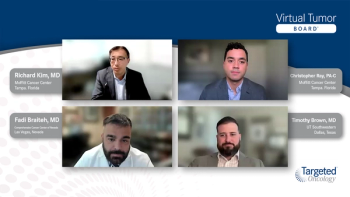
Panelists discuss how current NCCN guidelines for metastatic anal cancer recommend carboplatin-paclitaxel as preferred first-line therapy, with the recent addition of carboplatin-paclitaxel plus retifanlimab as category 2B evidence following FDA approval, while noting that induction chemotherapy for bulky disease remains case-specific without randomized data support.
Panelist discusses how new all-oral combination regimens are transforming the treatment landscape by addressing unmet needs in patients with high-risk chronic lymphocytic leukemia, particularly those with TP53 mutations and 17p deletions, while considering factors like cost, adverse effects, and patient-specific characteristics.
Panelists discuss how a woman aged 55 years with T3N1M0 locally advanced squamous cell carcinoma represents a typical case for definitive chemoradiation therapy over surgical resection, emphasizing the importance of supportive care measures, including pain management, hydration monitoring, and patient education, to optimize treatment completion rates and minimize toxicity.