Arturo Loaiza-Bonilla, MD, MSEd, discusses the potential of disitamab vedotin, toripalimab, and chemotherapy/trastuzumab in first-line treatment.
Arturo Loaiza-Bonilla, MD, MSEd, discusses the potential of disitamab vedotin, toripalimab, and chemotherapy/trastuzumab in first-line treatment.
Biren Saraiya, MD, discusses how he sees findings from the phase 3 AMPLITUDE trial being incorporated into clinical practice for the treatment of metastatic castration-sensitive prostate cancer.
Biren Saraiya, MD, provides background on the phase 3 AMPLITUDE study evaluating niraparib plus abiraterone acetate in metastatic castration-sensitive prostate cancer.
Panelists discuss how interferon therapy (particularly ropeginterferon) can provide better hematologic control over time and potentially modify disease progression in polycythemia vera patients.
Panelists discuss how to approach a 67-year-old man with advanced polycythemia vera who is resistant to hydroxyurea, requiring frequent phlebotomies despite maximum tolerated dosing, and experiencing new symptoms like night sweats and fatigue.
GLP-1 receptor agonists show promise in reducing cancer risk and enhancing early detection, highlighting the need for further research in oncology.
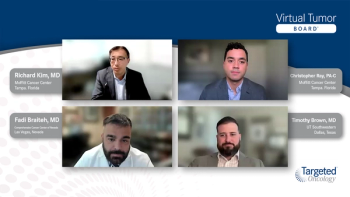
Panelists discuss how diagnosis and staging of anal cancer involves digital rectal examination, high-resolution anoscopy with biopsy, p16 testing, and pelvic MRI for accurate staging, while considering patient factors like HIV status, treatment adherence capability, and comorbidities when planning curative intent therapy.
Panelists discuss how anal cancer epidemiology shows increasing incidence in both sexes with HPV infection as the primary risk factor, affecting predominantly women with a median age of 60, while emphasizing the need to dispel misconceptions linking HPV-related anal cancer to sexual practices.

Surbhi Sidana, MD, discusses updates from the CARTITUDE-4 study assessing the CAR T therapy cilta-cel in patients with multiple myeloma.
Arturo Loaiza-Bonilla, MD, MSEd, discusses findings from the MATTERHORN trial in patients with resectable gastric or gastroesophageal junction adenocarcinoma.

A panelist discusses how patients with advanced cGVHD often cycle through multiple approved agents over time due to plateauing responses, and describes upcoming clinical trials testing upfront use of these novel agents with corticosteroids in newly diagnosed patients to potentially improve outcomes.


Dax Kurbegov, MD, discusses findings from the CORE-HH study that build on growing evidence to support the clinical feasibility of blood-based early detection tools.
The SEQUOIA arm D study demonstrates promising outcomes for treatment-naive patients with CLL, including high-risk patients.

Dale Shepard, MD, PhD, discusses the key themes emerging from the 2025 ASCO Annual Meeting, highlighting a prevailing sense of optimism driven by ongoing research.

Erika Hamilton, MD, shares key insights from the 2025 ASCO Annual Meeting that are set to impact breast cancer treatment.

Pedro C. Barata, MD, MSc, discusses a typical process for an oncologist to patients who are newly diagnosed with metastatic hormone-sensitive prostate cancer.

Ravi Muvner, MD, discusses changing paradigms in prostate cancer treatment.

Jeremy S. Abramson, MD, discusses pivotal advancements in DLBCL from the 2025 American Society of Clinical Oncology Annual Meeting.

An expert emphasizes that treatment decisions for metastatic castration-resistant prostate cancer (mCRPC) are highly personalized, balancing clinical efficacy with patient lifestyle, quality of life, and preferences—prioritizing overall survival alongside minimizing adverse effects and hospital visits—while endorsing flexible treatment durations, including breaks and dose adjustments, to maintain both effectiveness and patient well-being through shared decision-making.
An expert highlights that safety considerations in metastatic castration-resistant prostate cancer (mCRPC) treatment depend on prior therapies and disease status, emphasizing early combination therapy for better control, vigilant bone health management with bone-modifying agents, proactive adverse effect mitigation, and the importance of exercise, nutrition, and cardiovascular monitoring to optimize patient outcomes and quality of life.
Alicia Morgans, MD, MPH, discusses a potentially practice-changing abstract from the 2025 American Society of Clinical Oncology Annual Meeting: the AMPLITUDE trial.

Shahzad Raza, MD, discusses new data from the phase 2 RedirecTT-1 study of talquetamab with teclistamab for the treatment of patients with relapsed/refractory multiple myeloma and extramedullary disease.

Christina Poh, MD, discusses the recent FDA approval of tafasitamab plus lenalidomide and rituximab in relapsed/refractory follicular lymphoma.

Premal Thaker, MD, MS, discusses important implications and takeaways of the phase 1/2 OVATION study of IMMN-1 in addition to chemotherapy for the treatment of newly diagnosed epithelial ovarian cancer.
Erika Hamilton, MD, discusses the mechanism of action of emiltatug ledadotin, a B7-H4-directed Dolasynthen antibody-drug conjugate.

Alicia Morgans, MD, MPH, discusses new data that shows darolutamide with ADT significantly improves quality of life and delays pain for patients with metastatic hormone-sensitive prostate cancer.