
Panelists discuss how axatilimab emerges as a promising later-line treatment option for patients with refractory or recurrent chronic graft-versus-host disease (cGVHD), highlighting its potential in challenging cases.
Panelists discuss how axatilimab emerges as a promising later-line treatment option for patients with refractory or recurrent chronic graft-versus-host disease (cGVHD), highlighting its potential in challenging cases.
Panelists discuss how belumosudil serves as a third-line therapy option for patients with chronic graft-versus-host disease (cGVHD), exploring its role in advancing treatment when earlier options have been exhausted.
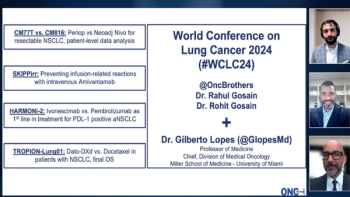
Panelists discuss how the TROPION-Lung01 study results presented at World Conference on Lung Cancer 2024 shed light on overall survival outcomes in patients with lung cancer, with a particular focus on survival rates across different histological subtypes.
Panelists discuss how the HARMONi-02 trial presented at World Conference on Lung Cancer 2024 revealed key lung cancer insights, focusing on progression-free survival and immune-related response criteria end points, while emphasizing the trial’s significance for specific patient subgroups.
Panelists discuss how the SKIPPirr data outcomes presented at World Conference for Lung Cancer 2024 provide valuable insights into the potential use of amivantamab for advancing lung cancer treatment strategies.
Panelists discuss how the latest outcomes from CheckMate-77T demonstrate improved efficacy of neoadjuvant immunotherapy in early-stage non–small cell lung cancer compared with CheckMate-816, potentially revolutionizing treatment strategies and enhancing long-term survival rates for patients with lung cancer.
Panelists discuss how to effectively manage the safety profile of ruxolitinib when used in the treatment of chronic graft-versus-host disease, addressing potential adverse effects and monitoring strategies.
Panelists discuss how ruxolitinib has demonstrated efficacy as a second-line treatment strategy for chronic graft-versus-host disease, reviewing the available data on its effectiveness.
Panelists discuss how chronic graft-versus-host disease severity can be stratified to guide the tailoring of systemic treatments and supportive care strategies for optimal patient management.
Panelists discuss how a case study illustrates the multisystem manifestations of chronic graft-versus-host disease and demonstrate the application of NIH organ-specific scoring for comprehensive assessment.
Panelists discuss how chronic graft-versus-host disease manifests across multiple organ systems and the diagnostic criteria used to identify and assess its various presentations.


Dr Sekeres discusses when to start therapy for a patient who has lower-risk MDS with amnesia.
Dr Sekeres discusses how he approaches second-line therapy selection in ESA-refractory, transfusion-dependent lower-risk MDS (LR-MDS) patients, specifically with imetelstat.
Dr Sekeres discusses treatment goals for a patient with lower-risk MDS.
Dr Sekeres discusses how he approaches second-line therapy selection in ESA-refractory, transfusion-dependent lower-risk MDS (LR-MDS) patients, specifically with luspatercept.
Dr Sekeres discusses key takeaways for optimizing anemia management in lower-risk MDS, as well as where he sees the most significant unmet needs.
Dr Sekeres discusses how he approaches second-line therapy selection in ESA-refractory, transfusion-dependent lower-risk MDS (LR-MDS) patients, specifically with lenalidomide.
Dr Sekeres shares his thoughts about the choice between an EMA and a telomerase inhibitor in the RS-negative patient.
Dr Sekeres discusses the adverse event profile and AE management of imetelstat.

Matthew Campbell, MD, MS, and Rana McKay, MD, conclude by addressing the remaining unmet needs and persistent treatment challenges faced in managing patients with advanced renal cell carcinoma.