Video Programs

Video 2 - "Treatment Options for mHSPC"

In this segment, Dr. Shore will offer an overview of current treatment options for metastatic hormone-sensitive prostate cancer (mHSPC), as outlined in the NCCN Guidelines for Prostate Cancer. He will discuss patient factors that guide the selection of therapeutic agents or combination therapies.
Video 1 - "Initial Impression and Risk Assessment"

Dr. Shore will provide his initial impressions of the patient case, including an assessment of the patient's risk level and how this influences clinical decision-making.

Video 6 - "Quality of Life + Clinical Monitoring Outside the Transplant Center"

Yi-Bin Chen, MD, proposes a strategy to enhance patients' quality of life by utilizing virtual monitoring as an alternative to requiring patients to travel to a transplant center, which includes regular remote assessments of blood work, such as liver function tests, lipid panels, and immunoglobulin levels.

Video 5 - "Second-Line Medications and Toxicities in GVHD"

A medical expert delves into various aspects of second-line therapies, including dose reductions, potential adverse reactions, and the possibility of transfusions, all of which are important considerations when managing patients on second-line treatments.

Video 2 - "FRESCO-2 Study Design Overview"

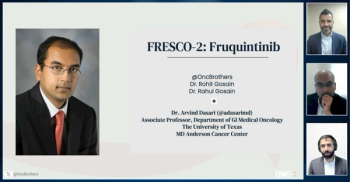
Medical professionals provide background on the FRESCO-2 trial, which compared Fruquintinib to placebo in patients with heavily pretreated metastatic colorectal cancer. The trial enrolled patients who had exhausted all standard treatment options, including cytotoxic chemotherapy, targeted therapies, anti-VEGF agents, and BRAF inhibitors for those with BRAF mutations.

Video 2 - "Importance of Biomarker Testing in Breast Cancer"

A hematologist-oncologist discusses the importance of biomarker testing in breast cancer, provides clinical insights on how to prioritize different testing assays, and outlines the roles of circulating tumor DNA and repeat testing.

Video 4 - "Updates on the iNTEGRATE and ROCKstar Trials"

Yi-Bin Chen, MD, provides an overview of the iNTEGRATE and ROCKstar trials, underscoring their significance in the current treatment paradigm for graft versus host disease, particularly highlighting their ability to inhibit the fibrosis cascade, which offers substantial benefits for patient healing and recovery.

Video 3 - "Lessons Learned from REACH-3 Clinical Trial"

Yi-Bin Chen, MD, presents the results of the phase-3 randomized REACH-3 Trial, highlighting the superior best overall response rate of 75% in the experimental arm compared to 60% in the best-available therapy arm.

Video 2 - "Setting Expectations + First-Line and Second-Line Treatment of Graft Versus Host Disease"

A medical professional outlines the goals and challenges of communicating with his patient, emphasizing the importance of setting realistic expectations for halting disease progression and potentially achieving some degree of disease reversibility, while also exploring the roles of first-line and second-line therapies in the management of chronic graft versus host disease.

Video 1 - "Patient Case: Pathology of Graft Versus Host Disease"

Yi-Bin Chen, MD, presents a patient case, detailing the symptomology and pathology of graft versus host disease, such as dry eyes, dry mouth, and difficulty swallowing, while also addressing steroid dependence as an indication for initiating second-line therapy.

Dr. McCloskey discusses the limitations of current treatment options for BPDCN, as well as the emerging research and data that are most anticipated in the field.

Dr. McCloskey discusses the general principles and practices for monitoring and mitigating adverse events, particularly capillary leak syndrome (CLS), in BPDCN patients treated with systemic agents like tagraxofusp.

Dr. McCloskey discusses the recent clinical trial results, such as the CADENZA trial, on the efficacy and safety of tagraxofusp in BPDCN patients.