Video Programs

Panelists discuss how the NCCN Guidelines define lower-risk myelodysplastic syndrome (LR-MDS) based on clinical hallmarks such as anemia and cytopenias, with treatment decisions guided by prognostic scoring systems (IPSS-R, IPSS-M), and how real-world data supports the evolving first-line treatment landscape for LR-MDS, including the use of therapies such as luspatercept.

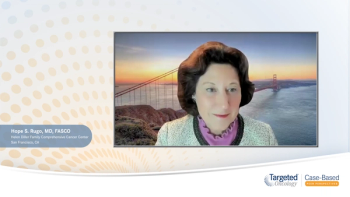
Hope S. Rugo, MD, FASCO, is featured in this series.

Hope S. Rugo, MD, FASCO, discusses how the phase 3 ELEVATE study evaluates the combination of elacestrant with abemaciclib in patients with ER+/HER2– advanced or MBC who have progressed on prior endocrine therapy.

Evan Y. Yu, MD, discusses how the goals of therapy for a patient with newly- diagnosed metastatic hormone-sensitive prostate cancer are to control disease progression, extend survival, maintain quality of life, and delay the transition to castration-resistant prostate cancer.

Evan Y. Yu, MD, introduces case 1, a 68-year-old patient with newly diagnosed metastatic hormone-sensitive prostate cancer (mHSPC), highlighting the clinical presentation, diagnostic workup, and treatment considerations for high-volume metastatic disease.

1 expert in this video

Panelist discusses how talquetamab’s step-up dosing strategy aims to mitigate cytokine release syndrome, a common immunologic toxicity. The reported grade 1 CRS with altered taste and dry mouth represents a mild manifestation compared with the MonumenTAL-1 trial, where the initial SUD schedule showed varying CRS rates. Real-world evidence has largely validated trial findings, though alternative SUD approaches may offer different risk-benefit profiles. The optimal SUD strategy continues to evolve as clinical experience expands, balancing efficacy with tolerability.

1 expert in this video

Panelist discusses how the RRMM treatment landscape has evolved significantly, with BiTEs emerging as a promising approach. BCMA-targeted BiTEs showed efficacy, while GPRC5D-targeting agents like talquetamab represent promising new options, particularly for patients with BCMA-refractory disease. Key challenges include managing cytokine release syndrome, developing optimal sequencing strategies, addressing drug resistance, and improving accessibility and affordability of novel therapies.

1 expert in this video

Panelist discusses the clinical patient, a 72-year-old man who was previously diagnosed 6 years ago with multiple myeloma, 60% plasma cells, which he presents to his oncologist after 5 prior treatment regimens. The patient also has had 2 episodes of pneumonia and multiple episodes of bronchitis over the prior 10 years.

1 KOL is featured in this series.

Hatim Husain, MD, discusses how the implementation of proactive prophylaxis strategies for patients taking amivantamab, including prophylactic antibiotics, good skin hygiene, and insights from the phase 2 COCOON study, can help manage potential adverse effects and improve treatment outcomes.

1 KOL is featured in this series.

Panelist discusses how the second interim overall survival data from MARIPOSA-2, presented at the European Society for Medical Oncology Congress 2024, affect treatment strategies for patients with non–small cell lung cancer that has developed resistance to osimertinib.

1 KOL is featured in this series.

Panelists discuss how specific disease characteristics, such as tumor burden, metastatic sites, and risk stratification, most strongly influence their decision-making process when choosing between immune checkpoint inhibitor plus tyrosine kinase inhibitor (ICI plus TKI) regimens and dual immune checkpoint inhibitor (ICI plus ICI) combinations for treating metastatic renal cell carcinoma.