BREAST CANCER
Latest News
FDA Reopens Review of ProSense for Early-Stage Breast Cancer Treatment
By Jordyn Sava
Latest Videos


CME Content





























More News
Subgroup analyses from the EMERALD trial show that oral SERD elacestrant may outperform standard endocrine therapy in metastatic breast cancer patients with bone or visceral metastases who previously received CDK4/6 inhibitors.
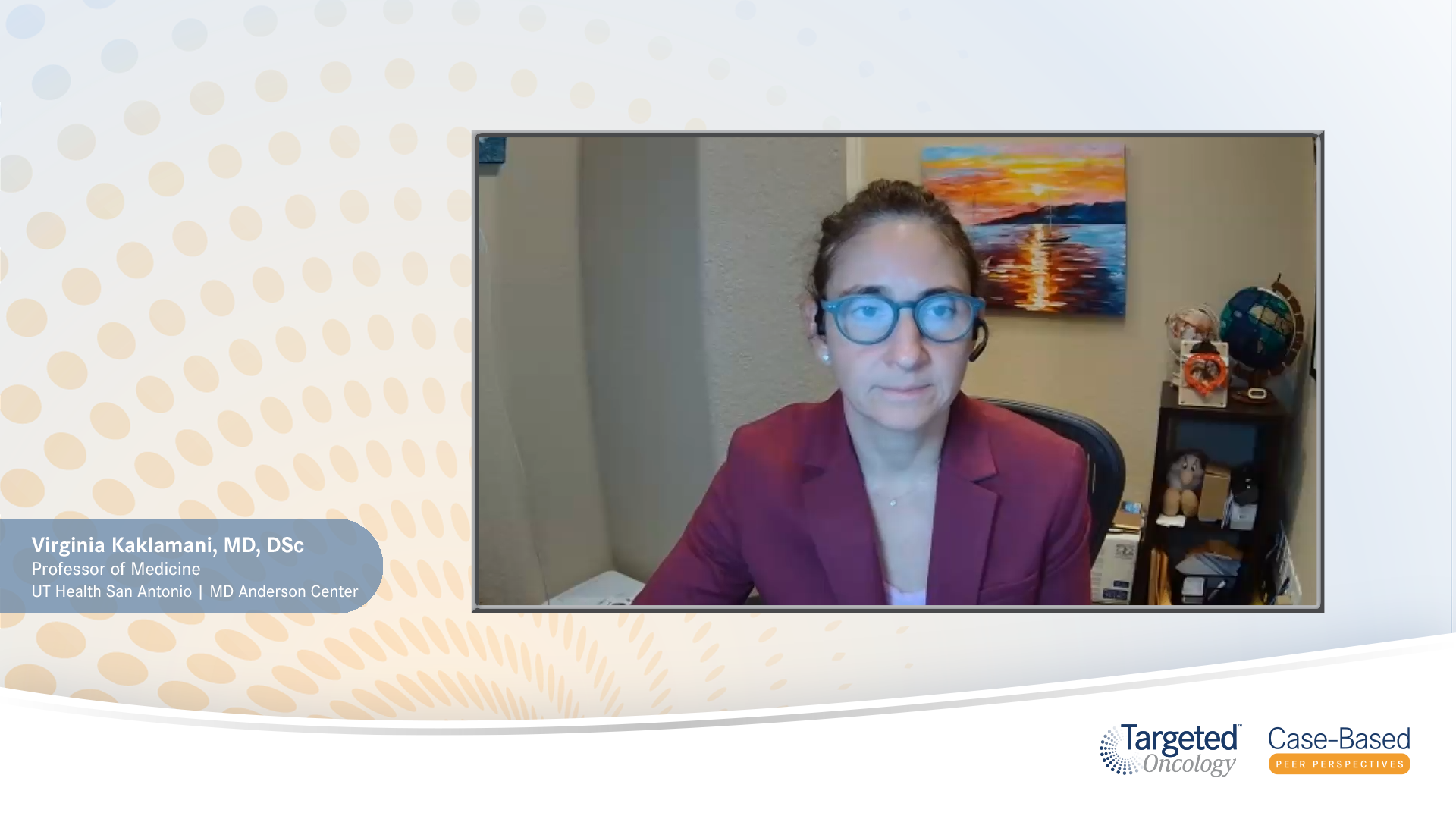
Virginia Kaklamani, MD, DSc, explains that in second-line treatment of metastatic HR+/HER2- breast cancer after CDK4/6 inhibitors, biomarker testing guides the choice between therapies based on the safety and resistance mutation profiles.
Virginia Kaklamani, MD, DSc, reviews the presented case of a postmenopausal patient with breast cancer who develops metastases after adjuvant endocrine therapy ends, and explains that later treatment selection is difficult because of endocrine resistance and mutations causing more aggressive disease.

In an interview with Targeted Oncology, Naomi Dempsey, MD, provided insight into the benefits of endocrine therapy in patients with breast cancer and the implications of findings from this research.

Halle Moore, MD, discusses findings from a study on young breast cancer survivors who attempted pregnancy after interrupting hormone therapy.

In the first article of a 2-part series, Komal Jhaveri, MD, guides a conversation on treatment options for patients with ESR1-positive metastatic breast cancer.

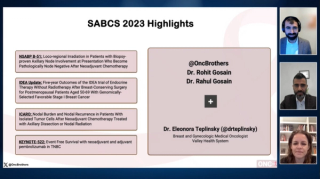
Following their review of clinical trial data presented at SABCS 2023, the Oncology Brothers discuss their key takeaways on recent updates in HER2+ breast cancer.
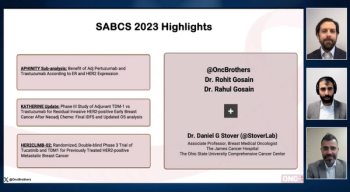
Daniel Stover, MD, and the Oncology Brothers review results from HER2CLIMB-02, a randomized, double-blind phase 3 trial of tucatinib and T-DM1 in patients with previously treated HER2+ metastatic breast cancer.
Medical oncologists discuss the recent update from the KATHERINE trial investigating adjuvant T-DM1 (trastuzumab emtansine) following neoadjuvant chemotherapy in patients with residual invasive HER2+ early breast cancer.
Following SABCS 2023, Daniel Stover, MD, joins the Oncology Brothers, Rohit Gosain, MD, and Rahul Gosain, MD, to discuss the benefit of adjuvant pertuzumab and trastuzumab according to ER and HER2 expression in patients with HER2+ breast cancer.
During a Targeted Oncology™ Case-Based Roundtable™ event, Virginia Kaklamani, MD, discussed with participants the case of a patient with estrogen receptor–positive breast cancer who showed signed of progression 20 months after treatment with letrozole plus palbociclib.

The FDA has approved the new drug application of a ready-to-dilute formulation of a treatment for breast and ovary adenocarcinoma.
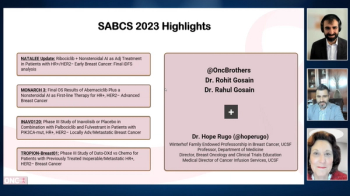
Following their review of clinical trial data presented at SABCS 2023, the Oncology Brothers offer their key takeaways on recent updates in HR+/HER2- breast cancer.
Medical oncologists discuss results from the TROPION-Breast01 study investigating Dato-DXd (datopotamab deurxtecan) in patients with previously treated inoperable or metastatic HR+/HER2- breast cancer.
Hope Rugo, MD, and the Oncology Brothers review results from the INAVO120 trial studying inavolisib in combination with palbociclib and fulvestrant in PIK3CA-mutated HR+/HER2- locally advanced or metastatic breast cancer.
Experts on breast cancer review the final overall survival results from MONARCH 3 investigating abemaciclib plus a nonsteroidal aromatase inhibitor as first-line therapy for HR+/HER2- advanced breast cancer.
Following SABCS 2023, Hope Rugo, MD, joins the Oncology Brothers, Rahul Gosain, MD, and Rohit Gosain, MD, to discuss the final invasive disease-free survival analysis from the NATALEE trial in HR+/HER2- early breast cancer.

Findings from a phase 3 trial of the Bria-IMT regimen showed a 71% intracranial objective response rate in patients with breast cancer and central nervous system metastases.
As clinicians navigate the array of available antibody-drug conjugates for HER2-negative metastatic breast cancer, Joshua Z. Drago, MD, MS, emphasizes the importance of considering various factors in therapy selection and sequencing.
During an in-person Targeted Oncology™ Clinical Case Forum event in New Jersey, Tiffany Traina, MD, discussed the role of antibody-drug conjugates in advanced breast cancer.
Virginia Kaklamani, MD, presents the case of a 56-year-old woman with HR+/HER2- metastatic breast cancer and visceral metastases.
Ruta D. Rao, MD, and Virginia G. Kaklamani, MD, discuss with participants the case of a patient with breast cancer who has received multiple lines of therapy and what the next steps are for her treatment.
A cohort study highlighted the racial and ethnic survival disparities that exist among patients with early breast cancer who are being treated with standardized initial care.
Trastuzumab administered subcutaneously delivered unique immunomodulation effects vs intravenous trastuzumab in patients with treatment-naive HER2-positive breast cancer.