
BREAST CANCER
Latest News


FDA Issues Warning on BioZorb Markers After Recall Due to Patient Complications
By Jordyn Sava
Latest Videos


CME Content





























More News

DeepHRD predicted homologous recombination deficiency with greater accuracy than FDA-approved standard molecular tests.

Sarah Sammons, MD, highlights the need for further investigation into trastuzumab deruxtecan in breast cancer treatment.

Following discussions on ado-trastuzumab emtansine and fam-trastuzumab deruxtecan-nxki, Tanya Gupta, MD, discusses sacituzumab govitecan and its approval from the FDA in the breast cancer space.
Tanya Gupta, MD, discusses the use of ado-trastuzumab emtansine for the treatment of patients with HER2-positive breast cancer.

During a Case-Based Roundtable® event, Aditya Bardia, MD, MS, FASCO discussed recent updates from the DestinyBreast03 trial and other key data on treatment for HER2+ breast cancer in the first article of a 2-part series.

During a Case-Based Roundtable® event, Ursa Brown-Glaberman, MD, discussed options for the treatment of patients with PIK3CA-altered metastatic breast cancer.

Peter Schmid, MD, PhD, discusses the background, methods, and design of the phase 3 KEYNOTE-522 trial.

For Breast Cancer Awareness Month, Deborah Toppmeyer, MD, emphasizes the crucial role of early breast cancer detection.

During a Case-Based Roundtable® event, Sagar D. Sardesai, MD, moderated a discussion on using antibody-drug conjugates and managing their toxicities in patients with metastatic breast cancer.

The approval of inavolisib is supported by findings from the phase 3 INAVO120 study evaluating the agent plus palbociclib and fulvestrant.

Erika P. Hamilton, MD, discusses the patient population with breast cancer enrolled in the TROPION-PanTumor01 trial in relation to the efficacy of datopotamab deruxtecan.
The final analysis of the phase 3 PANTHER study confirmed survival benefits for patients receiving dose-dense vs standard chemotherapy.
M. Michele Blackwood, MD, FACS, provided an overview of the significant advancements with personalized medicine with genomic testing in the breast cancer space.
For Breast Cancer Awareness Month, Oranus Mohammadi, MD, discussed the remarkable progress made in improving survival rates for patients with breast cancer.
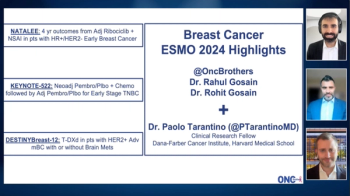
Panelists discuss how ESMO 2024 presented important updates on primary end points and progression-free survival data from recent clinical studies.
Panelists discuss how updates from KEYNOTE-522 at ESMO 2024 revealed important data on overall survival and event-free survival outcomes.
Panelists discuss how the NATALEE study at ESMO 2024 presented updates on primary, secondary, and exploratory end points for evaluating a new cancer treatment.

Christos Vaklavas, MD, discusses the results of the TROPION-Breast01 trial of datopotamab deruxtecan in patients with metastatic breast cancer.
Sherry Shen, MD, discusses the GLP-1 agonists analyzed for weight change in findings from a retrospective trial of patients with breast cancer.
During a Case-Based Roundtable® event, Virginia F. Borges, MD, MMSc, discussed treatment selection for a patient with ER+, HER2 0 metastatic breast cancer and a PIK3CA mutation.
The ELECTRA trial found that the combination of elacestrant and abemaciclib was well-tolerated and showed promising clinical activity in patients with ER-positive, HER2-negative metastatic breast cancer who had previously received endocrine therapy and another CDK4/6 inhibitor.

POSITIVE Trial Shows Breastfeeding is Possible During Endocrine Therapy Break in HR+ Breast Cancer
Published: | Updated:
Follow-up results from the POSITIVE trial showed that breastfeeding is achievable for patients with HR-positive breast cancer who conceived during a break from endocrine therapy.
The phase 3 HypoG-01 trial found moderately hypofractionated radiation therapy had similar lymphedema risk to standard therapy in patients with early breast cancer.
Peter Schmid, MD, PhD, discusses his key takeaways from the phase 3 KEYNOTE-522 trial and the updated findings presented at the 2024 ESMO Congress.
Superior efficacy at 12 weeks was seen with the frontline combination of abemaciclib and endocrine therapy vs standard chemotherapy in patients with advanced breast cancer.