
BREAST CANCER
Latest News

Latest Videos


CME Content





























More News
Experts on breast cancer offer comprehensive insights on findings from the TROPiCS-02 study investigating sacituzumab govitecan in patients with HR+/HER2- metastatic or locally recurrent inoperable breast cancer.
Breast cancer specialists review the study design, efficacy data, and safety profile findings from the TROPION-Breast01 study investigating datopotamab deruxtecan (Dato-DXd) in patients with HR+/HER2- metastatic breast cancer.
Medical oncologists provide insights on emerging pathways and TROP2-directed antibody-drug conjugates in HR+/HER2- metastatic breast cancer, highlighting ongoing research.
Hope S. Rugo, MD, discusses the ELEVATE trial of elacestrant combined with various targeted therapies for patients with endocrine receptor-positive/HER2-negative metastatic breast cancer who have already received endocrine therapy and CDK4/6 inhibitors.

Tanya Gupta, MD, discusses the current landscape of antibody-drug conjugates for breast cancer subtypes beyond HER2-positive disease.

The FDA approved Tepylute, a ready-to-dilute formulation of an existing treatment for breast and ovarian adenocarcinoma.
Laura Huppert, MD, and Aditya Bardia, MD, MPH, FASCO, share advice for community oncologists on the utilization of T-DXd and discuss the future outlook for antibody-drug conjugates in HR+/HER2-low breast cancer.
Experts on breast cancer describe the best candidates for HER2-directed antibody-drug conjugates in HR+/HER2-low metastatic breast cancer, highlighting the role of trastuzumab deruxtecan in later lines of therapy.

Recent approvals herald novel strategies for addressing advanced or metastatic breast cancer with ESR1 mutations.

Ali Duffens, MD, discusses a study in which investigators assessed the mode of detection for breast cancer recurrence within an integrated health system by assessing the utility and outcomes of current surveillance guidelines recommended by the National Comprehensive Cancer Network.
Tanya Gupta, MD, highlighted the approved indications for antibody-drug conjugates in breast cancer, the efficacy data supporting their approvals, and ongoing studies to advance the space further.
Breast cancer specialists review key efficacy and safety data from the DESTINY-Breast04 trial investigating trastuzumab deruxtecan in patients with HR+/HER2-low metastatic breast cancer.
Aditya Bardia, MD, MPH, FASCO, and Laura Huppert, MD, discuss treatment sequencing practices and ongoing challenges in patients with HR+/HER2-low breast cancer.

During a Case-Based Roundtable® event, Timothy J. Pluard, MD, explores datopotamab deruxtecan as an option in hormone receptor–positive, HER2-negative breast cancer in the second article of a 2-part series.

Capivasertib combined with paclitaxel failed to improve overall survival in a phase 3 trial CAPItello-290 in metastatic triple-negative breast cancer, missing the study’s dual primary end points.
During a Case-Based Roundtable® event, Stephanie L. Graff, MD, discussed biomarker testing and treatment exposure for a patient with metastatic breast cancer in the second article of a 2-part series.
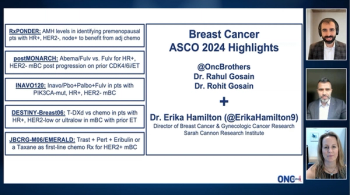
Focusing on HER2+ breast cancer, Erika P. Hamilton, MD, and the Oncology Brothers review data from JBCRG-M06/EMERALD looking at trastuzumab and pertuzumab in combination with eribulin or a taxane in locally advanced or metastatic disease.
Erika P. Hamilton, MD, and the Oncology Brothers review exciting data from DESTINY-Breast06 and discuss its impact on the evolving treatment landscape.
Medical oncologists discuss the INAVO120 study, which is evaluating inavolisib combination therapy in patients with PIK3CA-mutated breast cancer.
The Oncology Brothers and Erika P. Hamilton, MD, discuss the postMONARCH study investigating fulvestrant alone vs fulvestrant plus abemaciclib.
Following ASCO 2024, Erika P. Hamilton, MD, joins the Oncology Brothers, Rahul Gosain, MD, and Rohit Gosain, MD, to review recent updates from the RxPONDER trial investigating the use of AMH levels in premenopausal women.
Tarah Ballinger, MD, discusses what she considers to be the biggest developments from the 2024 ASCO Annual Meeting.
Aditya Bardia, MD, MPH, discusses results of a biomarker analysis of the TROPiCS-02 study of sacituzumab govitecan in HR-positive, HER2-negative metastatic breast cancer presented at ASCO 2024.

In separate, virtual live events, Sarah Sammons, MD, and Ruth O’Regan, MD, discussed molecular profiling and therapeutic options for a patient with advanced breast cancer after multiple lines of therapy.
Holly Pederson, MD, and Elisha Hughes, PhD, discuss the findings and implications of a study evaluating risk of triple-negative breast cancer for Black women presented at the 2024 ASCO Annual Meeting.