




BREAST CANCER
Latest News
Latest Videos



CME Content





























More News

In the second article of a 2-part series, Joyce O’Shaughnessy, MD, discusses the most recent findings from the phase 3 EMERALD study for patients with hormone receptor–positive metastatic breast cancer.

In the first article of a 2-part series, Aditya Bardia, MD, MPH, leads a discussion on what factors influence sequencing treatment for patients with estrogen receptor positive advanced breast cancer.

A number of trials evaluating rintatolimod as a combinational therapy for a wide range of solid tumor types are underway and planned, including in pancreatic and breast cancer.

According to Erica Mayer, MD, MPH, an analysis of the PALLAS study that patients with a higher BMI appeared to have less toxicity from the CDK4/6 inhibitor, palbociclib, and fewer cases of early discontinuation due to toxicity.

An era of advanced molecular testing and personalized medicine has allowed for the de-escalation of breast cancer treatment for many patients. This is part 1 of a 2-part series on overtreatment of breast cancer.

In this first part of a 2-article series, Joyce O’Shaughnessy, MD, recent updates to treatment and testing guidelines for patients with advanced breast cancer whose disease harbors an ESR1 mutation.
Docetaxel with carboplatin, trastuzumab, and pertuzumab has led to improved overall survival in patients with HER2-positive metastatic breast cancer. These findings led to the evaluation of dual blockade therapy in the neoadjuvant and adjuvant settings.

Key opinion leaders provide insight on testing strategies, primarily circulating tumor DNA, in patients diagnosed with HR+/HER2- metastatic breast cancer.
Opening their program on HR+/HER2- metastatic breast cancer, expert oncologists consider the growing list of therapeutic targets to test for in patients with early or late-stage disease.
KEYNOTE-756 is the first positive phase 3 study to generate a statistically significant improvement in pathological complete response rate with an immunotherapy regimen in the neoadjuvant setting for ER-positive/HER2-negative breast cancer.

Sara Tolaney, MD, MPH, discusses sacituzumab govitecan-hziy as an effective and safe treatment for patients with hormone receptor-positive/HER2-negative metastatic breast cancer.

During a Targeted Oncology™ Case-Based Roundtable™ event, Elizabeth Mittendorf, MD, discussed how antibody-drug conjugates fit into the treatment algorithm for patients with advanced breast cancers.
In an interview with Targeted Oncology, Hope S. Rugo, MD, explained the results of the phase 3 CAPItello-291 trial, and the potential impact of the study on the breast cancer treatment paradigm.
Health-related quality of life measures from the phase 3 DESTINY-Breast03 trial showed that patient-reported outcomes and time of hospitalization data favored trastuzumab deruxtecan despite having a longer duration of treatment than trastuzumab emtansine.
In an interview with Targeted Oncology, Daniel G. Stover, MD, highlighted the objective to enhance delivery of endocrine therapy plus CDK4/6 inhibitors to patients with hormone receptor-positive, HER2-negative breast cancer by utilizing biomarker assessments as a guide to interchange or cease treatment at the most favorable time.

Closing out his discussion on HR+/HER2- metastatic breast cancer, Kevin Kalinsky, MD, MS, highlights key takeaways and shares excitement for future evolutions in the treatment paradigm.
Key opinion leader Kevin Kalinsky, MD, MS, shares insight to recent and ongoing clinical trials with novel targeted therapies in the setting of HR+/HER2- metastatic breast cancer.
Expert perspectives on the mechanisms of resistance to frontline therapy in HR+/HER2- metastatic breast cancer and results from key clinical trials analyzing the safety and efficacy of rechallenging with prior therapy.
During a Targeted Oncology™ Case-Based Roundtable™ event, Hatem Soliman, MD, discussed how the FDA approval of elacestrant impacts the treatment setting of ER+, HER2- breast cancer

An investigation of treatment with concurrent paxalisib and whole brain radiotherapy is underway in a phase 1 clinical trial.
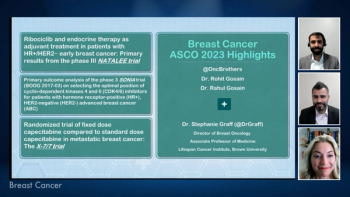
Following their interview with Stephanie Graff, MD, FACP, the Oncology Brothers share key takeaways from the NATALEE, SONIA, and X-7/7 trials and consider how they will impact the management of breast cancer.
The Oncology Brothers, joined by Stephanie Graff, MD, FACP, share their thoughts on data from the X-7/7 trial of fixed-dose capecitabine in patients with metastatic breast cancer.
Shared insight from the Oncology Brothers and Stephanie Graff, MD, FACP, on the role of CDK4/6 inhibition in combination with aromatase inhibitor therapy following data from the SONIA trial in HR+ metastatic breast cancer.
Expert oncologist Stephanie Graff, MD, FACP, joins the Oncology Brothers to review data from the NATALEE trial and consider the role of adjuvant ribociclib in patients with HR+ breast cancer.
During a Targeted Oncology™ Case-Based Roundtable™ event, Mark Pegram, MD, and participants discussed the use of elacestrant for patients who have received prior endocrine therapy for ER-positive, HER2-negative breast cancer. This is the second of 2 articles based on this event.