
BREAST CANCER
Latest News


Pembrolizumab/Olaparib Did Not Improve Survival in Locally Advanced or Metastatic TNBC
By Gina Mauro
Latest Videos



CME Content





























More News

Patients with hormone receptor-positive, HER2-negative, node-positive, high-risk early breast cancer given abemaciclib for 2 years in addition to endocrine therapy demonstrated an association between ctDNA positivity and disease recurrence.
Patient-reported outcomes of the CAPItello-291 study of capivasertib plus fulvestrant showed a positive benefit-risk profile for the combination in patients with HR-positive, HER2-negative advanced breast cancer.

Senthil Damodaran, MD, PhD, discusses data from a phase 2 trial of futibatinib in patients with metastatic HR-positive/HER2-negative breast cancer with FGFR1 amplifications.
Prospective models show a drop in the cost of running sentinel lymph node assessments when artificial intelligence is used.
Adding ribociclib to endocrine therapy shows efficacy and tolerability for those with hormone receptor–positive, HER2-negative advanced breast cancer, even in older patients.

An experimental drug combination of inavolisib, palbociclib, and fulvestrant significantly improved progression-free survival in patients with HR-positive/HER2-negative PIK3CA-mutated breast cancer.

Sandra M. Swain, MD, FACP, FASCO, discusses the potential role for HER2-directed TKIs for the treatment of patients with early-stage HER2+ breast cancer and shares insights about emerging data that could impact the future treatment landscape.

A fast track designation has been granted to zotatifin with fulvestrant, and abemaciclib for adult patients with estrogen receptor-positive/HER2-negative advanced or metastatic breast cancer.
In this companion article, Sandra M. Swain, MD, FACP, FASCO, provides insights into effective management of patients with early-stage HER2+ breast cancer and reviews recent data in the evolving treatment landscape.

In the first article of a 2-part series, Hope S. Rugo, MD, FASCO, discusses how the use of circulating tumor DNA can aid in allowing next generation sequencing to better identify targets for patients with hormone receptor positive metastatic breast cancer.
In addition to the approval of capivasertib and fulvestrant, the FDA has granted approval to the FoundationOne® CDx as a companion diagnostic to identify patients with advanced HR-positive, HER2-negative advanced breast cancer.
During a Targeted Oncology™ Case-Based Roundtable™ event, William J. Gradishar, MD, discussed dosing and toxicity considerations related to elacestrant in metastatic breast cancer with participants.
The FDA has approved capivasertib with fulvestrant for adult patients with hormone receptor-positive, HER2-negative, locally advanced or metastatic breast cancer harboring 1 or more PIK3CA, AKT1, or PTEN alterations.
In 2 separate, live virtual Case-Based Roundtable events, physicians from across the country discussed the treatment path from frontline therapy to second-line sacituzumab govitecan for patients with metastatic TNBC.
Following the FDA’s denial of a de novo classification request of ProSense, citing concerns about the choice of comparator group used in the ICE3 trial, IceCure is working to identify a more representative comparator group.

In an interview with Targeted Oncology, Peter Schmid, FRCP, MD, PhD, discussed the implication of findings from the KEYNOTE-522 trial of the addition of pembrolizumab to neoadjuvant chemotherapy in patients with high-risk triple-negative breast cancer.
During a Targeted Oncology™ Case-Based Roundtable™ event, Igor Makhlin, MD, reviewed data from the TROPiCS-02 study of sacituzumab govitecan and the DESTINY-Breast04 study of trastuzumab deruxtecan in patients with metastatic breast cancer.
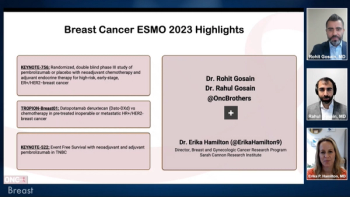
Following their review of data presented at ESMO 2023, the Oncology Brothers offer their key takeaways on the evolving breast cancer treatment landscape.
Findings from the phase 2 AVATAR trial suggest stereotactic ablative body radiotherapy may postpone the use of systemic therapy, offering patients with ER-positive/HER2-negative metastatic breast cancer another option.

In the second article of a 2-part series, Aditya Bardia, MD, MPH, discusses the favorable toxicity profile of sacituzumab govitecan for patients with metastatic breast cancer and how he handles neutropenia through the course of treatment.
In an interview, Funda Meric-Bernstam, MD, discussed the phase 2 DESTINY-PanTumor02 trial and the data on fam-trastuzumab deruxtecan-nxki for the treatment of patients with HER2-expressing cancers.
Rhenium obisbemeda shows potential to address the unmet need of new treatment options for patients with breast cancer and leptomeningeal metastases and will continue to be evaluated in the ReSPECT-LM program.

The primary end point of progression-free survival was met in TROPION-Breast01, a phase 3 study of datopotamab deruxtecan for patients with hormone receptor-positive/HER2-negative breast cancer.
Treatment with datopotamab deruxtecan led to a statistically significant and clinically meaningful improvement in progression-free survival in patients with metastatic hormone receptor-positive breast cancer.