Matthew Matasar, MD, discusses odronextamab and the ongoing phase 1 ELM-1 trial in patients with CD20-positive B-cell malignancies.
Matthew Matasar, MD, discusses odronextamab and the ongoing phase 1 ELM-1 trial in patients with CD20-positive B-cell malignancies.

Uday R. Popat, MD, discusses a phase 2 trial exploring the use of itacitinib combined with post-transplant cyclophosphamide and tacrolimus to prevent graft-vs-host disease in patients undergoing a myeloablative fractionated busulfan regimen.

Amarnath Challapalli, MBBS, MD, MRCP, FRCR, PhD, discusses some of the most promising findings from the EPIC-A trial of cemiplimab with chemotherapy in treating locally advanced or metastatic penile carcinoma.
Panelists discuss how recent updates in progression free survival data complement secondary endpoints of overall survival, overall response rates, and duration of response to provide a comprehensive picture of treatment efficacy.
Panelists discuss how the latest progression-free survival, overall survival, and overall response rate data presented at ASCO 2025 demonstrate significant advancements in treatment efficacy across multiple tumor types.
Panelists discuss how incorporating both neoadjuvant and adjuvant treatment approaches into clinical trial designs has shown promising improvements in event-free survival outcomes across multiple cancer types.
Panelists discuss how recent clinical data presented at ASCO 2025 showed varying results across primary endpoints including overall survival, progression-free survival, efficacy measures, and safety profiles, with key opinion leaders highlighting implications for current treatment paradigms.

Panelists discuss how to select optimal therapy for a 66-year-old patient with early relapse following autologous stem cell transplantation (ASCT), considering factors such as prior treatment exposure, duration of response, and emerging therapeutic options including cellular therapies.
Panelists discuss how to identify, monitor, and manage delayed toxicities following ciltacabtagene autoleucel (cilta-cel) chimeric antigen receptor (CAR) T therapy, including prolonged cytopenias, infections, and neurotoxicity, to optimize long-term patient outcomes and safety.

Marlise R. Luskin, MD, MSCE, discusses the trial of tagraxofusp in BPDCN, which showed high response rates and overall survival.
Alexander Spira, MD, PhD, FACP, discusses the PAPILLON trial, including its methods, design, and rationale as well as new data from the study.
A panelist discusses how patient-reported outcomes and real-world evidence contribute valuable insights into the practical impact of these treatments, complementing traditional efficacy measures and helping inform clinical decision-making in actual practice settings.
The panelist discusses how, expanding clinical trials, biomarker testing, and financial support improves access to emerging EGFR therapies. Novel bispecific antibodies and ADCs may shift treatment. Key insights include resistance monitoring and proactive AE management.
An expert discusses the design and objectives of the Phase 3 PEACE-3 study, which evaluates the combination of enzalutamide (ENZA) and radium-223 (Ra-223) for ARPI-naïve metastatic castration-resistant prostate cancer (mCRPC).

An expert discusses how, in third line (3L) therapy, goals shift from optimal disease control to managing treatment-resistant disease while preserving quality of life. Unlike 2L therapy where significant disease control is still expected, 3L aims for modest clinical benefit, symptomatic relief, and stabilizing disease progression. Treatment choices now heavily prioritize tolerability, patient preferences, and palliative considerations.

The panelist discusses first-line options including atezolizumab plus bevacizumab, lenvatinib, and sorafenib. Second-line treatments include regorafenib, cabozantinib, and ramucirumab. Clinical trials should be prioritized when available.
An expert discusses the patient case of a 65-year-old woman who has presented to the emergency department with abdominal pain. The patient’s previous medical issues include a duodenal ulcer that she experienced 10 years ago. The patient is a smoker, and her current medication is lansoprazole (30 mg). After the patient begins to present worsening lower back pain, a CT scan shows lytic lesions in her thoracic spine and rounded lesion in both lungs. A biopsy of the lung lesion confirms clear cell renal cell carcinoma (RCC) with sarcomatoid differentiation.
The panelist discusses the case of a 60-year-old man diagnosed with unresectable hepatocellular carcinoma (HCC). The patient has a history of metabolic dysfunction-associated steatohepatitis managed with lifestyle changes and medication. Initially, there was no clinical or radiographic evidence of cirrhosis. The patient recently presented to his gastroenterologist complaining of abdominal pain in the upper right quadrant and fatigue.
An expert discusses the design and objectives of the PEACE-3 study, which investigates the combination of enzalutamide and radium-223 for ARPI-naïve metastatic castration-resistant prostate cancer (mCRPC).
A panelist discusses how the CONTACT-03 and TiNivo-2 studies yielded important insights about ICI rechallenge and tivozanib in the post-ICI setting, with particular attention to the notable 9.2-month median PFS with tivozanib monotherapy, the impact of dosing strategies, and the timing of therapy initiation, though questions remain about the broader implications for ICI rechallenge efficacy across different treatment contexts.
The panelist discusses how, Healthcare professionals use osimertinib 1L for EGFR-mutated NSCLC, re-testing at progression for resistance mutations. MARIPOSA data refine 1L choices by predicting resistance pathways, guiding optimal sequencing.

Jeff Auletta, MD, discusses his key takeaways from the 2025 Transplant and Cellular Therapy Meetings.
Panelists discuss the efficacy and safety of KRAS inhibitors for non–-small cell lung cancer (NSCLC), evaluating clinical trial results and their potential impact on treatment strategies.
Panelists discuss second-line treatment decision-making for KRAS-mutated metastatic non–-small cell lung cancer (NSCLC), focusing on available therapies and personalized approaches based on patient characteristics.
Colton Ladbury, MD, discusses radiation therapy for hematologic malignancies, total marrow irradiation, and findings that were presented during the American Society for Radiation Oncology Annual Meeting.

David Spigel, MD, discusses the findings from and methodology behind the ADRIATIC study of durvalumab as consolidation therapy for patients with limited-stage small cell lung cancer.
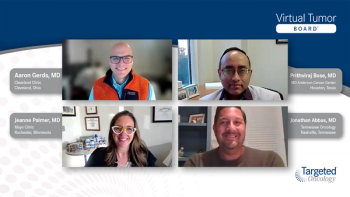
Panelists discuss how treatment sequencing decisions in myelofibrosis should be guided by clinical evidence, patient response patterns, and strategic consideration of future therapeutic options to maintain long-term disease control.
Panelists discuss how the timing of therapeutic interventions in early-stage myelofibrosis must be carefully weighed against potential risks and benefits, with consideration of disease trajectory and patient-specific factors to optimize long-term outcomes.
Andrew Kuykendall, MD, discusses the background, methods, and design of a phase 2 study which evaluated fedratinib.
Kathryn Beckermann, MD, PhD, discusses the patient-reported outcomes for tivozanib plus nivolumab from the phase 3 TiNivo-2 study.