John M. Burke, MD, shares his tips for offering bispecific antibody therapy in a community setting.
John M. Burke, MD, shares his tips for offering bispecific antibody therapy in a community setting.
John M. Burke, MD, provides practical tips for administering mosunetuzumab in a community setting.
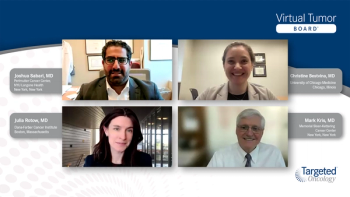
Panelists discuss second-line treatment options and emerging approaches for HER2-mutated non–-small cell lung cancer (NSCLC), highlighting novel therapies and clinical strategies.
Panelists discuss the role of HER2 mutations in non–-small cell lung cancer (NSCLC), focusing on diagnostic approaches, clinical implications, and targeted treatment strategies.

Bernd Kasper, MD, PhD, provides an overview of the phase 3 DeFi trial of nirogacestat for the treatment of patients with progressing desmoid tumors.
Yelena Y. Janjigian, MD, discusses the standard approval of pembrolizumab plus trastuzumab and chemotherapy for the treatment of patients with HER2-positive gastric or gastroesophageal junction adenocarcinoma.
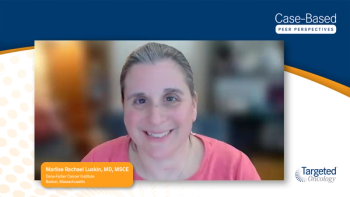
Panelists discuss how optimizing shared-care models between academic and community centers enhances continuity in complex hematologic malignancies. Key monitoring parameters for tagraxofusp include capillary leak syndrome risk. Timely transplant referral depends on disease kinetics. Novel therapies are among the unmet needs in plasmacytoid dendritic cell neoplasm. Support resources aid patient management. Emerging treatments and clinical insights continue to advance care.
Regina Barragan-Carrillo, MD, evaluates the current state of the global availability of clinical trials for patients with renal cell carcinoma.

Jennifer Chan, MD, MPH, discussed the findings from the phase 3 CABINET trial leading to the FDA approval of cabozantinib in patients with neuroendocrine tumors.
A panelist discusses how graft-vs-host disease (GVHD) manifests through a complex constellation of symptoms affecting multiple organ systems, including the skin (rash, itching), gastrointestinal tract (diarrhea, nausea, abdominal pain), liver (elevated enzymes, jaundice), and lungs (shortness of breath, cough), with severity assessment typically following established criteria.
Experts discuss how the 5-year outcomes of polatuzumab have influenced its position in current NCCN guidelines for diffuse large B-cell lymphoma (DLBCL) treatment, offering insights on how to interpret and apply these recommendations in various patient scenarios.
Experts discuss the 5-year efficacy and safety outcomes of polatuzumab in diffuse large B-cell lymphoma (DLBCL), highlighting its meaningful progression-free survival (PFS) and overall survival (OS) results for first-line patients with DLBCL and emphasizing key long-term safety considerations for clinicians.

Marleen I. Meyers, MD, emphasizes prioritizing whole foods, particularly fruits and vegetables, over relying on supplements for patients with cancer.

Douglas A. Tremblay, MD, discusses the long-term data supporting ropeginterferon alfa-2b-njft as treatment in patients with polycythemia vera.
Bernd Kasper, MD, PhD, discusses the key efficacy results from the updated analysis of the phase 3 DeFi trial of nirogacestat in desmoid tumors.

Trisha Wise-Draper, MD, PhD, discusses anticipated data on head and neck cancers and their potential impact on the field.
Alan Tan, MD, discusses the 8-year follow-up data from the CheckMate 214 trial of patients with advanced renal cell carcinoma.
Shirish M. Gadgeel, MD, provides and overview of the MARIPOSA trial of lazertinib and amivantamab vs osimertinib in EGFR-mutated advanced or metastatic NSCLC.
Seth Wander, MD, PhD, discusses genomic variations effect on elacestrant in ESR1-mutated breast cancer from findings in real-world data.

An expert shares their perspective on the future of care for patients with myeloproliferative neoplasms (MPNs).

Nicolas Girard, MD, PhD, discusses data from the COCOON trial for patients with EGFR-mutant advanced non–small cell lung cancer.
Trisha Wise-Draper, MD, PhD, provides an overview of the advancements for the management of head and neck cancers.
Panelists discuss how ongoing trials in first-line advanced hepatocellular carcinoma (HCC) may reshape treatment paradigms, influencing tyrosine kinase inhibitor (TKI) and immune checkpoint inhibitor (ICI) use. Patient selection depends on clinical (liver function, ECOG status) and biological (PD-L1, VEGF expression) factors. Lenvatinib remains a key TKI, balancing efficacy and safety. As emerging regimens (CARES-310, CheckMate-9DW) gain traction, lenvatinib’s role evolves, with experts assessing its place in monotherapy and combinations.
Panelists discuss how current first-line systemic therapies for advanced hepatocellular carcinoma (HCC) include atezolizumab + bevacizumab and durvalumab + tremelimumab, replacing tyrosine kinase inhibitors (TKIs) like sorafenib and lenvatinib. Emerging combinations with anti–PD-L1 agents enhance efficacy. TKI + immune checkpoint inhibitor (ICI) combinations offer synergistic benefits but pose toxicity, cost, and biomarker challenges.
John L. Marshall, MD, discusses the impact of the SUNLIGHT trial in patients with refractory metastatic colorectal cancer.
Firas Eladoumikdachi, MD, FACS, and M. Michele Blackwood, MD, FACS, assess preoperative radiation boosts in breast cancer care.
Nicolas Girard, MD, PhD, discusses the final overall survival results from the MARIPOSA trial of amivantamab plus lazertinib in EGFR-mutant advanced non–small cell lung cancer.
Alan H. Bryce, MD, discusses ongoing research in radioligand therapies.
Panelists discuss the presentation and management of a case involving HER2-mutated metastatic non–-small cell lung cancer (NSCLC), exploring treatment options and clinical decision-making
Panelists discuss the management of metastatic non–-small cell lung cancer (NSCLC) with a ROS1 alteration in patients with central nervous system (CNS) involvement, focusing on treatment strategies and challenges.