Videos

1 expert is featured in this series.

A panelist discusses how nasopharyngeal carcinoma (NPC) differs from other head and neck malignancies through its distinct geographical distribution, Epstein-Barr virus association, unique genetic profile, and characteristic clinical presentation, including early lymph node involvement.

3 experts are featured in this series.

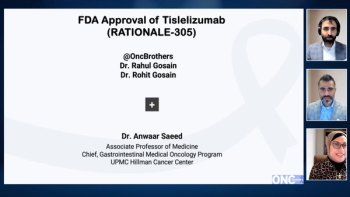
Panelists discuss how RATIONALE-305 represents a significant advancement in first-line treatment for advanced gastric cancer with tislelizumab demonstrating meaningful survival benefits while maintaining a tolerable safety profile that could potentially reshape standard clinical practice.

3 experts are featured in this series.

Panelists discuss how the optimal sequencing between available therapies for advanced gastric cancer remains challenging but should be guided by patient-specific factors, prior treatment response, and molecular characteristics of the tumor.

3 experts are featured in this series.

Panelists discuss how the RATIONALE-305 trial revealed a manageable adverse event profile for tislelizumab plus chemotherapy despite increased rates of neutropenia and anemia compared to placebo plus chemotherapy in advanced gastric cancer patients.

3 experts are featured in this series.

Panelists discuss how RATIONALE-305 trial data shows promising updated overall survival benefits for patients receiving tislelizumab plus chemotherapy compared to placebo plus chemotherapy in advanced gastric or gastroesophageal junction adenocarcinoma.

1 KOL is featured in this series.

A panelist discusses how emerging research in RCC treatment encompasses several promising investigational approaches that could potentially reshape the therapeutic landscape, from novel drug combinations to innovative treatment strategies that may address current gaps in care.

1 expert in this video

An expert discusses how recent analyses from the REFLECT trial in unresectable hepatocellular carcinoma (uHCC) demonstrate that both achieving objective response and greater depth of response correlate with improved survival outcomes. The depth of response serves as a potentially valuable early biomarker for prognosis and treatment decisions, with deeper responses associated with better overall survival among responders.

1 expert in this video

An expert discusses how treatment selection for first-line (1L) tyrosine kinase inhibitor (TKI) therapy in advanced hepatocellular carcinoma (HCC) requires careful evaluation of multiple factors, including liver function (Child-Pugh status), ECOG performance status, tumor burden, and presence of macrovascular invasion or extrahepatic spread. In reviewing individual cases, clinicians assess liver enzyme levels, α-fetoprotein values, radiographic findings, and comorbidities.

1 KOL is featured in this series.

A panelist discusses how managing adverse events associated with TKIs and belzutifan requires a proactive approach encompassing prevention strategies, regular monitoring, dose modifications when needed (particularly for combination regimens), and evidence-based mitigation techniques, while considering the distinct toxicity profiles of each agent and the impact of dose adjustments on treatment efficacy.

1 expert is featured in this series.

A panelist discusses how community practitioners should monitor for immune-related adverse events when using toripalimab for recurrent/metastatic (R/M) nasopharyngeal carcinoma (NPC), establish clear patient communication about toxicities, coordinate multidisciplinary care, consider EBV monitoring, and ensure appropriate patient selection to optimize outcomes.

1 expert is featured in this series.

A panelist discusses A panelist discusses how the integration of immunotherapy with chemotherapy as first-line treatment for recurrent/metastatic (R/M) nasopharyngeal carcinoma (NPC) is transforming the treatment landscape, with data from trials such as JUPITER-02 and DIPPER demonstrating improved progression-free and overall survival outcomes, while patient selection factors including performance status, comorbidities, PD-L1 expression, and EBV status remain critical considerations for optimizing therapeutic benefit in both the metastatic setting and potentially in neoadjuvant/adjuvant approaches.

1 expert is featured in this series.

A panelist discusses how toripalimab has emerged as the preferred treatment regimen for metastatic nasopharyngeal carcinoma (NPC), according to NCCN guidelines, based on improved survival outcomes in clinical trials compared with traditional chemotherapy approaches alone, though individual patient factors including performance status, prior treatments, and specific tumor characteristics must be carefully considered when personalizing the treatment strategy.

1 expert in this video

An expert discusses how adjuvant therapy options for high-risk muscle-invasive bladder cancer (MIBC); ypT2-ypT4a or N+) include cisplatin-based chemotherapy, which improves survival by targeting micrometastatic disease. Immune checkpoint inhibitors, such as atezolizumab and nivolumab, offer alternatives for cisplatin-ineligible patients.

1 expert in this video

An expert discusses how patients with muscle-invasive urothelial carcinoma (MIUC) undergoing radical cystectomy face a significant recurrence risk. High-risk factors include advanced stage, lymph node involvement, and positive surgical margins. Neoadjuvant cisplatin-based chemotherapy can improve survival but does not eliminate recurrence risk. Other predictors include lymphovascular invasion, variant histology, and systemic inflammation markers.

2 experts in this video

Panelists discuss how combining systemic therapy with locoregional treatments like transarterial chemoembolization (TACE) aims to enhance therapeutic efficacy by addressing its limitations, such as incomplete tumor necrosis and hypoxia-induced progression. Tyrosine kinase inhibitors (TKIs) like lenvatinib and immune checkpoint inhibitors (ICIs) counteract TACE-induced resistance by inhibiting angiogenesis and boosting immune response, improving overall tumor control.

1 expert in this video

An expert discusses using sequence therapies based on disease progression, patient factors, and resistance mechanisms. After a first-line tyrosine kinase inhibitor plus immune checkpoint inhibitor (TKI +  ICI) regimen, preferred subsequent-line options include alternative TKIs, chemotherapy, or combination strategies, tailored to patient response and tolerability.

2 experts in this video

Panelists discuss how systemic therapy plays a crucial role in embolization-eligible hepatocellular carcinoma (HCC), particularly for patients with progressive or extensive disease. In locally advanced cases, systemic therapies, including immunotherapy combinations and tyrosine kinase inhibitors (TKIs), are first-line options. Patients typically transition from transarterial chemoembolization (TACE) to systemic therapy upon progression, high tumor burden, or liver function decline.

1 expert in this video

An expert discusses how third line (3L) systemic therapy for metastatic renal cell carcinoma (mRCC) is guided by prior treatments, patient comorbidities, and drug-specific profiles. Options include tyrosine kinase inhibitors (TKIs; eg, tivozanib, cabozantinib), mTOR inhibitors (eg, everolimus), and immune-oncology– based approaches. Efficacy, tolerability (grade 3/4 adverse events [AEs]), and pharmacokinetic (PK) differences drive selection. Dose modifications, such as for tivozanib and lenvatinib/everolimus, balance efficacy and safety. Selection prioritizes sequencing strategy, with evidence (eg, Pal 2022) supporting reduced-dose efficacy.


1 expert in this video

The panelist discusses how for patients initially eligible for embolization, systemic therapy may be combined with transarterial chemoembolization (TACE) upfront for high-risk disease (ie, large tumor burden, elevated AFP) or reserved for progression after regional therapy in lower-risk cases. Treatment decisions should be individualized based on tumor characteristics, liver function, and patient preferences.

1 expert is featured in this series.

A panelist discusses how patient-reported outcomes have transformed their ability to deliver more personalized care approaches for patients with polycythemia vera (PV) by providing critical insights into symptom burden, quality-of-life impacts, and treatment effectiveness that might otherwise go unrecognized through standard clinical assessments alone.

1 expert in this video

The panelist discusses how the patient underwent transarterial chemoembolization (TACE) 3 times with an initial partial response. However, at the end of the 6-month treatment period, the patient had disease progression. The panelist advises that the best treatment option for the patient would be systemic therapy.

1 expert is featured in this series.

A panelist discusses how advances in JAK2 V617F and other molecular monitoring have enhanced their ability to assess polycythemia vera (PV) disease progression and guide initial treatment decisions by providing quantifiable markers for tracking mutation burden, treatment response, and risk stratification that complement traditional clinical parameters.