Panelists discuss how addressing current knowledge gaps and improving real-world integration of emerging therapies will advance care for patients with EGFR-mutant non–small cell lung cancer (NSCLC).
Panelists discuss how addressing current knowledge gaps and improving real-world integration of emerging therapies will advance care for patients with EGFR-mutant non–small cell lung cancer (NSCLC).
Panelists discuss how dose optimization and personalized adjustment strategies sustain efficacy and enhance long-term outcomes in EGFR-mutant NSCLC.
Panelists discuss how proactive adverse event prevention and patient support improve tolerability and continuity of targeted treatment in EGFR-mutant non–small cell lung cancer (NSCLC).
Panelists discuss how molecular testing and biomarker profiling guide individualized first-line treatment planning for EGFR-mutant non–small cell lung cancer (NSCLC) with central nervous system (CNS) involvement.

An expert discusses the evolving treatment landscape for EGFR-mutated non–small cell lung cancer (NSCLC), highlighting the frontline shift of targeted therapies like those in MARIPOSA, the growing complexity of treatment sequencing, and the importance of patient education and clinical trial participation in navigating this transformative era of care.
An expert discusses the successful long-term use of amivantamab in frontline regimens like MARIPOSA, emphasizing the importance of proactive adverse effect management, patient education, and team-based care in supporting adherence and delivering sustainable, patient-centered cancer treatment.
An expert discusses findings from the Paloma-3 study, emphasizing how subcutaneous amivantamab improves patient-reported outcomes and quality of life, reinforcing a growing oncology focus on treatment experience, tolerability, and patient-centered care alongside clinical efficacy.
An expert discusses efforts to improve the tolerability and delivery of the MARIPOSA regimen, highlighting subcutaneous amivantamab from the Paloma studies and proactive skin care strategies from the Cocoon study as key advances in enhancing patient experience, adherence, and clinical outcomes.
An expert discusses the MARIPOSA study’s impact on managing central nervous system (CNS) involvement in EGFR-mutated non–small cell lung cancer, emphasizing improved brain progression-free survival, dual-targeted resistance prevention, and a promising shift toward more effective and personalized treatment strategies.
An expert discusses emerging frontline treatments for EGFR-mutated non–small cell lung cancer (NSCLC), highlighting the evolving role of regimens like FLORA2 and MARIPOSA, and emphasizing the shift toward personalized, patient-centered therapy strategies.
Alexander Spira, MD, PhD, FACP, discusses the PAPILLON trial, including its methods, design, and rationale as well as new data from the study.

Alexander I. Spira, MD, PhD, FACP, discusses the next steps in the clinical development of zoldonrasib for patients with KRAS G12D pancreatic ductal adenocarcinoma based on preliminary findings.
Alexander I. Spira, MD, PhD, FACP, discusses the clinical implications of ctDNA for treatment decisions and monitoring in patients with KRAS G12D pancreatic ductal adenocarcinoma treated with zoldonrasib.

Alex Spira, MD, PhD, discusses a subset analysis of the phase 3 MARIPOSA trial looking at dose interruptions during the course of amivantamab and lazertinib treatment for EGFR-mutant non-small cell lung cancer.
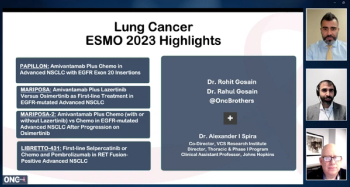
Shared insight from key opinion leaders on results from MARIPOSA-2 and the role of amivantamab plus lazertinib and chemotherapy in patients with advanced NSCLC following progression on osimertinib.
Expert insight into results from MARIPOSA, a study of frontline amivantamab plus lazertinib in advanced non–small cell lung cancer, and the potential for this regimen’s use in real-world practice.
Oncology Brothers Rohit Gosain, MD, and Rahul Gosain, MD, are joined by Alexander Spira, MD, PhD, FACP, to review data from PAPILLON, which combined amivantamab and chemotherapy as frontline treatment for patients with advanced NSCLC.

Alexander Spira, MD, PhD, FACP, discusses osimertinib-relapsed disease and its sensitivity to EGFR or MET inhibition.

Alexander Spira, MD, PhD, FACP, discusses the rationale for combining amivantamab-vmjw and lazertinib for the treatment of relapsed or refractory EGFR-mutant non–small cell lung cancer.

Alexander Spira, MD, PhD, FACP, director of the Virginia Cancer Specialists Research Institute, discusses the safety profile of amivantamab and lazertinib in EGFR-mutated non-small cell lung cancer, based on data from the CHRYSALIS tria.

During a virtual Targeted Oncology Case-Based Roundtable event, Alexander Spira, MD, PhD, discusses when the use of durvalumab followed by chemoradiotherapy is appropriate for patients with unresectable stage III non–small cell lung cancer.

Alexander Spira, MD, PhD, discusses how he chooses treatment for patients with lung cancer.

Alexander Spira, MD, PhD, shares an important message with community oncologists regarding the treatment of patients with lung cancer.

Alexander Spira, MD, PhD, discusses the phase 1 CHRYSALIS trial of amivantamab plus lazertinib in 2 EGFR-mutant non–small cell lung cancer patient populations, which include patients with relapsed/refractory and those who are treatment-naive.