


Ovarian Cancer
Latest News
Latest Videos


CME Content





























More News

To gain insight into the integration of olaparib (Lynparza) into clinical practice, Targeted Oncology interviewed Ursula A. Matulonis, MD, medical director of gynecologic oncology at Dana-Farber Cancer Institute.

An orphan drug designation has been granted to Reolysin (wild-type reovirus) for the treatment of patients with ovarian cancer.

Screening techniques for use in the general population have long been available for cervical cancer and are being actively developed for ovarian cancers.

Targeted agents have become available in recent years to treat many major cancers, but for women with ovarian cancer, standard treatment following cytoreductive surgery remains systemic intravenous/intraperitoneal chemotherapy with a platinum agent and a taxane. Approximately 80% of women who receive first-line treatment with this platinum-based regimen experience relapsed disease. However, early research indicates that more and better options may be on the way.

Representatives Diana DeGette (D, Colorado) and Fred Upton (R, Michigan) recently released a "discussion draft" of the 21st Century Cures Act.

Donna McNamara, MD, discusses PARP inhibitors for the treatment of ovarian cancer.

Metastatic disease accounts for the vast majority of cancer-related deaths. Ensuring a definitive diagnosis and the most effective treatment in a timely fashion is essential for extending life expectancy.

In the past decade, there has been a rapid increase in the understanding of how various cancers develop and progress.

The New York State Stem Cell Science Program recently awarded a 4-year $11.9 million grant to Roswell Park Cancer Institute to fund research and development of a stem-cell based treatment for ovarian cancer.
Jason D. Wright, MD, discusses progression-free survival (PFS) as an endpoint for ovarian cancer trials.

The FDA has approved the PARP inhibitor olaparib (Lynparza) for the treatment of women with BRCA-positive advanced ovarian cancer.

Women with HR+ breast cancer who remained premenopausal after receiving chemotherapy had a lower risk of disease recurrence when adding ovarian suppression to adjuvant exemestane or—to a lesser extent—tamoxifen, compared with standard tamoxifen alone.

The monoclonal antibody cirmtuzumab, currently in clinical trials to treat CLL, targets ROR1 on the surface of cancerous B cells, and the agent may have a wider reach in the treatment of ovarian and other cancers.

Bevacizumab (Avastin) has been approved for patients with recurrent platinum-resistant ovarian cancer in combination with chemotherapy. The approval was based on results from the phase III AURELIA trial.

Translating current and emerging knowledge of the molecular drivers of ovarian cancer is yielding promising new insights into potential clinical targets, moving treatment away from historical paradigms in favor of more personalized therapeutic approaches.

PARP inhibitors represent an important class of emerging therapies for the treatment of patients with ovarian cancer and possibly other malignancies, but many scientific questions about the underlying molecular mechanisms that these agents target must be answered before they can be fully employed in clinical practice.

A statistically significant improvement in overall survival (OS) was not seen with the combination of paclitaxel and the angiogenesis inhibitor trebananib when compared with paclitaxel alone for patients with recurrent platinum-resistant ovarian cancer.
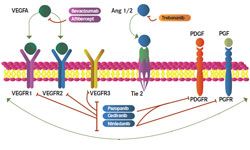
Two agents with contrasting mechanisms of actions exert synergistic effects while limiting tumor blood supply in ovarian cancer. Patient enrollment began this month (October 2014) for a new phase 1b/2 clinical study1 to evaluate this novel combination with the VDA fosbretabulin plus pazopanib.
Maurie Markman, MD, discusses the role of molecular testing in gynecologic cancers.

Mary-Claire King, PhD, the researcher who identified BRCA1's linkage to hereditary breast and ovarian cancer, was announced as the winner of the 2014 Lasker~Koshland Special Achievement Award in Medical Science.
Bradley Monk, MD, gynecologic oncologist, University of Arizona Cancer Center Phoenix Branch, discusses trabectedin as a potential agent to treat ovarian cancer.

Most patients with ovarian cancer present with bulky and metastatic disease. Surgery and platinum-based chemotherapies are the mainstay of treatment for newly diagnosed disease, but recurrence/resistance are common.

Jyoti D. Patel, MD, discusses a phase II trial that looked at olaparib in combination with cediranib versus olaparib alone in recurrent platinum-sensitive ovarian cancer.

The poly (ADP-ribose) polymerase (PARP) inhibitor veliparib exhibits antitumor activity and is safe and tolerable on a continuous dosing schedule when used for the treatment of patients with BRCA-positive and BRCA-wild type tumors.

Patients with a rare but aggressive form of ovarian cancer had mutations in the chromatin regulator SMARCA4, suggesting a causative role of these mutations.