

MULTIPLE MYELOMA
Latest News
Latest Videos


CME Content





























More News

Paul G Richardson, MD, discusses the ways treatment approaches for patients with multiple myeloma has changed over the past few years.
In the phase 3 IKEMA study, isatuximab added to carfilzomib and dexamethasone improved progression-free survival in patient with relapsed multiple myeloma.

Findings from a phase 1 study of CART-ddBCMA cells exemplify their safety and ability to induce durable responses in patients with relapsed or refractory multiple myeloma.
Adam Cohen, MD, discussed the recent updates and advancements in BCMA-directed therapies for multiple myeloma.
Before closing out his discussion on newly diagnosed multiple myeloma, Ajay K. Nooka, MD, MPH, FACP, emphasizes the continued role of transplantation in this setting.
Ajay K. Nooka, MD, MPH, FACP, shares insight on strategies to optimally deliver maintenance therapy and manage toxicities in patients with multiple myeloma.
Considerations for assessing treatment response and electing to continue therapy in patients with newly diagnosed multiple myeloma.
Insight on the role of isatuximab and VRd in patients with newly diagnosed multiple myeloma following data from the GMMG-HD7 study.
Shifting his focus to the MASTER study in newly diagnosed multiple myeloma, Ajay K. Nooka, MD, MPH, FACP, highlights the role of daratumumab with KRd.
Expert perspectives on the use of daratumumab with RVd in patients with newly diagnosed multiple myeloma in the context of updates from the GRIFFIN study.
Expert hematologist-oncologist Ajay K. Nooka, MD, MPH, FACP, shares his perspective on the management of a woman newly diagnosed with multiple myeloma.
Sponsored in Part by AbbVie/Content Independently Developed by Targeted Oncology. Drs. Shaji Kumar and Jonathan Kaufman discuss how BCL-2 inhibitors fit into the different treatment options for multiple myeloma.
Sponsored in Part by AbbVie/Content Independently Developed by Targeted Oncology. An explanation of the focus on BCL-2 inhibitors versus the development of MCL-1 inhibitors for multiple myeloma treatment.

During a live virtual event, Douglas Sborov, MD, MS, discussed the most important goals for treatment and the use of minimal residual disease assessment for a patient with transplant-eligible multiple myeloma.
Sponsored in Part by AbbVie/Content Independently Developed by Targeted Oncology. Jonathan Kaufman, MD, describes clinical trials looking at venetoclax resistance, including the CANOVA study.
Sponsored in Part by AbbVie/Content Independently Developed by Targeted Oncology. Oncologists discuss the use of carfilzomib for multiple myeloma and their typical treatment regimens of choice.
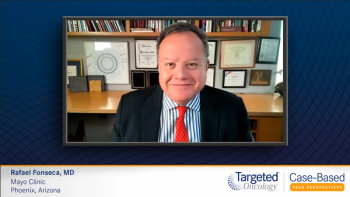
Before closing out his discussion on transplant-ineligible multiple myeloma, Rafael Fonseca, MD, considers the future roles of CAR T-cell and bispecific antibody therapies.
Expert perspectives on two bispecific antibodies, teclistamab and talquetamab, that have been investigated in multiply relapsed multiple myeloma.
Shared insight on two novel CAR T-cell therapies, cilta-cel and ide-cel, that have been tested in multiply relapsed multiple myeloma.
Rafael Fonseca, MD, shares an overview of the treatment armamentarium for patients with relapsed/refractory multiple myeloma.
Practical advice on strategies to improve care for patients with transplant-ineligible multiple myeloma regarding induction and maintenance therapy, and aiming for deep and durable responses.
Expert perspectives on updated data from the MAIA trial in newly diagnosed transplant-ineligible multiple myeloma and how this can be applied to clinical practice.
Rafael Fonseca, MD, provides details on a patient case of transplant-ineligible multiple myeloma and reviews the selection of frontline triplet versus doublet therapy.
During a case-based roundtable event, Dan Vogl, MD, MSCE, discussed possible targeted therapies for a patient with relapsed/refractory multiple myeloma who had previously received several combination therapies.
Findings from an analysis of the KarMMa study in patients with multiple myeloma signal that certain baseline characteristics are predictive of response to chimeric antigen receptor T-cell therapy.