


LUNG CANCER
Latest News

Latest Videos


CME Content





























More News
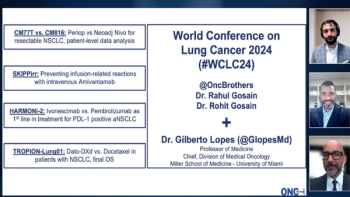
Panelists discuss how the TROPION-Lung01 study results presented at World Conference on Lung Cancer 2024 shed light on overall survival outcomes in patients with lung cancer, with a particular focus on survival rates across different histological subtypes.
Panelists discuss how the HARMONi-02 trial presented at World Conference on Lung Cancer 2024 revealed key lung cancer insights, focusing on progression-free survival and immune-related response criteria end points, while emphasizing the trial’s significance for specific patient subgroups.
Panelists discuss how the SKIPPirr data outcomes presented at World Conference for Lung Cancer 2024 provide valuable insights into the potential use of amivantamab for advancing lung cancer treatment strategies.
Panelists discuss how the latest outcomes from CheckMate-77T demonstrate improved efficacy of neoadjuvant immunotherapy in early-stage non–small cell lung cancer compared with CheckMate-816, potentially revolutionizing treatment strategies and enhancing long-term survival rates for patients with lung cancer.

The PIONeeR trial, evaluating combinations of immunotherapy drugs for advanced NSCLC, identified durvalumab plus ceralasertib as a promising treatment option, demonstrating long-term clinical benefit in some patients.
In an updated analysis of the phase 3 CheckMate 77T study, perioperative nivolumab showed event-free survival benefits for the treatment of resectable non–small cell lung cancer.
Adagrasib demonstrated superior outcomes to docetaxel in patients with previously treated KRAS G12C-mutated non-small cell lung cancer, even among those with baseline brain metastases.
Encorafenib plus binimetinib demonstrated antitumor activity in patients with treatment-naive BRAF V600E-mutant advanced non–small cell lung cancer.
Adding relatlimab to nivolumab and chemotherapy improved clinical benefit in patients with stage IV non–small cell lung cancer compared to nivolumab and chemotherapy alone.
Zipalertinib appeared safe and effective in the treatment of heavily pretreated patients with non-small cell lung cancer harboring EGFR exon 20 insertion mutations who progressed on or after amivantamab.
The novel ROS1 inhibitor zidesamtinib demonstrated promising early activity in heavily pretreated patients with advanced ROS1-fusion-positive non–small cell lung cancer, including in those treated with other next-generation TKIs.
A study found that reducing the dose of pembrolizumab in patients with advanced stage non–small cell lung cancer did not significantly affect overall survival compared to the standard dose.
The combination of belrestotug and dostarlimab significantly improved response rates in patients with previously untreated non–small cell lung cancer when compared to dostarlimab alone.

Shirish M. Gadgeel, MD, discusses research that he is particularly excited to see presented at the 2024 European Society for Medical Oncology Congress.
The BR.31 trial found that adjuvant durvalumab did not improve disease-free survival in patients with non-small cell lung cancer, regardless of PD-L1 expression.

Pretreatment with dexamethasone significantly reduced infusion-related reactions in patients receiving amivantamab for advanced lung cancer, according to findings from the SKIPPirr study.

The trial previously met its primary end point of progression-free survival, and the final overall survival analysis was recently presented at the 2024 World Conference on Lung Cancer.
Firmonertinib showed efficacy and safety in patients with EGFR PACC-mutated non–small cell lung cancer.

The phase 3 KEYNOTE-867 and KEYNOTE-630 studies will be stopped due to futility, following analysis from independent data monitoring committees.

The phase 3 SOHO-02 trial has enrolled its first patient with advanced non–small cell lung cancer harboring activating HER2 mutations.
New data on zongertinib for HER2-positive non–small cell lung cancer will be presented at the IASLC 2024 World Conference on Lung Cancer, shedding light on its potential as a novel treatment option for this patient population.
The TruSight Oncology Comprehensive test has been approved by the FDA as a companion diagnostic for NTRK-fusion positive solid tumors and RET-fusion positive non–small cell lung cancer.
Biagio Ricciuti, MD, discussed findings from a retrospective study exploring the use of immune checkpoint inhibitors for longer than 2 years in patients with non–small cell lung cancer.
Byoung Chul Cho, MD, PhD, discussed findings from cohort C of the CHYRSALIS-2 study exploring amivantamab plus lazertinib in patients with non–small cell lung cancer with uncommon EGFR mutations.