



GYNECOLOGIC CANCERS
Latest News

Latest Videos




CME Content





























More News


The investigational agent SM-88 demonstrated promising survival in the phase II TYME-88-Panc study in patients with advanced pancreatic cancer.<sup>1,2</sup> The oral modified dysfunctional tyrosine induced a median overall survival of 6.4 months in patients.<br />

The Association of Community Cancer Centers has launched the Barriers to Quality Care in Ovarian Cancer project, a collaboration with AstraZeneca, Merck, and partners including the Association for Molecular Pathology, the National Society of Genetic Counselors, and the Society of Gynecologic Oncology. The project aims to understand the key issues associated with ovarian cancer care and provide guidance to help cancer centers implement better care for patients diagnosed with epithelial ovarian cancer.
Bradley J. Monk, MD, noted the FDA’s approval of the biosimilar agent bevacizumab-awwb across multiple indications including metastatic colorectal cancer, non–small cell lung cancer, glioblastoma, metastatic renal cell carcinoma, and cervical cancer, but he wondered aloud why ovarian cancer was not on the list.

Ghanshyam Yadav, MD, a first-year resident in Obstetrics Gynecology & Reproductive Services, Baylor College of Medicine, talks through the results of a preclinical trial that found synergy in the combination of the PARP inhibitor olaparib and the pan-HER tyrosine kinase inhibitor neratinib for uterine serous cancers that overexpress HER2.

In June 2019, the FDA approved a number of agents many fields, including diffuse large B-cell lymphoma, head and neck squamous cell carcinoma, small cell lung cancer, gastroenteropancreatic neuroendocrine tumors, and multiple myeloma. The FDA also approved the fifth biosimilar for trastuzumab and another biosimilar for bevacizumab across several indications.
In an interview with <em>Targeted Oncology, </em>Richard T. Penson, MD, discussed the significance of the findings recently presented for the SOLO3 trial in patients with platinum-sensitive, relapsed <em>BRCA-</em>positive ovarian cancer.
Hanneke Poort, PhD, discusses the burden of cancer-related fatigue in women with gynecologic cancers; she also highlights a new intervention technique that is being used at Dana-Farber for these patients.
The FDA has approved Zirabev, a biosimilar to bevacizumab for 5 indications. Zirabev has been approved for the treatment of patients with metastatic colorectal cancer; unresectable, locally advanced, recurrent or metastatic non-squamous non–small cell lung cancer; recurrent glioblastoma; metastatic renal cell carcinoma; and persistent, recurrent or metastatic cervical cancer.
Susan Friedman, executive director and founder, FORCE, a non-profit organization supporting education, advocacy, and research around breast and ovarian cancer, explains the relevance of PARP inhibitors and the recent developments in oncology research that may improve cancer treatment for patients with genetic mutations.
A prefilled syringe of lanreotide has been approved by the FDA to enable healthcare providers to administer the injection easier to adults with unresectable, well or moderately differentiated, locally advanced or metastatic gastroenteropancreatic neuroendocrine tumors.
A priority review designation has been granted by the FDA to a supplemental biologics license application for niraparib as a treatment for patients with advanced ovarian, fallopian tube, or primary peritoneal cancer who have been treated with ≥3 prior chemotherapy regimens, and who have either a <em>BRCA </em>mutation or have homologous recombination deficiency and progressed >6 months after their last platinum-based regimen.
The American Cancer Society, Dana-Farber Cancer Institute, Baptist Cancer Center, and the Mayo Clinic report that treatment patterns varied markedly by cancer type and care facility setting for patients with de novo metastatic disease who died within 1 month after diagnosis, based on an analysis of data from 100,848 patients collected from the National Cancer Database, a hospital-based cancer registry that captures 70% of patients in the United States with a new diagnosis.
Olaparib has been approved by the European Commission as a treatment in the maintenance setting for adult patients with advanced <em>BRCA1/2</em>-mutated germline and/or somatic high-grade epithelial ovarian, fallopian tube, or primary peritoneal cancer who are in complete or partial response following frontline treatment with a platinum-based chemotherapy.
The FDA recently released 5 new draft guidance documents that promote broader patient eligibility for cancer clinical trials. The policies encourage inclusion of certain individuals who were previously disqualified due to medical conditions or biological factors, including brain metastases, organ dysfunction, prior or concurrent malignancies, chronic infections, and age.

David Spigel, MD, chief scientific officer, Sarah Cannon Research Institute, discussed with <em>Targeted Oncology</em>at the 2019 ASCO Annual Meeting how the Association of Community Cancer Centers (ACCC) is the change agent for helping physicians provide their patients with quality care. <br />
A cohort of cancer centers was selected to serve as models for identifying key strategies for racial and ethnic minority group engagement in clinical trials. On the basis of several qualifying criteria, such as sustained accrual of minorities into clinical cancer research, an established minority population ≥10% in the overall catchment, an established clinical trial infrastructure, and a formal community outreach program, the investigators identified 8 cancer centers for participation.
In a case-based-style discussion, Tanios S. Bekaii-Saab, MD, and Wells Messersmith, MD, reviewed the treatment of patients with colorectal cancer whose tumors express rare gene mutations or molecular signatures, such as <em>NTRK</em> fusions.
ABP 980, a trastuzumab biosimilar, has been approved by the FDA for the treatment of patients with HER2-overexpressing breast cancer as well as HER2-overexpressing metastatic gastric or gastroesophageal junction adenocarcinoma, marking the fifth approval by the agency for a trastuzumab biosimilar.
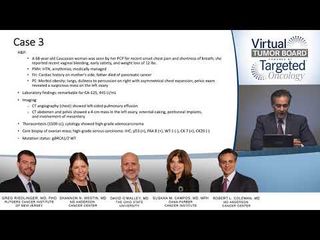
During a recent <em>Targeted Oncology </em>live case-based peer perspectives presentation, Tanios Bekaii-Saab, MD, discussed with a group of physicians the treatment options for patients with gastrointestinal cancers and the characteristics that influence his decision making. Bekaii-Saab explained his clinical decisions based on the case scenario of one patient with colorectal cancer and one with hepatocellular carcinoma.
Eric Pujade-Lauraine, MD, PhD, discusses the exploratory findings from the phase III JAVELIN Ovarian 200 trial, which investigated the use of combination avelumab plus pegylated liposomal doxorubicin in patients with platinum-resistant, refractory ovarian cancer.
One set of researchers are exploring the possibility of re-challenging patients with ovarian cancer with PARP inhibitors later in the course of treatment when their disease became recurrent. As the first to examine re-challenging patients with PARP inhibitors, researchers found that patients who had prior exposure to PARP inhibitors did not develop resistance and could, therefore, receive repeat treatment with PARP inhibitors.
In an interview with <em>Targeted Oncology, </em>Emese Zsiros, MD, PhD, discussed the findings from this phase II trial investigating the triplet regimen in patients with recurrent disease. In addition, she shared details for the next steps planned for this regimen.

Compared to chemotherapy, treatment with the PARP inhibitor olaparib reduced the risk of disease progression or death by 38% in patients with platinum-sensitive, relapsed, germline <em>BRCA1/2</em>-mutated ovarian cancer who had received at least 2 prior chemotherapy regimens, based on topline findings from the confirmatory phase III SOLO3 trial.
The combination of niraparib and bevacizumab demonstrated a significant increase in progression-free survival compared with niraparib alone in patients with platinum-sensitive recurrent ovarian cancer, according to the results of the randomized ENGOT-OV24 trial.<br />