
GI CANCERS
Latest News
Latest Videos
CME Content





























More News
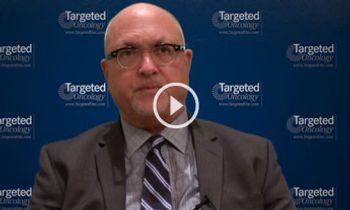
David H. Ilson, MD, PhD, discusses the current role of pembrolizumab in patients with gastric cancer or gastroesophageal junction adenocarcinoma based on the results from the KEYNOTE-062 trial.

In a presentation at the 2019 ESMO Congress on a case series of 7 pretreated patients with <em>NRG1</em>-positive tumors, Stephen Liu, MD, and colleagues discussed the efficacy of afatinib and explained that afatinib may be a potential treatment option for <em>NRG1</em>-positive tumors across multiple cancer types.

In an interview with <em>Targeted Oncology</em>, Michael A. Choti, MD, MBA discussed the treatment landscape for patients with pancreatic cancer, as well as how the role of neoadjuvant chemotherapy in this space is changing. He highlights advantages of neoadjuvant strategies, and also some other treatment options for patients with pancreatic cancer.
The FOLFIRINOX regimen remains the treatment of choice for patients with pancreatic cancer even as clinical trials exploring potential therapies, including CD40 and CPI-613, offer the possibility of new options for a notoriously difficult-to-treat disease, Davendra P.S. Sohal, MD, MPH, told an audience at the 2019 Gastrointestinal Oncology Conference.
A pivotal multicenter, open-label, randomized phase III trial has been initiated to evaluate the efficacy and safety of the novel mitochondrial inhibitor, devimistat in combination with a modified FOLFIRNOX regimen for the first-line treatment of patients with metastatic pancreatic cancer, according to a press release from Rafael Pharmaceuticals.

Following the 2019 ESMO Congress, experts across various fields highlighted some next steps and how these treatment options will improve the treatment landscape for patients with ovarian, lung, breast, GI, or GU cancers. Overall, the abstracts presented at this year’s meeting will change the treatment paradigm in a number of patient populations.
Marcelo C. Pasquini, MD, discusses the rationale for analyzing real-world data for the use of tisagenlecleucel, a chimeric antigen receptor T-cell therapy, as a treatment for patients with acute lymphoblastic leukemia and diffuse large B-cell lymphoma. This CD19 CAR T cell was approved 2 years ago for use in both ALL and DLBCL.
The addition of direct oral oral anticoagulants for the management of venous thromboembolism in patients with cancer is the latest change to previous guidelines issued by the American Society of Clinical Oncology.
In an interview with <em>Targeted Oncology</em>, Gregory Gores, MD explained the role of molecular therapy and the use of genetic testing to guide treatment of iCCA.
Using a measure known as the growth modulation index, patients with TRK fusion–positive cancers who were treated with larotrectinib had a clinically meaningful improvement in progression-free survival compared with the time to progression on their prior treatment, an analysis of patients enrolled in 1 of 3 clinical trials has found.
During his presentation at the Cleveland Clinic Cholangiocarcinoma Symposium, Davendra P.S. Sohal, MD, MPH, reviewed promising novel therapies and those that recently gained indications for patients with cholangiocarcinoma.
The risk of progression or death was reduced by 63% with ivosidenib as treatment of pretreated patients with IDH1-mutant advanced cholangiocarcinoma compared with placebo, according to data from the phase III ClarIDHy study that was presented at the 2019 ESMO Congress.
Three clinical trials presented at the 2019 ESMO Congress show that the tropomyosin receptor kinase inhibitor larotrectinib continues to show anti-tumor activity, including long-lasting objective responses and low toxicity, according to results from an integrated analysis.
An objective response rate of 35.5% was seen with treatment with pemigatinib, a selective oral inhibitor of FGFR1, 2, and 3, in patients with previously treated, locally advanced or metastatic cholangiocarcinoma with an <em>FGFR2 </em>rearrangement or fusion, according to findings from the phase II FIGHT-202 clinical trial presented at ESMO 2019.

Gulam A. Manji, MD, PhD, discusses the need to identify mutations that may be actionable in patients with colorectal cancer. The identification of such mutations can further impact patient survival and improve efficacy, says Manji, in both CRC and other gastrointestinal cancers.

Now in it 24th year, the annual International Congress on Hematologic Malignancies: Focus on Leukemias, Lymphomas, and Myeloma, hosted by Physicians’ Education Resource, LLC, continues to bring significant advances in hematology to the forefront.

Amol K. Narang, MD, discusses the unanswered questions that still need to be addressed to further expand the role of stereotactic body radiation therapy in gastrointestinal cancers.

To improve the efficacy of chimeric antigen receptor T-cell therapies, Nirali N. Shah, MD, MHSc, suggested including new constructs that target more than 1 antigen in patients with acute lymphoblastic leukemia, during a presentation at the 2019 SOHO Annual Meeting.<br />
In an interview with Targeted Oncology, John Bartlett, MD, explained the standardized cancer testing project, its relevance, and how it could be used to improve the treatment of patients with pancreatic, prostate, breast cancer.

In an interview with Targeted Oncology, Florencia McAllister, MD, discussed the data from these analyses of the tumor microbiome in patients with pancreatic cancer and their potential significance. She also discussed the next steps necessary for validating these results.
In an interview with Targeted Oncology, Sattva S. Neelapu, MD, discussed the evolving role for CAR T-cell therapy in patients with B-cell lymphomas. He also highlighted the toxicities commonly associated with these therapies and how physicians can treat these AEs as they arise.
John L. Marshall, MD, spoke with a group of physicians during a Targeted Oncology live case-based peer perspectives discussion on the different classes of agents available to treat patients with gastrointestinal cancers.

Management of neuroendocrine liver metastases relies on many treatment modalities, ranging from surgery to ablation. Clinicians have in their armamentarium interventional radiology techniques that use regional and systemic treatments spanning a diverse group of biologic, cytotoxic, and targeted agents.
Howard S. Hochster, MD, discusses the role of TAS-102 in patients with gastric/gastroesophageal junction or colorectal cancer in comparison to fluorouracil.
In patients with <em>RAS </em>wild-type metastatic colorectal cancer, maintenance therapy with single-agent panitumumab was inferior in terms of progression-free survival compared with a combined regimen of panitumumab plus fluorouracil and leucovorin; however, the combination regimen showed a higher rate of treatment-related toxicities, according to results from the phase II noninferiority VALENTINO trial.<br />