

GI CANCERS
Latest News
Latest Videos





CME Content





























More News


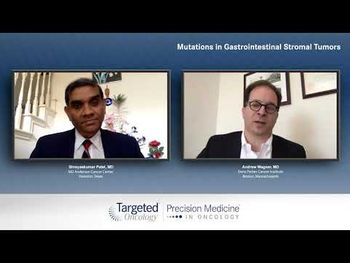


Key opinion leaders discuss the evolving treatment paradigm for relapsed/refractory gastrointestinal stromal tumors, and provide an overview of supplemental data presented at the ASCO (American Society of Clinical Oncology) 2020 Annual Meeting.

"The Orphan Drug Designation we received from the FDA is of significant importance in accelerating the development of PBP1510 to provide better treatment for pancreatic cancer."

Shubham Pant, MD, discusses the ESPAC-5F trial methods and efficacy in patients with pancreatic cancer.

A liposomal irinotecan combination was granted FDA Fast Track designation for the treatment of untreated and unresectable, locally advanced or metastatic pancreatic ductal adenocarcinoma.

In an interview with Targeted Oncology, Andrew L. Coveler, MD, discussed the phase 1 trial study of SEA-CD40 combined with a chemotherapy regimen, which he recently presented during the ASCO Virtual Scientific Program.
"We believe DKN-01 has the potential to be an important new therapy for this patient population that remains an area of high unmet medical need."
The FDA granted approval to nivolumab for the treatment of patients with unresectable advanced, recurrent, or metastatic esophageal squamous cell carcinoma after receiving prior fluoropyrimidine- and platinum-based chemotherapy.
The FDA has granted margetuximab an orphan drug designation for the treatment of patients with gastric and gastroesophageal junction cancer.

“Although these are early data, we are encouraged by these findings. The depth of response is particularly impressive in some patients."
The immune checkpoint inhibitor induced 1 objective response but appeared safe as treatment of patients with metastatic high-grade neuroendocrine neoplasms in 2 open-label phase 2 clinical trials.
Fam-trastuzumab deruxtecan-nxki has received an Orphan Drug designation for the treatment of patients with gastric or gastroesophageal junction cancer.

Van K. Morris, MD, discusses the findings of the KEYNOTE-158 trial, which evaluated pembrolizumab in advanced solid tumors in relation to patients with advanced unresectable anal cancer.
The New Drug Application for avapritinib as treatment of unresectable or metastatic fourth-line gastrointestinal stromal tumor was refused by the FDA, according to a recently issued complete response letter.
Joseph Kim, MD, discusses the utility of liquid biopsies in patients with gastric or gastrointestinal cancer at the 2020 GI Cancers Symposium held by the American Society of Clinical Oncology.
Trastuzumab deruxtecan received Breakthrough Therapy Designation for the treatment of patients with HER2-positive unresectable or metastatic gastric or gastroesophageal junction adenocarcinoma who have received two or more prior regimens including trastuzumab.
In an interview with Targeted Oncology, Gregory L. Beatty, MD, PhD, discussed the science behind the development of metastases in pancreatic tumors, including how metastases differ in various sites in the body. He also reviewed the treatment options for this disease.
In an interview with Targeted Oncology following SOGO 2020, Andrea Cercek, MD, discussed the rising incidence of CRC in young adults in detail. She also advised community oncologists who encounter these patients in their clinics.
"The third independent safety review has once again confirmed the favorable safety profile of our lead product candidate eryaspase, and the trial has now surpassed 75% of the planned target enrollment."
The FDA has approved pemigatinib for the treatment of adult patients with previously treated, unresectable locally advanced or metastatic cholangiocarcinoma harboring an FGFR2 fusion or rearrangement.
The FDA granted two Fast Track designations to surufatinib for the treatment of both advanced and progressive pancreatic neuroendocrine tumors and extra-pancreatic NETs in patients who are not amenable for surgery, according to a press release from the developer, Chi-Med. The agent was previously granted Orphan Drug Designation by the FDA for this indication.
A liquid biopsy test with the ability to screen for a panel of biomarkers rather than just one can reportedly detect pancreatic ductal adenocarcinoma, the most common form of pancreatic cancer, in the early stages of disease.