
LUNG CANCER
Latest News
Latest Videos

CME Content





























More News
Joshua K. Sabari, MD, reviews clinical trial data from FLAURA2 on osimertinib plus chemotherapy in patients with EGFR-mutated advanced lung cancer.
A medical oncologist provides an overview of treatment options available for patients with EGFR+ non–small cell lung cancer.
Joshua K. Sabari, MD, reviews the patient profile of a 73-year-old patient with EGFR+ non–small cell lung cancer.

A phase 1/2 study of KSQ-001EX will commence at MD Anderson Cancer Center following this investigational new drug approval from the FDA.

During a Targeted Oncology™ Case-Based Roundtable™ event, Devika Das, MD, discussed the role of KRAS inhibitors and the outcome of the KRYSTAL-1 trial in patients with non–small cell lung cancer. This is the first of 2 articles based on this event.
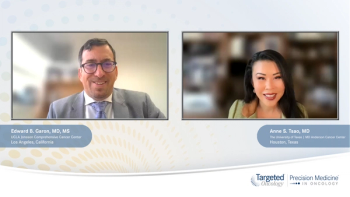
Edward B. Garon, MD, MS, and Anne S. Tsao, MD, provide an overview of TROP2 as a target for patients with non–small cell lung cancer.
Expert perspectives on unmet needs in the NSCLC treatment landscape and the role of antibody-drug conjugates in addressing them.
At the recent European Society for Medical Oncology Congress 2023, a number of trials evaluated antibody-drug conjugates in non–small cell lung cancer.

Carlos Rojas, MD, discusses preliminary findings from a phase 1 trial which of MK-1084 alone and with pembrolizumab in patients with advanced solid tumors and metastatic non–small cell lung cancer.
Thoracic medical oncologists discuss the evolving role of biomarkers in the non–small cell lung cancer treatment landscape.
Anne S. Tsao, MD, and Edward B. Garon, MD, MS, introduce themselves and provide an overview of the incidence, prognosis, and treatment of non–small cell lung cancer.
During a Community Case Forum event in partnership with the South Carolina Oncology Society, Kathryn Mileham, MD, discussed the significance of the IMpower133 and CASPIAN trials for patients with extensive-stage small cell lung cancer.
In a phase 3 trial, concurrently administered durvalumab and platinum-based chemoradiotherapy did not increase progression-free survival in stage III unresectable non–small cell lung cancer.
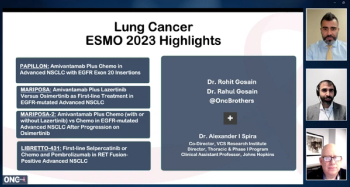
Following their program with expert Alexander Spira, MD, PhD, FACP, Oncology Brothers Rohit Gosain, MD, and Rahul Gosain, MD, share key takeaways from ESMO 2023 centered on advancements in the management of NSCLC.
Alexander Spira, MD, PhD, FACP, joins the Oncology Brothers in reviewing data from LIBRETTO-431 and frontline selpercatinib in patients with RET fusion–positive advanced non–small cell lung cancer.
Shared insight from key opinion leaders on results from MARIPOSA-2 and the role of amivantamab plus lazertinib and chemotherapy in patients with advanced NSCLC following progression on osimertinib.
Expert insight into results from MARIPOSA, a study of frontline amivantamab plus lazertinib in advanced non–small cell lung cancer, and the potential for this regimen’s use in real-world practice.
Oncology Brothers Rohit Gosain, MD, and Rahul Gosain, MD, are joined by Alexander Spira, MD, PhD, FACP, to review data from PAPILLON, which combined amivantamab and chemotherapy as frontline treatment for patients with advanced NSCLC.
Survival benefits for immunotherapy doublets outweigh chemotherapy alone in advanced stage PD-L1-negative non-small cell lung cancer.
Hossein Borghaei, MS, DO, provides an overview on his presentation given at the 18th Annual New York Lung Cancers Symposium.
The early adoption of ctDNA into the clinical workflow improves time to treatment, survival, and monitoring for patients undergoing molecular-based therapy.
In an interview with Targeted Oncology, Penn Medicine’s Qian Wang, MD, MPH, gives an in-depth overview of the molecular targets in the small cell lung cancer field.
For many immune-related adverse events, steroids are used as frontline treatment. However, it remains unclear if steroids allow for preservation of the antitumor immune response, resulting in the need for more options for patients with cancer.
In an interview with Targeted Oncology, Joshua Sabari, MD, discussed the rationale of studying LY3537982 in the LOXO-RAS-20001 trial and next steps for the evaluation of the agent.
THIO has received 2 prior orphan drug designations, and the agent has shown promise in preclinical studies for the treatment of glioblastoma.