


BREAST CANCER
Latest News
Latest Videos


CME Content





























More News

During a Case-Based Roundtable event, Laura Huppert, MD, reviewed antibody-drug conjugates for a patient with metastatic breast cancer who had progressed on multiple line of therapy.
Virginia G. Kaklamani, MD, DSc, discusses findings from the phase 3 TROPION-Breast01 trial of datopotamab deruxtecan.

CDK4/6 inhibitors like abemaciclib and ribociclib improve invasive disease-free survival in breast cancer trials, but controversy surrounds study designs, bias, and cost-effectiveness, raising critical questions about their clinical benefit.

In this episode of Targeted Talks, Sanjay K. Juneja, MD, discusses the exciting advancements of artificial intelligence in 2024.
During a Case-Based Roundtable® event, Ian Krop, MD, and participants discussed how the outcomes of the DESTINY-Breast03 and other trials impact treatment of metastatic HER2-positive breast cancer in the second article of a 2-part series.

The FDA has granted fast track designation to emiltatug ledadotin for advanced or metastatic breast cancer treatment, as supported by new phase 1 data.
Here are the top 10 developments from the year.

During a Case-Based Roundtable® event, Komal Jhaveri, MD, FACP, discussed dosing and toxicity concerns with the approved CDK4/6 inhibitor regimens used in the adjuvant setting for patients with hormone receptor–positive breast cancer.

One new frontier of cancer detection is emerging: metabolomics.

The phase 3 EMBER-3 trial showed imlunestrant improved PFS over SOC endocrine therapy in ER-positive, HER2-negative advanced breast cancer with ESR1 mutations, though not significantly in the overall population.
A phase 2 trial showed ctDNA detection in HR-positive early breast cancer was linked to larger tumors, higher residual cancer burden, and increased recurrence after neoadjuvant endocrine therapy.
An analysis of phase 3 trials found tamoxifen significantly reduced 15-year ipsilateral breast recurrence in patients with “good risk” DCIS treated without radiation therapy.
In the phase 3 EUROPA trial, exclusive postoperative radiation therapy led to better health-related quality of life and fewer treatment-related adverse events in older patients with stage I luminal-like breast cancer at 24 months.

Hope S. Rugo, MD, FASCO, discusses how the combination of elacestrant and abemaciclib compares with other treatment options for patients with advanced breast cancer, whether estrogen receptor-positive or HER2-negative.
Progression-free survival was superior with first-line maintenance of palbociclib in HR-positive, HER2-positive metastatic breast cancer.
A study of 9,146 patients found no OS difference among first-line CDK4/6 inhibitor combinations for HR+/HER2- metastatic breast cancer, presented at SABCS 2024.
Virginia G. Kaklamani, MD, DSc, discusses how effective elacestrant (Orserdu) is in CDK4/6 inhibitor-naive estrogen receptor-positive/HER2-negative metastatic breast cancer treatment.
In the phase 2 SOLTI VALENTINE trial, patritumab deruxtecan with or without letrozole showed similar efficacy to multiagent chemotherapy in HR-positive, HER2-negative breast cancer with fewer severe adverse events.
T-DXd improves progression-free survival vs physician’s choice, regardless of time to progression or endocrine resistance, in HR-positive, HER2-low/-ultralow metastatic breast cancer.
Aditya Bardia, MD, MPH, FASCO, discusses how fam-trastuzumab deruxtecan-nxki compares with physician’s choice of chemotherapy in estrogen receptor-positive/HER2-low breast cancer.
Immediate surgery significantly lowered local recurrence rates in elderly patients with breast cancer compared with delayed surgery, according to a meta-analysis presented at SABCS 2024.
A phase 1 trial of α-lactalbumin vaccine for the treatment of patients with triple-negative breast cancer demonstrated safety and tolerability.
Denise Yardley, MD, discussed results with ribociclib in patients with early-stage breast cancer with no lymph node involvement who were enrolled in the phase 3 NATALEE trial.

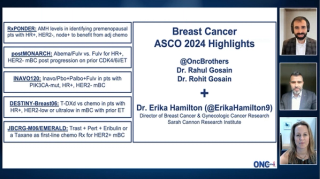
Erika P. Hamilton, MD, discusses antibody-drug conjugates in multiple types of breast cancer, and when to use these drugs in sequence.
During a Case-Based Roundtable® event, Aditya Bardia, MD, MS, FASCO, discussed data from the DESTINY-Breast04 and DESTINY-Breast06 trials for HER2-low breast cancer in the second article of a 2-part series.