MULTIPLE MYELOMA
Latest News

Latest Videos
More News

Rafael Fonseca, MD, recently shared the treatment considerations and decisions he makes when treating patients with multiple myeloma. Fonseca, professor of medicine, chair, Department of Internal Medicine, Mayo Clinic, explained how he would treat these patients based on case scenarios during a <em>Targeted Oncology </em>live case-based peer perspectives presentation.

An FDA analysis of data from 2 randomized clinical trials investigating pembrolizumab in multiple myeloma showed inconsistent results regarding the relationship between immune-related adverse events and objective responses. The KEYNOTE-183 and KEYNOTE-185 trials were reviewed during the 2018 ASCO Annual Meeting.

Patients with relapsed/refractory t(11;14) multiple myeloma achieved high rates of responses when venetoclax was added to the combination of carfilzomib and dexamethasone, according to findings from an ongoing phase II study presented during the 2018 ASCO Annual Meeting.

According to the phase III ARROW study, a prolonged progression-free survival was found when carfilzomib was administered with a new dosing schedule of 70 mg/m<sup>2</sup> once weekly with dexamethasone compared to the standard of care, a twice-weekly schedule, in patients with relapsed/refractory multiple myeloma.

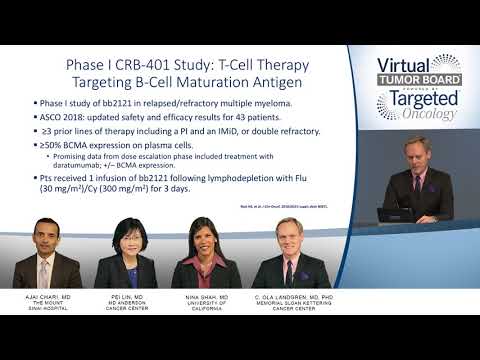
In updated findings from the multicenter phase I CRB-401 study that were presented at the 2018 ASCO Annual Meeting, the anti-BCMA CAR T-cell therapy bb2121 induced a median progression-free survival of 11.8 months and a median duration of response of 10.8 months for patients with relapsed/refractory heavily pretreated multiple myeloma.

Following a planned interim analysis, 2 early-phase clinical trials exploring daratumumab in combination with either a PD-1 inhibitor for multiple myeloma or a PD-L1 inhibitor for non–small cell lung cancer have been terminated, according to a statement from Genmab, the company codeveloping daratumumab with Janssen.

The use of triplet regimens for the treatment of patients with relapsed multiple myeloma has become one of the most favorable treatments recently. OPTIMISMM, a phase III trial, investigated bortezomib and dexamethasone with or without pomalidomide as another triplet regimen option for use in earlier lines of therapy, said Peter Voorhees, MD.<br />

Andrew L. Pecora, MD, president of the Physician Services Division and chief innovation officer at Hackensack Meridian Health, discusses the significance of his findings when combining an anti-CTLA-4 and anti-PD-1 in patients with multiple myeloma. He sought out to find whether these 2 drugs could be combined safely after an autologous stem cell transplant.

Roswell Park Comprehensive Cancer Center has selected Jens Hillengass, MD, as its new Chief of Myeloma. Hillengass will continue his research on hematologic malignancies in his new position.

Ivan Borrello, MD, recently shared the treatment considerations and decisions he makes when treating patients with multiple myeloma. Borrello, an associate professor of oncology, Johns Hopkins University School of Medicine, and director of cell therapy, Sydney Kimmel Comprehensive Cancer Center, in Baltimore, Maryland, explained his treatment decisions based on a case scenario during a <em>Targeted Oncology</em> live case-based peer perspective presentation.


Treating High-Risk Multiple Myeloma

Daratumumab (Darzalex) in combination with bortezomib (Velcade), melphalan, and prednisone received FDA approval as a frontline regimen for the treatment of patients with newly diagnosed multiple myeloma who are ineligible for autologous stem cell transplant.

In top-line results from part 2 of the phase IIb STORM trial, selinexor induced an overall response rate of 25.4% in patients with penta-refractory multiple myeloma, according to Karyopharm Therapeutics, the manufacturer of the oral SINE compound.

The FDA approved several indications throughout the month of April 2018. A number of drugs were granted priority review and Fast Track designation. The FDA also halted all clinical trials using tazemetostat as treatment, and new initiatives were introduced to help ease the development of genetic and genomic-based tests. Check out our list of all FDA happenings from April 2018.