

MULTIPLE MYELOMA
Latest News
Latest Videos


CME Content





























More News
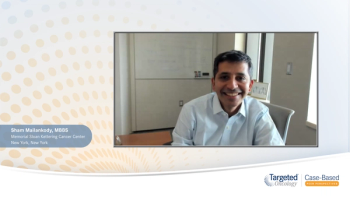
Sham Mailankody, MBBS, presents the case of a 70-year-old man with early relapse multiple myeloma and outlines clinical practices for identifying patients with high risk.

Paula Rodríguez Otero, MD, PhD, discussed the deepening of response and minimal residual negativity during maintenance in the PERSEUS study for patients with multiple myeloma.
A deep and durable response rate was seen with linvoseltamab for the treatment of patients with relapsed/refractory multiple myeloma.
During a Case-Based Roundtable® event, Ariel Grajales-Cruz, MD, discussed the long-term results of the phase 3 IKEMA study that build the rationale for use of the triplet therapy isatuximab, carfilzomib, and dexamethasone, in patients with relapsed/refractory multiple myeloma in the second article of a 2-part series.
In this episode of Targeted Talks, Binod Dhakal, MD, MS, discusses the recent FDA approval of ciltacabtagene autoleucel for the treatment of relapsed/refractory multiple myeloma.
Anita Boyapati, PhD, discussed her research on the link between soluble BCMA and both disease burden and response to BCMA-targeted therapies in this patient population.
David Samuel Dicapua Siegel, MD, shared his perspectives on promising areas of research that could advance the care of patients with myeloma.
During a Case-Based Roundtable® event, Ariel F. Grajales-Cruz, MD, discussed data from the KarMMa-3 trial of idecabtagene vicleucel and real-world data on the CAR T-cell therapy in patients with relapsed/refractory multiple myeloma.
During a Case-Based Roundtable® event, Stephanie L. Elkins, MD, discussed with participants how they manage toxicity of transplant-eligible newly diagnosed multiple myeloma in the first article of a 2-part series.
During a Case-Based Roundtable® event, Jack Khouri, MD, discussed data from the GRIFFIN, PERSEUS, and MASTER trials that investigated quadruplet therapy in patients with newly diagnosed multiple myeloma.

Prophylactic treatment with tocilizumab shows promise for reducing a serious adverse effect in multiple myeloma treatment.
The first safety run-in cohort of the MajesTEC-7 trial showed promising safety/efficacy results with teclistamab, daratumumab, and lenalidomide in newly diagnosed multiple myeloma.
The IMROZ trial reveals significant improvements in PFS for patients with newly diagnosed, transplant-ineligible multiple myeloma.
Linvoseltamab may have similar — if not better — outcomes compared with teclistamab for patients with triple-class exposed relapsed or refractory multiple myeloma.
Data from DREAMM-7 showed comparable patient-reported outcomes between belantamab/bortezomib/dexamethasone and daratumumab/bortezomib/dexamethasone in relapsed/refractory multiple myeloma.
A step-up dosing regimen of teclistamab with prophylactic tocilizumab for relapsed/refractory multiple myeloma showed promising responses in a small patient cohort.
Treatment with talquetamab demonstrated promising safety and efficacy findings when used in relapsed/refractory multiple myeloma, including patients with comorbidities and poor functional status.
Retreatment with daratumumab showed response rates similar to overall response rates from initial daratumumab-based regimens in a retrospective study.
In a phase 3 trial, BVd demonstrated a substantial improvement in progression-free survival compared with DVd for patients with relapsed/refractory multiple myeloma.
Belantamab mafodotin in combination with other therapies shows promise for patients with multiple myeloma following the first relapse.

The FDA has set a target action date of September 27, 2024, for a decision on the supplemental biologics license application of isatuximab plus bortezomib, lenalidomide, and dexamethasone.
During a Case-Based Roundtable® event, Stephanie L. Elkins, MD, discussed with participants about quadruplet vs triplet regimens and the goals of deep responses in transplant-eligible newly diagnosed multiple myeloma in the first article of a 2-part series.

Rahul Banerjee, MD, FACP, physician-researcher at Fred Hutch Cancer Center in Seattle, WA, discusses the potential links between CAR T-cell therapy and secondary T-cell malignancies.
Binod Dhakal, MD, MS, discusses the basis of the FDA approval of ciltacabtagene autoleucel for relapsed/refractory multiple myeloma that has been treated with at least 1 prior line of therapy and is refractory to lenalidomide.
During a Case-Based Roundtable® event, Jonathan L. Kaufman, MD, discussed which lines of therapy and at what doses would be appropriate to use selinexor in a patient with relapsed/refractory multiple myeloma in the second article of a 2-part series.