

MULTIPLE MYELOMA
Latest News
Latest Videos

CME Content





























More News
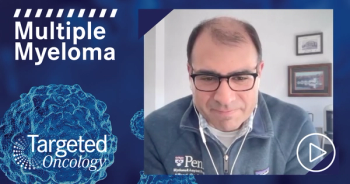
Alfred L. Garfall, MD, discusses the phase 2 BMT CTN 1902 trial of idecabtagene vicleucel in patients with multiple myeloma.

Panelists discuss how to select optimal therapy for a 66-year-old patient with early relapse following autologous stem cell transplantation (ASCT), considering factors such as prior treatment exposure, duration of response, and emerging therapeutic options including cellular therapies.
Panelists discuss how to identify, monitor, and manage delayed toxicities following ciltacabtagene autoleucel (cilta-cel) chimeric antigen receptor (CAR) T therapy, including prolonged cytopenias, infections, and neurotoxicity, to optimize long-term patient outcomes and safety.

In a Community Case Forum in partnership with the North Carolina Oncology Association, Cristina Gasparetto, MD, discussed the CEPHEUS, IMROZ, and BENEFIT trials of treatment for transplant-ineligible newly diagnosed multiple myeloma.
Panelists discuss how CARTITUDE-4 demonstrated superior progression-free survival and overall response rates with ciltacabtagene autoleucel (cilta-cel) compared with standard treatment options in relapsed/refractory multiple myeloma (R/R MM) patients who received 1 to 3 prior lines of therapy.
Panelists discuss how to address practical challenges in delivering chimeric antigen receptor (CAR) T cell therapy, including patient selection, bridging therapy, manufacturing delays, access barriers, and coordination of care to optimize real-world outcomes.
Peers & Perspectives in Oncology editorial board member Marc J. Braunstein, MD, PhD, FACP, discussed the significant advancements in multiple myeloma treatment at the 2024 ASH Annual Meeting and Exposition.

The FDA granted orphan drug designation to OPN-6602 for the potential treatment of relapsed/refractory multiple myeloma.
Idecabtagene vicleucel induced high complete response and minimal residual disease negativity rates in multiple myeloma after suboptimal first-line therapy.
Binod Dhakal, MD, MS, discussed the use of bispecific antibodies and chimeric antigen receptor T-cell therapy in relapsed/refractory multiple myeloma treatment.
Ciltacabtagene autoleucel improved minimal residual disease negativity and sustained responses vs standard care in lenalidomide-refractory multiple myeloma.
Panelists discuss how to manage an aggressive case of early posttransplant progression in a young woman with functionally high-risk multiple myeloma (MM), focusing on rapid intervention strategies and novel therapeutic approaches to overcome poor prognosis disease.
Panelists discuss how to approach treatment selection and sequencing for a 58-year-old woman with high-risk multiple myeloma (MM) who has developed progressive disease after stem cell transplantation, considering factors such as prior therapy exposure, available options, and disease biology.
One concern with bispecific antibody therapies in community settings is managing adverse events, with emerging patterns guiding management strategies.
During a Case-Based Roundtable® event, Muhammad Umair Mushtaq, MD, discussed managing long-term toxicity concerns related to CAR T-cell therapy in multiple myeloma.
The FDA has accepted the resubmitted biologics license application for linvoseltamab to treat relapsed/refractory multiple myeloma in heavily pretreated adults.

Ashraf Z. Badros, MB, ChB, discusses the results of the phase 3 AURIGA trial which evaluated daratumumab and lenalidomide vs lenalidomide maintenance in patients with newly diagnosed multiple myeloma.
Ashraf Z. Badros, MB, ChB, discusses the background, methods, and design of the phase 3 AURIGA trial.
The panelist discusses how the treatment landscape for early-stage relapsed/refractory multiple myeloma (R/R MM) has evolved significantly with CAR T-cell therapies (idecabtagene vicleucel, ciltacabtagene autoleucel [ide-cel, cilta-cel]) and novel drug combinations. Treatment selection now considers prior therapies, patient characteristics, and response duration. For third-line chimeric antigen receptor (CAR) T after no prior CAR T use, cilta-cel shows favorable efficacy data with deeper, more durable responses than ide-cel, though both are viable options.
The panelist discusses how the patient had triplet therapy 6 years ago, which was the standard for myeloma treatment at the time. Since then, the patient has had a biochemical relapse, renal insufficiency, and moderate anemia, so he needs therapy but not immediate therapy.
Panelists discuss how the CEPHEUS trial demonstrates the comparative efficacy and safety of subcutaneous daratumumab combined with VRd vs VRd alone in patients with transplant-ineligible or transplant-deferred newly diagnosed multiple myeloma, highlighting key outcomes and clinical implications.
Bispecific antibody therapy is transforming cancer treatment, especially in multiple myeloma, with ongoing studies exploring early-line and maintenance use.
During a Case-Based Roundtable® event, Rahul Banerjee, MD, discussed approaches to dosing and tolerability when using talquetamab in patients with relapsed/refractory multiple myeloma.
The phase 3 IRAKLIA trial of subcutaneous isatuximab met its co-primary end points in multiple myeloma.
Panelists discuss how guideline-recommended treatment regimens for patients with transplant-ineligible or transplant-deferred newly diagnosed multiple myeloma should be evaluated and selected based on patient characteristics, efficacy data, and safety profiles to achieve optimal outcomes.