

MULTIPLE MYELOMA
Latest News
Latest Videos

CME Content





























More News

Experts on multiple myeloma review recent data updates from the IsKia study looking at Isa-KRd vs KRd as pre-transplant induction and post-transplant consolidation in newly diagnosed multiple myeloma.
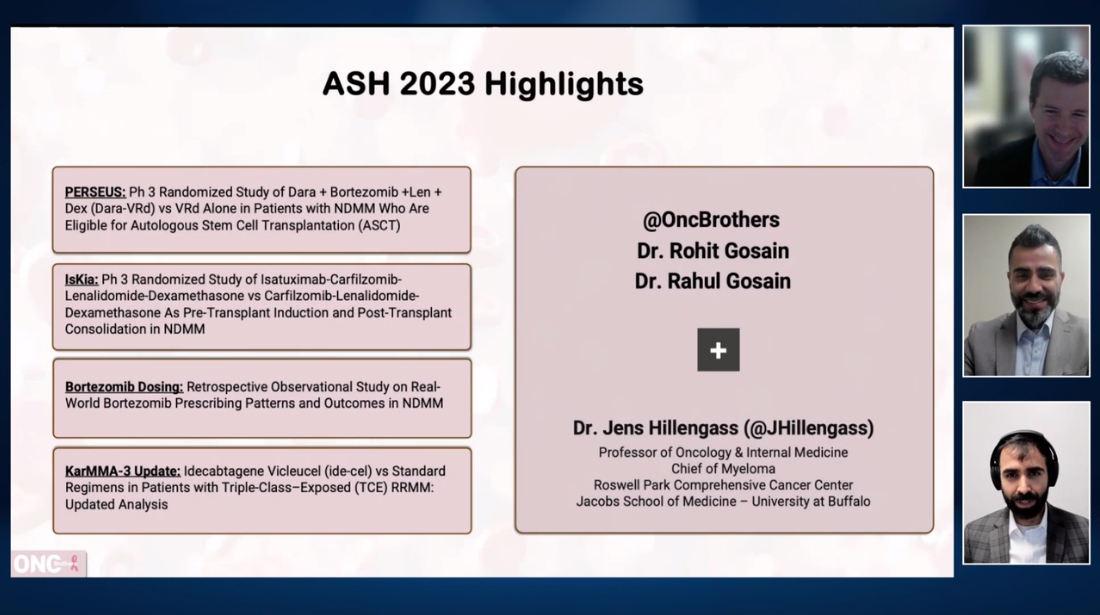
Following ASH 2023, Jens Hillengass, MD, PhD, joins the Oncology Brothers, Rahul Gosain, MD, and Rohit Gosain, MD, to discuss recent data from the PERSEUS study investigating Dara-VRd in newly diagnosed multiple myeloma.

Douglas W. Sborov, MD, MS, provides a summary of the key details of the 54-year-old patient's medical history and multiple myeloma diagnosis.

Paula Rodriguez-Otero, MD, PhD, discusses the promising results from the phase 3 PERSEUS trial in patients with newly diagnosed, transplant-eligible multiple myeloma.

The approval of talquetamab, a GPRC5D-targeted bispecific T-cell engager, led to discussions in 2 separate Case-Based Roundtable events on therapy sequencing selection, toxicity, and outpatient treatment.

During a Targeted Oncology™ Case-Based Roundtable™ event, Susan Bal, MD, discussed the ongoing significance of the IFM2009, DETERMINATION, and FORTE trials in patients with newly diagnosed multiple myeloma. This is the first of 2 articles based on this event.

During a Targeted Oncology™ Clinical Case Forum event in partnership with the Empire State Hematology & Oncology Society, Joshua Richter, MD, discussed the GRIFFIN trial and issues in treating newly diagnosed multiple myeloma including minimal residual disease, consolidation, maintenance, and transplant.
During a Targeted Oncology™ Case-Based Roundtable™ event, Jonathan L. Kaufman, MD, and participants discussed their impressions of the efficacy and safety of the MonumenTAL-1 trial of talquetamab in patients with heavily pretreated relapsed/refractory multiple myeloma. This is the second of 2 articles based on this event.
The treatment combination of isatuximab with carfilzomib, lenalidomide, and dexamethasone resulted in a 100% objective response rate among patients with newly diagnosed multiple myeloma.
Anitocabtagene autoleucel showcased early efficacy with acceptable toxicity in patients with relapsed and/or refractory multiple myeloma—even in those with high-risk features.
Induction therapy with subcutaneous daratumumab followed by autologous stem cell transplant and D-VRd consolidation and daratumumab/lenalidomide maintenance significantly prolonged progression-free survival.
Study findings support the use of a financial navigation program, in hopes to aid patients with multiple myeloma affected by financial toxicity.
Dose reductions of the GPRC5D/CD3 bispecific antibody talquetamab effectively improved on-target adverse events while sustaining high response rates for patients with relapsed/refractory multiple myeloma.

In the second article of a 2-part series, Joshua Richter, MD, discusses how the isatuximab, carfilzomib, and dexamethasone regimen fits into the landscape of treatment for patients with early relapsed multiple myeloma.
Investigators in the MCARTY study reported safety and high response rates in a small number of patients with relapsed/refractory multiple myeloma who received chimeric antigen receptor T-cell therapy designed with a new process to target the D8 binder, meant to improve efficacy in targeting BCMA.
Idecabtagene vicleucel improved health-related quality of life compared with standard regimens in patients with triple-class exposed, relapsed/refractory multiple myeloma.
The retrospective analysis demonstrated comparable outcomes with teclistamab from the phase 2 MajesTEC-1 trial, highlighting the need for close monitoring and supportive care in patients treated for their relapsed or refractory multiple myeloma.
During a Targeted Oncology™ Case-Based Roundtable™ event, Saulius K. Girnius, MD, and participants discussed use of combination therapies including daratumumab as frontline therapy for patients with transplant-eligible multiple myeloma.
During a Targeted Oncology™ Case-Based Roundtable™ event, Robert Mancini, PharmD, BCOP, FHOPA, discussed the various approved bispecific T-cell engagers and gave guidance for healthcare professionals, patients, and caregivers related to adverse event management. This is the second of 2 articles based on this event.
During a Targeted Oncology™ Clinical Case Forum event in partnership with the South Carolina Oncology Society, Hamza Hashmi, MD, discusses the significance of the MajesTEC-1 of the bispecific T-cell engager teclistamab for patients with relapsed/refractory multiple myeloma.

During a Targeted Oncology™ Case-Based Roundtable™ event, Jonathan L. Kaufman, MD, discussed results of the MonumenTAL-1 trial of talquetamab in patients with heavily pretreated relapsed/refractory multiple myeloma. This is the first of 2 articles based on this event.

A real-world analysis found that patients with acute coronary syndrome who were also diagnosed with a hematologic malignancy had worse survival outcomes, and patients with multiple myeloma were overrepresented in the population.

The phase 3 DREAMM-7 trial met its primary end point of progression-free survival, and overall survival data is trending positively.
Steady-state and chemotherapy-based mobilization both demonstrate feasibility in stem cell collection for patients with multiple myeloma undergoing autologous stem cell transplants, but challenges remain.
In the first article of a 2-part series, Sumit Madan, MD, discusses how the combination of selinexor, bortezomib, and dexamethasone shows superior survival outcomes for patients with relapsed/refractory multiple myeloma that are proteasome inhibitor naive or have high-risk cytogenetics.