



LYMPHOMAS
Latest News
Latest Videos


CME Content





























More News

The National Comprehensive Cancer Network has added loncastuximab tesirine-lpyl to the NCCN Clinical Practice Guidelines in oncology for B-cell lymphomas.

The relapse-free survival benefit observed with rituximab maintenance added to autologous stem cell transplant suggests that the treatment strategy may help with disease eradication.

Here is a look back at the FDA happenings from the month of April 2021.
In an interview with Targeted Oncology, Scott R. Solomon, MD, a medical oncologist with the Blood and Marrow Transplant Program, Leukemia and Cellular Immunotherapy Program at the Northside Hospital Cancer Institute, discussed the efficacy of liso-cel in large B-cell lymphoma patients with prior anti-CD19 exposure and future research.
The FDA has granted approval top loncastuximab tesirine for the treatment of relapsed or refractory diffuse large B-cell lymphoma, according to a press release from ADC Therapeutics.
When given at the recommended phase 2 dose, lenzilumab in combination with taxicabtagene ciloleucel, induced a 100% objective response rate while showing no severe cytokine release syndrome cases or severe neurotoxicity in patients with relapsed or refractory diffuse large B-cell lymphoma.
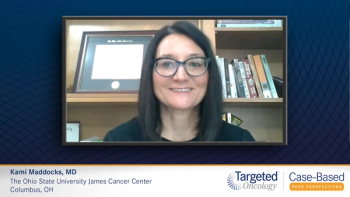
Citing clinical pearls from her own experience in working with patients with relapsed/refractory follicular lymphoma, Kami Maddocks, MD, gives advice to colleagues in their efforts to combat follicular lymphoma.
Kami Maddocks, MD, lists the future directions and unmet needs present in treating relapsed/refractory follicular lymphoma.
The challenges faced in treating patients beyond second-line treatment are addressed. Kami Maddocks, MD, reviews the frequency of patients who require third- and fourth-line treatment, in addition to the factors that affect treatment decisions in later lines of therapy.
Considerations for subsequent treatment options in the second-line setting for patients with follicular lymphoma are reviewed by an expert hematologist.
Kami Maddocks, MD, highlights what findings may trigger a change in therapy or the introduction of a new agent into a patient’s current treatment.
Kami Maddocks, MD, explains the factors surrounding when and why a physician may choose to introduce maintenance therapy for a patient with follicular lymphoma.
An expert hematologist discusses choosing first-line therapy options for patients with follicular lymphoma.
Kami Maddocks, MD, presents the patient diagnosis and treatment history of a 74-year-old-man with relapsed/refractory follicular lymphoma.
Kami Maddocks, MD, reviews the case of a 74-year-old man with relapsed/refractory follicular lymphoma and discusses current treatment options.

Anthony Mato, MD, MSCE, discusses the use of a triplet combination of the novel Bruton tyrosine kinase inhibitor DTRMWXHS-12, the mTOR inhibitor, everolimus, and the IMiD pomalidomide for the treatment of relapsed/refractory Richter’s transformation and de novo diffuse large B-cell lymphoma.
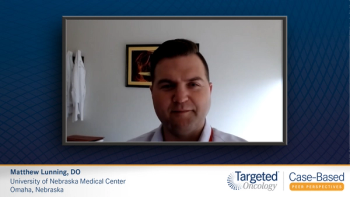
Dr Lunning reviews potential options for later line therapy for patients with R/R DLBCL and shares his thought about future directions in the evolving treatment landscape.
Matthew Lunning, DO, presents the efficacy and safety findings of the L-MIND trial in relapsed/refractory diffuse large B-cell lymphoma and discusses the implications for clinical practice.
Dr Matthew Lunning reviews second-line treatment options for patients with R/R DLBCL and provides insight on individualizing therapy.
DLBCL expert Matthew Lunning, DO, describes risk assessment in patients with DLBCL and how it informs first-line treatment choice.
Matthew Lunning, DO, presents a case of a 71-year-old woman with relapsed/refractory diffuse large B-cell lymphoma and discusses considerations for therapy.
Matthew Lunning, DO, presents a case study of a 71-year-old woman with relapsed/refractory diffuse large B-cell lymphoma.
Pirtobrutinib showed promising efficacy and safety as treatment of patients with mantle cell lymphoma, demonstrating the potential to serve an unmet medical need.
The interim analysis from the phase 3 KEYNOTE-204 study suggests pembrolizumab should be considered the preferred treatment option for patients with relapsed or refractory classical Hodgkin lymphoma over brentuximab vedotin.
Andrew M. Evens, DO, MSc, considered the data supporting brentuximab vedotin with chemotherapy for the treatment of a patient with peripheral T-cell lymphoma.