



HEMATOLOGY
Latest News
Latest Videos



CME Content





























More News

Expert perspective on evolving data and strategies for managing relapsed/refractory CLL.

In an interview with Targeted Oncology, Guenther Koehne, MD, provides a comprehensive overview of the dynamic landscape and evolving strategies in immunotherapy for hematologic malignancies.

In the first article of a 2-part series, Lori Muffly, MD, MS, discusses with a panel of physicians what their approach is to identifying patients with severe chronic graft-versus-host-disease and how they treat them in conjunction with the transplant team.
Dipti Patel-Donnelly, MD, highlights challenges for physicians and patients when managing treatment of hematologic malignancies in the community setting.
Experts comment on factors that influence their decision-making when treating patients with lower-risk MDS.
Insights into treatment goals and review of the current treatment landscape for lower-risk MDS.
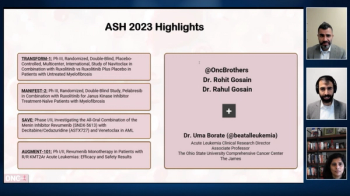
Following their review of updates from clinical trials presented at ASH 2023, the Oncology Brothers provide their key takeaways on recent data in myelofibrosis and acute myeloid leukemia.
Medical oncologists discuss the results from the SAVE and AUGMENT-101 clinical trials investigating revumenib in patients with acute myeloid leukemia.
Uma Borate, MBBS, and the Oncology Brothers provide insights gleaned from the MANIFEST-2 study, a phase 3, randomized, double-blind study on pelabresib plus ruxolitinib for JAK inhibitor treatment–naïve patients with myelofibrosis.
Following ASH 2023, Uma Borate, MBBS, joins the Oncology Brothers, Rahul Gosain, MD, and Rohit Gosain, MD, to discuss results from the TRANSFORM-1 trial investigating navitoclax plus ruxolitinib in patients with untreated myelofibrosis.
Dr Shadman provides an overview of zanubrutinib efficacy and safety data for relapsed/refractory CLL from the Phase 2 ALPINE trial.
An overview of highlights from ASH 2023 on integrating BTK inhibitors into frontline CLL therapy.
Dr Mazyar Shadman reviews emerging targeted therapies shaping the treatment landscape and optimal sequencing in CLL.

Expert perspectives on 2 abstracts presented at ASH 2023 looking at durable continuous transfusion independence and efficacy across different risk subgroups in the IMerge phase 3 trial in MDS.
Gary J. Schiller, MD, a hematologist/oncologist, discusses the current treatment landscape for patients with lower-risk myelodysplastic syndrome [MDS].

In an interview with Targeted Oncology, Lee Greenberger, PhD, discussed some of the latest, interesting research that caught his attention in 2023 and what community oncologists should know about the space as we move into 2024.
Clinicians discuss the importance of early detection in patients with MDS as well as providing insights into some of the unmet needs in MDS, such as a better understanding of the role of molecular alterations and its specific impact in MDS.
Hana Safah, MD explains how the risk stratification for MDS has evolved over time and provides an in-depth of the current risk stratification tools, IPSS, IPSS-R and IPSS-M.
Drs Safah and Koprivnikar review updates made to the WHO and ICC guidelines when classifying MDS as well as discussing the impact of molecular alterations when treating MDS.

Iopofosine I-131 showed impressive results in a study for patients with advanced Waldenstrom's macroglobulinemia, achieving a major response rate of 61%.
New treatments, including luspatercept-aamt, have been added to the treatment algorithm of patients with low-risk myelodysplastic syndrome in 2020.
Yazan Madanat, MD, comments on the updates that were recently presented at ASH 2023 for the management of lower-risk MDS and discusses the impact of emerging therapies.
In an interview with Targeted Oncology, Daniel Wolff, MD, discussed findings from the phase 2 AGAVE-201 trial evaluating axatilimab as a potential treatment option for patients with chronic graft-vs-host disease.
Dipti Patel-Donnelly, MD, discusses the gaps between academic centers and community oncology regarding treatments for hematologic malignancies.
Mazyar Shadman, MD, MPH, explains the current standard-of-care treatment for patients with chronic lymphocytic leukemia and details the factors he considers when choosing an appropriate therapy.