
Yuri E. Nikiforov, MD, PhD, discusses improvements in diagnosis of thyroid cancer including the classification of noninvasive follicular thyroid neoplasm with papillary-like nuclear features.
Yuri E. Nikiforov, MD, PhD, discusses improvements in diagnosis of thyroid cancer including the classification of noninvasive follicular thyroid neoplasm with papillary-like nuclear features.
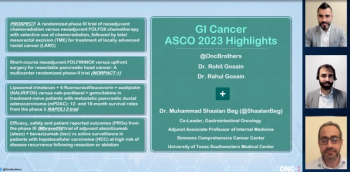
Rohit Gosain, MD, and Rahul Gosain, MD, provide a summary of the key gastrointestinal cancer data updates discussed following the 2023 ASCO Annual Meeting.
The Oncology Brothers, joined by Muhammad Shaalan Beg, MD, share their thoughts on data from the IMbrave050 trial investigating adjuvant atezolizumab plus bevacizumab in patients with high-risk hepatocellular carcinoma.
A review of recent data from NAPOLI-3 comparing the NALIRIFOX chemotherapy regimen versus nab-paclitaxel plus gemcitabine for patients with metastatic pancreatic ductal adenocarcinoma.
Expert oncologists review recent data from the NORPACT-1 study on the use of neoadjuvant FOLFIRINOX chemotherapy for patients with resectable pancreatic head cancer.
Muhammad Shaalan Beg, MD, joins the Oncology Brothers, Rohit Gosain, MD, and Rahul Gosain, MD, to discuss recent data from the PROSPECT trial investigating neoadjuvant therapy regimens for the treatment of locally advanced rectal cancer.

Edwin Choy, MD, provides key recommendations for community oncologists treating patients with gastrointestinal stromal tumor.

Dr Chen and Dr Cutler review a clinical case and discuss GVHD assessment for the patient.

Dr Lee shares an overview of therapy and supportive care options for chronic GVHD according to the severity of a symptom.
Lucia Masarova, MD, PhD, discusses therapeutic options for patients with polycythemia vera who are refractory to hydroxyurea.
A closer look at disease modifying treatments in MDS, providing insights into their mechanisms of action and impact on the management of the disease.

Panelists provide insight on ongoing studies evaluating doublet combinations in frontline advanced RCC.
Expert oncolgists examine 1-year follow-up data from the IMerge trial, discussing the durability of response (transfusion independence), the impact of imetelstat on hemoglobin levels, key safety outcomes and managing cytopenias.
Experts share their approach to CEACAM5 testing, including the testing procedure, patient selection criteria, and timing of testing.
Expert oncologists share experiences and insights on key treatment protocols for patients with aRCC, including perspectives from community oncologists.
The role of CEACAM5, its expression in NSCLC, and its potential as a therapeutic target are thoroughly examined, including its impact on tumorigenesis and prognosis in NSCLC patients.

Christina Fotopoulou, MD, PhD, discusses the results of the DUO-O trial in patients with newly diagnosed ovarian cancer.

Sara Tolaney, MD, MPH, discusses sacituzumab govitecan-hziy as an effective and safe treatment for patients with hormone receptor-positive/HER2-negative metastatic breast cancer.
John Diaz, MD, discusses potential innovations for the ovarian cancer space.

Roby Thomas, MD, discusses the shortage of lutetium Lu 177 vipivotide tetraxetan, and how it had affected patients with metastatic castration-resistant prostate cancer being treated at UPMC Hillman Cancer Center.
Jonathan W. Goldman, MD, discusses the use of osimertinib in the first line setting for patients with non–small cell lung cancer.
Mitchell E. Horwitz, MD, discusses the next steps for research following the FDA approval of omidubicel.
Roby Thomas, MD discusses chemotherapy shortages and the impact these shortages have had on oncology research.

The panel shares future areas of research in malignant PEComa that interest them, and how they see the treatment landscape evolving.
Dr Andrew Wagner presents the case of a young man with a retroperitoneal PEComa.

Ashwin Kishtagari, MD, discusses the adverse events of pacritinib for patients with primary myelofibrosis and low platelet counts.
Amer Zeidan, MBBS, closes his discussion with a look at the potential implications of the COMMANDS trial data on the treatment of lower-risk MDS in clinical practice.
Dr Amer Zeidan details the design, patient population, and key efficacy and safety data from the phase 3 COMMANDS trial investigating luspatercept for the frontline treatment of lower-risk MDS with anemia.
Amer Zeidan, MBBS, explains the treatment options for patients with lower-risk MDS prior to the approval of luspatercept.
The panel engages in a discussion on lenvatinib dosing in clinical practice, addressing dose reductions, their impact on treatment effectiveness, and real-world tolerability.