Matthew J. Matasar, MD, discusses the current landscape of diffuse large B-cell lymphoma.
Matthew J. Matasar, MD, discusses the current landscape of diffuse large B-cell lymphoma.
Yonina R. Murciano-Goroff, MD, MSc, DPhil, discussed the prevalence of MET fusions in patients with non-small cell lung cancer and the impact of identifying them when making treatment decisions.

Charles J. Schneider, MD, FACP, discusses the overall prognosis of patients with anal carcinoma.

Charles Geyer, MD, discusses the end point that was met within the OlympiA study.
Thomas Habermann, MD, discusses the unmet clinical needs which still exist for patients with diffuse large B-cell lymphoma.

Charles E. Geyer, MD, discusses the efficacy of olaparib in the OlympiA study of patients with BRCA-positive, HER2-negative high-risk early breast cancer.

Valencia Thomas, MD, MHCM, discusses how the management of care for patients with non-melanoma skin cancers has changed over the past decade.

Comprehensive insight on the neoadjuvant treatment armamentarium for early-stage HER2+ breast cancer and the appropriate selection of specific agents.
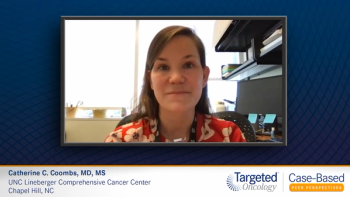
Catherine Coombs, MD, MS, shares her thoughts on the future of treatment and where the field is moving for patients with CLL.
A detailed description of emerging treatment options for patients with relapsed/refractory CLL.
Catherine Coombs, MD, MS, highlights available data and considerations for retreatment with venetoclax in the relapsed/refractory setting.
A comprehensive review of existing second-line treatment options for patients with R/R CLL.
Catherine Coombs, MD, MS, reviews factors that impact the selection of treatment in patients with CLL.
An expert in treating CLL discusses potential treatment options for a patient with relapsed/refractory CLL who has been previously treated with venetoclax plus obinutuzumab.
Catherine Coombs, MD, MS, introduces the case of a patient with relapsed/refractory CLL and shares her impressions on the patient’s initial presentation.

Centering discussion on a patient case of early-stage HER2+ breast cancer, expert oncologists consider when it is appropriate to utilize neoadjuvant therapy.

Lyudmila Bazhenova, MD, discusses targeted therapies for patients with HER2-mutated non–small cell lung cancer.
Tanya Dorff, MD, discusses the phase 1 study of chimeric antigen receptor T-cell therapy in patients with metastatic castration-resistant prostate cancer.

Martin Dietrich, MD, PhD, discusses the study design and results of the CheckMate 9LA trial of ipilimumab and nivolumab for patients with non–small cell lung cancer.

Ron Bose, MD, PhD, discusses the rationale for a trial of neratinib plus alpelisib for patients with HER2-positive breast cancer.
Manali Kamdar, MD, MBBS, discusses the background on a phase 1 clinical trial testing a novel anti-CD19 chimeric antigen receptor T-cell product in adults with relapsed/refractory B-cell non-Hodgkin’s lymphoma.

Ravi Salgia, MD, PhD, discusses how to address and treat transformation from non–small cell lung cancer to small cell lung cancer.

Paul G Richardson, MD, discusses the ways treatment approaches for patients with multiple myeloma has changed over the past few years.

Clayton Lau, MD, discusses the consequences of patients delaying cancer screenings due to fears of COVID-19.

Eric Pujade-Lauraine, MD, PhD, discusses the prognostic factors researchers are looking for when testing patients with ovarian cancer.
Raajit Rampal, MD, PhD, discusses the challenges and unmet needs of myelofibrosis treatments and highlights promising investigational therapies.
Dr Raajit Rampal provides a brief overview of the criteria used to define response to myelofibrosis treatment.
Dr Raajit Rampal discusses factors to consider when switching between therapies among patients with myelofibrosis.
Raajit Rampal, MD, PhD, reviews data from the PERSIST trials which support the use of pacritinib for myelofibrosis treatment.
An overview of the currently available treatment options in myelofibrosis.