Matthew Ingham, MD, highlights a recent clinical study in the sarcoma space and discusses what else is being evaluated for this patient population.
Matthew Ingham, MD, highlights a recent clinical study in the sarcoma space and discusses what else is being evaluated for this patient population.

The panel describes the factors they consider when selecting an appropriate BCMA-directed bispecific antibody for a patient with relapsed/refractory multiple myeloma.

Hana Safah, MD, details the prevention and management of cytokine release syndrome (CRS) and immune effector cell-associated neurotoxicity syndrome (ICANS) in patients receiving BCMA-directed bispecific antibodies for relapsed/refractory multiple myeloma.
Samer A. Srour, MD, MS, discusses some of the takeaways from the dose-expansion phase of an ongoing phase 1 trial evaluating Orca-Q.

David O’Malley, MD, discusses the background and updated results of the KEYNOTE-158 trial looking at pembrolizumab monotherapy in patients with advanced endometrial cancer.
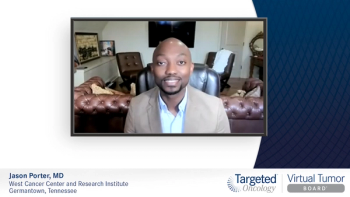
Jason Porter, MD, and fellow panelists discuss how expression of NSCLC biomarkers and biomarker testing rates may vary by patients’ clinical characteristics, including tumor histology, stage, race, and sex.
Expert panelists are introduced and review common biomarkers in non-small cell lung cancer (NSCLC), followed by a focused discussion on EGFR mutations.
Fadi Haddad, MD, discusses the background of a phase 2 study of blinatumomab in combination with ponatinib in Philadelphia chromosome-positive acute lymphoblastic leukemia.
Andrew Kuykendall, MD, discusses some of the recent changes there have been for patients with myeloproliferative neoplasms.
Hussein Tawbi, MD, PhD closes the discussion by outlining current unmet needs in the unresectable metastatic melanoma treatment landscape.
Discussion centered around planning for, managing, and overcoming adverse effects in the first-line systemic therapy setting for melanoma.
Dr Moshe Ornstein provides an overview of renal cell carcinoma (RCC) and treatment considerations for patient who have progressed with advanced RCC.
Yann-Alexandre Vano, MD, discusses the main findings from the phase 2 BIONIKK trial that were presented at the 2023 Genitourinary Cancers Symposium.

Guru P. Sonpavde, MD, discusses The Cancer Genome Atlas and key takeaways for community oncologists.

Yago Nieto, MD, PhD, discusses the findings from a phase 2 trial evaluating treatment with panobinostat, gemcitabine, busulfan, and melphalan for high-risk or relapsed/refractory myeloma.

Krina Patel, MD, MSc, explains which patients with relapsed/refractory multiple myeloma she would not treat with CAR T-cell therapy, and the options after disease progression on CAR-T.
Aaron Gerds, MD, MS, discusses the MOMENTUM study and the potential role of momelotinib in the myelofibrosis treatment landscape.
A look at BCMA targeting in relapsed/refractory multiple myeloma treatment and the BCMA-directed bispecific antibody teclistamab.
A comprehensive overview of ruxolitinib, fedratinib, and pacritinib, the approved therapies for the treatment of myelofibrosis.

Samuel Klempner, MD, explains the rationale for the phase 3 SPOTLIGHT study.

Chung-Han Lee, MD, PhD, discusses the most important factors in treatment selection for later-line therapy in renal cell carcinoma.
Edward B. Garon, MD, MS, discusses data from the phase 3 CANOPY-A study and what they mean for the future of canakinumab for patients with non–small cell lung cancer.

Seth Wander, MD, PhD, discusses what research and topics excite him when looking to further evaluate future treatments for patients with breast cancer.

Laura A. Dawson, MD, FRCPC, discusses quality-of-life outcomes from the NRG/RTOG 1112 study of stereotactic body radiation therapy followed by sorafenib versus sorafenib alone in hepatocellular carcinoma.
Gene Finley, MD, discusses his hopes for the small cell lung cancer field and what he hopes research focuses on in coming years.
Thoughtful comments from Dr Hussein Tawbi on setting first-line treatment goals and typical treatment responses in patients with unresectable or metastatic melanoma.
Clinical insights regarding the treatment of patients with BRAF-mutated metastatic melanoma presenting with symptomatic/asymptomatic brain metastases.
Neeta Somaiah, MD, discusses her presentation given at the Inaugural Miami Cancer Institute Precision Medicine Oncology Symposium.
Ben Derman, MD, discussed results from a trial investigating minimal residual disease–guided discontinuation of maintenance therapy in patients with multiple myeloma.
John Diaz, MD, discusses some of the targeted therapies that are showing promise for patients with ovarian cancer.