Matthew R. Smith, MD, PhD introduces a nonmetastatic castration-resistant prostate cancer (CRPC) patient case featuring a 52-year-old man referred to urology with a PSA of 6.8 ng/mL.
Matthew R. Smith, MD, PhD introduces a nonmetastatic castration-resistant prostate cancer (CRPC) patient case featuring a 52-year-old man referred to urology with a PSA of 6.8 ng/mL.

An expert on chronic lymphocytic leukemia reviews the CLL14 trial, evaluating venetoclax plus obinutuzumab in patients with previously untreated CLL.
An expert hematologist-oncologist discusses the patient case and risk stratification for patients with newly diagnosed CLL.

Roby Thomas, MD, provides ideas for oncologists to consider while multiple chemotherapy drug are on shortage in the United States.
Looking at the results of the BIONIKK trial, Yann-Alexandre Vano, MD, discusses the importance of having biomarkers drive treatment decisions in patients with metastatic renal cell carcinoma.

According to Hagop M. Kantarjian, MD, there are options for limited oncology drug shortages that require multi-sector involvement.
Rebecca Silbermann, MD, MMS, discusses the relevance of patient-reported outcomes from the phase 2 GRIFFIN study and the importance of individualizing treatment for patients with multiple myeloma.

Closing thoughts from a panel of NSCLC experts, with an emphasis on improving access to and utilization of biomarker testing for patients with the disease.

Experts consider how they might approach third-line treatment selection for patients with EGFR exon 20-mutated mNSCLC who experience disease progression on amivantamab or other second-line therapies.

Dr Velázquez Mañana revisits the second patient case and details the use of second-line amivantamab for the patient’s disease progression, and the panel confers about adverse event management strategies for patients taking this regimen.
Gayathri Ravi, MD, discusses the role minimal residual disease plays in decision making and treating patients with hematologic malignancies.

Chung-Han Lee, MD, PhD, reviews clinical trial data and how they apply to the evolving treatment landscape in non-clear cell renal cell carcinoma.

Expert perspectives on factors that aid in the selection of optimal therapy for patients with relapsed/refractory ALK+ non–small cell lung cancer.

Key opinion leaders in the field of endometrial carcinoma management share advice on optimal patient monitoring and the identification of recurrent disease.
Moving on to discuss the second patient case of ALK+ NSCLC, expert panelists elucidate the sequencing ALK TKIs following progression on first-line therapy.
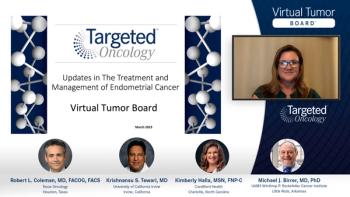
Shared insight on the advent of molecular testing in patients with endometrial carcinoma and how it helps inform the treatment pathway.
While results of the PALOMA-2 study did not show a survival benefit for the overall population on the combination of palbociclib and letrozole but did show an overall survival benefit in Black patients on the combination therapy.

Mitchell Smith, MD, PhD, discusses how the updated results of the phase 2 ECOG-ACRIN E1411 trial of patients with previously untreated mantle cell lymphoma can be interpreted in context of data supporting the use of the Bruton’s tyrosine kinase inhibitor ibrutinib in this setting.

Tycel Phillips, MD, discusses the agents available for the second-line treatment of diffuse large B-cell lymphoma, and the utility of chimeric antigen receptor T-cell therapy.

Rana McKay, MD engages with critical gaps in mCRPC patient care, comments on promising clinical trials, and shares clinical pearls for community oncologists treating patients with mCRPC.
Subject matter expert reviews key trial data from recent years and explains how these data impact the prostate cancer treatment landscape.
Dr McKay shares her initial impressions of an mCRPC patient case before discussing typical patient treatment protocols, NCCN guidelines, and standard therapeutic options.
Rana McKay, MD introduces a metastatic castration-resistant prostate cancer (mCRPC) patient case featuring a 72-year-old man with a history of metastatic castration-resistant prostate cancer.
Carolyn Owen, MD, discusses minimal residual disease as an area of research in the chronic lymphocytic leukemia space.
Ariel Perez, MD, discusses polatuzumab vedotin in combination with bendamustine and rituximab since garnering approval from the FDA and studies that evaluated the combination.

Michael T. Tees, MD, discusses chimeric antigen receptor T-cell therapies, including ALLO-501A, and its use for patients with relapsed or refractory large B-cell lymphoma.
Abdulraheem Yacoub, MD, offers closing thoughts on the future myelofibrosis treatment landscape, with a focus on treatments under investigation.
A detailed overview on monitoring patients with myelofibrosis, and signs that a treatment isn’t effective.
An expert on myelofibrosis discusses recently updated data on momelotinib, which was recently submitted for FDA approval.
Abdulraheem Yacoub, MD, details the systemic therapy options for myelofibrosis and his approach to treatment sequencing.