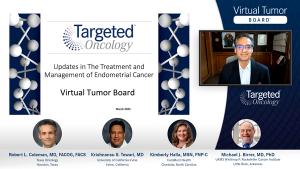
Closing out their program on endometrial carcinoma management, key opinion leaders highlight key novel therapeutic strategies in the evolving treatment landscape.
Robert L. Coleman, MD, FACOG, FACS, is a gynecologic oncologist at Texas Oncology.
Closing out their program on endometrial carcinoma management, key opinion leaders highlight key novel therapeutic strategies in the evolving treatment landscape.

Collaborative discussion on the advent of triplet therapy in patients with metastatic uterine serous carcinoma and clinical data behind this strategy.

Expert Robert L. Coleman, MD, details the final patient case and provides an overview of metastatic uterine serous carcinoma.
Key opinion leaders in the field of endometrial carcinoma provide advice on adverse event management, focusing on immune checkpoint inhibitor therapy.
Robert L. Coleman, MD, and Krishnansu S. Tewari, MD, reflect on data from the GARNET clinical trial of dostarlimab in dMMR recurrent endometrial carcinoma.
Shared insight on the utilization of pembrolizumab in dMMR recurrent endometrial carcinoma in the context of the KEYNOTE-158 clinical trial.
Robert L. Coleman, MD, opens discussion on a second patient case and highlights critical aspects of mismatch repair deficient (dMMR) recurrent endometrial carcinoma.
Before closing out their discussion on the first patient case, key opinion leaders on endometrial carcinoma reflect on the optimal selection and sequencing of therapy in pMMR recurrent disease.
Expert panelists provide their perspective on the real-world use of combination lenvatinib + pembrolizumab in patients with MMRp recurrent endometrial carcinoma.
Moderator Robert L. Coleman, MD, spearheads a review of clinical data from KEYNOTE 775, which combined lenvatinib with pembrolizumab in patients with endometrial carcinoma.
Key opinion leaders in the field of endometrial carcinoma management share advice on optimal patient monitoring and the identification of recurrent disease.
Shared insight on the advent of molecular testing in patients with endometrial carcinoma and how it helps inform the treatment pathway.
Experts Michael J. Birrer, MD, PhD, and Kimberly Halla, MSN, FNP-C, share insight to a typical patient presentation of MMRp recurrent endometrial carcinoma.
Opening its discussion on endometrial carcinoma, a panel of experts led by Robert L. Coleman, MD, reflects on a patient with mismatch repair proficient (MMRp) recurrent disease.

Future opportunities being explored in clinical trials that show promise in treating advanced endometrial cancer.
What patients can expect in terms of prognosis when receiving systemic therapy for advanced endometrial cancer.
Recommendations on how to best prepare patients for chemotherapy, lenvatinib plus pembrolizumab, and other therapies used to treat advanced endometrial cancer.
Variables that impact choice of therapy for patients with advanced endometrial cancer.
The rationale for using systemic therapy to treat patients with advanced endometrial cancer.
A discussion on risk factors associated with endometrial cancer and the role of molecular testing to help evaluate for mismatch repair abnormality.
Dr Robert L. Coleman, US Oncology Research, reacts to how the case of a woman with advanced endometrial cancer was managed from diagnosis through treatment.

Robert L. Coleman, MD, FACOG, FACS, discusses the results of the phase III VELIA trial in patients with advanced ovarian cancer.
Robert L. Coleman, MD, discusses the importance of early BRCA testing for patients with ovarian cancer.
Robert L. Coleman, MD, FACOG, FACS, professor, Ann Rife Cox Chair in Gynecology, Department of Gynecologic Oncology and Reproductive Medicine, vice chair, Clinical Research, The University of Texas MD Anderson Cancer Center, discusses the results of the ARIEL2 trial, a phase II study to identify patients with ovarian cancer likely to respond to rucaparib using tumor genetic analysis.
Robert L. Coleman, MD, FACOG, FACS, professor, Department of Gynecologic Oncology and Reproductive Medicine, University of Texas MD Anderson Cancer Center, discusses a study which examined the impact of bevacizumab in ovarian cancer.

Robert L. Coleman, MD, FACOG, FACS, professor, The University of Texas MD Anderson Cancer Center, discusses the results and key takeaways from GOG0213.
March 31st 2023
April 21st 2023

May 5th 2023