


Ovarian Cancer
Latest News
Latest Videos




CME Content





























More News










General Cancer

Despite all the positive data associated with PARP inhibitors for the treatment of patients with epithelial ovarian cancer who have known <em>BRCA</em> mutations, these agents are not curing patients, said Leslie M. Randall, MD, MAS, at the 2019 SGO Annual Winter Meeting.
Genomic testing can help physicians in the treatment decision process for women with ovarian cancer. As more of these platforms become commercially available, however, physicians must also learn the similarities and differences between each of these tests.
Debra Richardson, MD, discussed the role of PARP inhibitor combinations for frontline maintenance of women with ovarian cancer at the 2019 SGO Winter Meeting.
According to recently announced topline findings, the confirmatory phase III SOLO-3 trial of olaparib has met its primary endpoint, demonstrating a statistically significant and clinically meaningful improvement in objective response rate in patients with <em>BRCA</em>-mutant ovarian cancer who have relapsed on at least 2 prior lines of therapy
At a planned interim analysis of the phase III JAVELIN Ovarian 100 study evaluating frontline avelumab in ovarian cancer, an independent panel determined the study would not meet its primary endpoint of progression-free survival. The co-developers of the PD-L1 inhibitor have announced they will terminate the trial on this basis.
Maurie Markman, MD, discusses how management and treatment strategies in ovarian cancer have influenced other cancers and will continue to do so.
David O’Malley, MD, discussed the findings from 2 clinical trials investigating PARP inhibition in ovarian cancer.
According to findings from a subgroup analysis of the phase III ARIEL3 study presented at the 2018 ESMO Congress, the PARP inhibitor rucaparib (Rubraca) improved progression-free survival as a maintenance therapy in patients with platinum-sensitive recurrent ovarian cancer compared to placebo, despite the number prior of chemotherapy regimens.

Olaparib has been approved by the FDA as a maintenance therapy for patients with deleterious or suspected deleterious germline or somatic <em>BRCA</em>-mutated advanced epithelial ovarian, fallopian tube, or primary peritoneal cancer who are in complete or partial response to frontline platinum-based chemotherapy, as approved by an FDA-approved companion diagnostic assay.
Based on findings from the phase III ARIEL3 trial, the European Medicines Agency’s Committee for Medicinal Products for Human Use has issued a positive opinion recommending an expanded approval for single-agent rucaparib as a maintenance treatment for adult patients with platinum-sensitive relapsed high-grade epithelial ovarian, fallopian tube, or primary peritoneal cancer who are in complete or partial response to platinum-based chemotherapy.
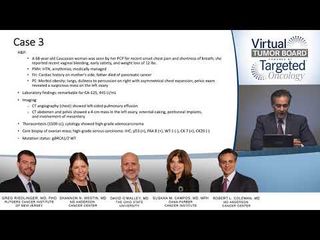
During a <em>Targeted Oncology</em> live case-based peer perspectives presentation, David O’Malley, reviewed the treatment considerations and decisions he makes when treating patients with ovarian cancer. O’Malley explained to the group the factors that go into treatment decision making during the meeting based on a case scenario of a patient with high-grade serous carcinoma.