



HCC
Latest News
Latest Videos


CME Content





























More News

During a Targeted Oncology™ Case-Based Roundtable™ event, Daneng Li, MD, discussed what role a biopsy and other procedures might serve in a patient with a LI-RADS 5 liver lesion. This is the first of 2 articles based on this event.

Moving on to the dose-expansion study of a phase 1b/2a trial of fostroxacitabine bralpamide plus lenvatinib in hepatocellular carcinoma, investigators will assess the recommended phase 2 dose of 30 mg.

The upcoming THIO-102 trial will evaluate the safety and efficacy of THIO administered in sequence with pembrolizumab or atezolizumab across multiple tumor types.

Laura A. Dawson, MD, FRCPC, discusses quality-of-life outcomes from the NRG/RTOG 1112 study of stereotactic body radiation therapy followed by sorafenib versus sorafenib alone in hepatocellular carcinoma.
During a Targeted Oncology case-based roundtable event, Amit Singal, MD, and participants discussed the significance of LEAP-002 and other trials investigating immunotherapy plus tyrosine kinase inhibitor therapy in patients with hepatocellular carcinoma.
In an interview with Targeted Oncology, Laura Dawson, MD, FRCPC, discussed the results of the phase 3 NRG/RTOG 1112 study of SBRT followed by sorafenib compared with sorafenib alone in locally advanced hepatocellular carcinoma.
The first-in-class PPT-1 inhibitor ezurpimtrostat has been granted an orphan drug designation by the FDA for patients with hepatocellular carcinoma.

The phase 3 NRG/RTOG 1112 adds to the body of evidence for the role of external beam radiation, bringing SBRT to the armamentarium of treatment for patients with locally advanced hepatocelluar carcinoma, according to Laura Dawson, MD, FRCPC.
Patients with hepatocellular carcinoma treated from 2018 to 2021 experienced better efficacy vs patients treated from 2008 to 2018, according to a real-world study.
Results from the phase 2 Talem trial, presented at the 2023 Gastrointestinal Cancers Symposium, showed the promising signs of efficacy, anti-tumor activity, and tolerable adverse events when combining blank-microsphere transarterial chemoembolization with lenvatinib and sequential microwave ablation for patients with HCC.
Favorable safety and efficacy data were seen with envafolimab, lenvatinib and transarterial chemoembolization in patients with unresectable hepatocellular carcinoma.
Anti-drug antibodies did not seem to affect how well the STRIDE regimen of durvalumab and tremelimumab or durvalumab alone worked in patients with unresectable hepatocellular carcinoma.
Data from the health-related quality of life analysis of the LEAP-002 study showed similar scores with the addition of pembrolizumab to lenvatinib vs placebo plus lenvatinib in patients with hepatocellular carcinoma.
Laura A. Dawson, MD, FRCPC, discusses findings from the NRG/RTOG 1112 study of stereotactic body radiation therapy followed by sorafenib vs sorafenib alone in hepatocellular carcinoma.
Better health-related quality of life outcomes were seen with tislelizumab vs sorafenib in patients with hepatocelluar carcinoma.
Patients with advanced hepatocellular carcinoma who were treated with lenvatinib following progression on immunotherapy had a median overall survival of 12.8 months and progression-free survival of 3.7 months.

In IMbrave050, the risk of disease recurrence or death was decreased with adjuvant atezolizumab and bevacizumab compared with active surveillance in patients with early-stage hepatocellular carcinoma.
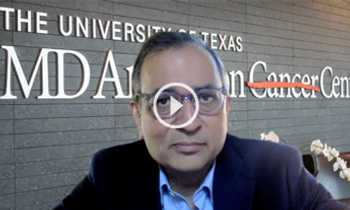
Milind Javle, MD, discusses the phase 3 HIMALAYA study of durvalumab and tremelimumab in patients with locally advanced or metastatic hepatocellular cancer.
During a Targeted Oncology case-based roundtable event, Amit Singal, MD, discussed the data from the LEAP-002 trial of lenvatinib/pembrolizumab vs lenvatinib in patients with hepatocellular carcinoma.
Ghassan K. Abou-Alfa, MD, discusses the data from a phase 3 trial evaluating camrelizumab and rivoceranib vs sorafenib in the first-line for unresectable hepatocellular carcinoma.
During a Targeted Oncology case-based roundtable event, Richard S. Finn, MD, discussed the case of a patient with a 4.5-cm Liver Imaging Reporting and Data System category 5 (LR-5) hepatic mass, Crohn disease, and cirrhosis.

Richard Kim, MD, walks through options in the frontline setting for patients with advanced staged hepatocellular carcinoma and how newer treatments have impacted this patient population.
In data from a first-in-human study of a novel MPS1 inhibitor in patients with advanced solid tumors, clinical activity was observed.
During a Targeted Oncology case-based roundtable event, Ghassan K. Abou-Alfa, MD, MBA, discusses with participants the unexpected results of the LEAP-002 trial of lenvatinib plus pembrolizumab versus pembrolizumab alone for patients with hepatocellular carcinoma. This is the second of 2 articles based on this event.

OTX-2002 has received an orphan drug designation by the FDA for patients with hepatocellular carcinoma. The agent will further be evaluated in the phase 1/2 MYCHELANGELO trial.