Articles by Hetty E. Carraway, MD
An expert discusses how addressing unmet needs in early diagnosis, treatment options, and long-term management, alongside exploring targeted therapies, combination approaches, and advancements in stem cell transplantation, holds promise for more effective and less toxic treatments for blastic plasmacytoid dendritic cell neoplasm (BPDCN).
An expert discusses how structuring clear roles, fostering communication, and using technology in the shared-care model between academic and community centers, alongside monitoring blood glucose levels, kidney function, and comorbidities, ensures effective collaboration and safe use of tagraxofusp (TAG) therapy.
An expert discusses how effective use of tagraxofusp in blastic plasmacytoid dendritic cell neoplasm (BPDCN) requires proactive monitoring for capillary leak syndrome, liver toxicity, and myelosuppression, with structured protocols and multidisciplinary coordination—especially in community settings—to ensure early intervention and safe, successful treatment delivery.
An expert discusses how treatment selection in blastic plasmacytoid dendritic cell neoplasm (BPDCN) involves balancing disease-specific targeting and patient fitness, with tagraxofusp remaining the frontline standard due to its efficacy and favorable hematologic recovery, whereas venetoclax/azacitidine may be reserved for less fit patients or relapsed settings.
An expert discusses how effective blastic plasmacytoid dendritic cell neoplasm (BPDCN) management requires early central nervous system (CNS) evaluation and a multidisciplinary approach, with treatment decisions guided by disease burden, patient fitness, and CNS involvement—highlighting the need for systemic tagraxofusp combined with prompt intrathecal therapy to address high-risk features.
An expert discusses how the diagnosis and management of blastic plasmacytoid dendritic cell neoplasm (BPDCN) require careful recognition of characteristic dermatologic and hematologic features, with tagraxofusp as frontline therapy and vigilant monitoring for central nervous system (CNS) involvement and treatment-related toxicities to guide a multidisciplinary care approach.
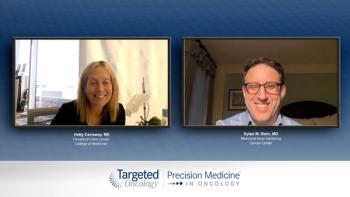
Closing out their discussion, Drs Hetty Carraway and Eytan M. Stein highlight an ongoing clinical trial investigating a triplet therapy for AML.
Dr Stein explains clinical trial data on the use of magrolimab plus azacitidine for patients with TP53-mutated AML.
Dr Carraway highlights some of the most urgent unmet needs for patients with higher-risk MDS.
Eytan M. Stein, MD, discusses how to treat patients with MDS who have IDH or TP53 mutations, and whether there is a role for targeted therapy in this patient population.
Dr Hetty Carraway muses on whether magrolimab plus azacitadine will be used as a standard treatment for higher-risk MDS in the future.
Drs Stein and Carraway explain the rationale for a magrolimab and azacitidine combination treatment for patients with higher-risk MDS with supporting data from 2 clinical trials.
Key opinion leaders describe the role of hypomethylating agents in treating higher-risk MDS and the treatment options after HMA failure.
Hetty Carraway, MD, illustrates the role of allogenic stem cell transplant in MDS and the criteria used to determine a patient’s eligibility.
Eytan M. Stein, MD, outlines the biggest factors to consider when choosing a treatment for higher-risk MDS, including the differences in quality-of-life for patients.
Dr Hetty Carraway reviews the available treatment options for patients with higher-risk MDS, and the biggest challenges of treatment.
Experts explain the treatment goals for patients with MDS, and discusses the role of molecular testing in patients with MDS.
Dr Eytan M Stein breaks down how patients with MDS are risk-stratified, and how the clinical outcomes differ between risk groups.
Hetty Carraway, MD, describes how MDS differs from acute myeloid leukemia (AML), and the percentage of patients who progress to AML from MDS.
Eytan M. Stein, MD, provides an overview of myelodysplastic syndrome, including risk factors, symptoms, and diagnosis.
Eytan Stein, MD and Hetty Carraway, MD, wrap up their discussion with a review of the unmet needs in AML treatment and exciting therapies in the pipeline.
Hetty Carraway, MD, explains the importance of bone marrow biopsies in patients with AML receiving treatment with venetoclax + azacitidine.
Hetty Carraway, MD and Eytan Stein, MD, discuss the appropriate strategies for the management of cytopenias in patients with AML on venetoclax + azacitidine treatment.
Eytan Stein, MD, presents the case of an 81-year-old patient with AML who is unfit for intensive induction therapy for discussion.
Hetty Carraway, MD, highlights the role of venetoclax + azacitidine in the treatment of patients with acute myeloid leukemia who are unfit for intensive induction therapy.
Eytan Stein, MD, continues the discussion of AML treatments with a look at the options for patients with AML and mutations.
Eytan Stein, MD, reviews the available treatment options for patients with secondary AML or AML with myelodysplasia-related changes.
Hetty Carraway, MD, describes the criteria used to determine if a patient with newly-diagnosed acute myeloid leukemia is suitable for intensive induction therapy.
Eytan Stein, MD, provides an overview of the frontline treatment options currently available for acute myeloid leukemia.
Experts explain the goals of treatment for acute myeloid leukemia and the challenges presented.