Commentary|Articles|September 23, 2025
Deep Responses and Favorable Safety with Linvoseltamab in HR-SMM
Author(s)Sabrina Serani, Paula Rodriguez Otero, MD, PhD
Fact checked by: Andrea Eleazar, MHS
Listen
0:00 / 0:00
Research explores innovative treatments for high-risk smoldering multiple myeloma, highlighting promising results from the bispecific antibody linvoseltamab.
The current landscape of treating high-risk smoldering multiple myeloma, a premalignant state of active multiple myeloma, remains a subject of ongoing discussion and research.
Studies have successfully demonstrated that early intervention with drugs like lenalidomide (Revlimid) and daratumumab (Darzalex) can delay progression and improve overall survival. A new phase 2 study, LINKER-SMM1 (NCT05955508) is now investigating the bispecific antibody linvoseltamab (Lynozyfic), which was approved by the FDA in July in relapsed/refractory multiple myeloma,1 in patients with high-risk smoldering myeloma.
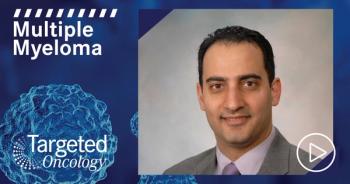
In an interview with Targeted Oncology, Paula Rodriguez Otero, MD, PhD, consultant and deputy professor at the University of Navarra, discusses preliminary findings from LINKER-SMM1 presented at the 2025 International Myeloma Society Annual Meeting.2
What is the current treatment paradigm for high-risk smoldering multiple myeloma?
Paula Rodriguez Otero, MD: High-risk smoldering multiple myeloma is a precursor condition. It’s a premalignant state of multiple myeloma. There is still no consensus on whether the recommendation is to treat or not to treat.
We are defining high-risk smoldering myeloma as a patient that has a diagnosis of a smoldering multiple myeloma and has a high risk of progression to active disease by the development of any of the SLiM-CRAB criteria.
Using either the International Myeloma Working Group criteria, the Mayo Clinic criteria, or PETHEMA criteria, we are able to identify this subgroup of patients that have at least a 50% chance to progress to active disease in 2 years.
In the in the field of smoldering multiple myeloma, there have been 3 very important studies conducted. The first study to show preemptive therapy or treatment of high-risk smoldering multiple myeloma was able to delay progression to multiple myeloma and improve overall survival was conducted by the Spanish Myeloma Group that compared lenalidomide single-agent vs observation. That study showed that 2 years of treatment with lenalidomide was able to delay progression to myeloma and also to improve overall survival in patients with high-risk smoldering multiple myeloma.
Then, there was a confirmation study that was run by the ECOG group that had the same outcome. The latest study to be presented was the phase 3 randomized [AQUILA] study [NCT03301220] comparing daratumumab vs observation. This was one of the first registration studies showing that treatment with daratumumab for a fixed duration. was able to dely progression to multiple myeloma and improve overall survival in patients with high-risk smoldering myeloma.
Now, we know that if we treat these patients in the face of smoldering disease without any SLiM criteria, we may be able to delay or even prevent a disease progression, and now that we have more potent platforms of therapy, and that includes, for example, CAR T-cell therapy or bispecific antibodies, there are studies evaluating the role of these T-cell–regulating therapies in the setting of high-risk smoldering multiple myeloma.
What is the design of the study you presented at IMS?
This is a phase 2 study with a safety run-in phase that enrolls patients with high-risk smoldering myeloma defined as a smoldering diagnosis within 5 years of study entry and high-risk features, either using the 2/20/20 risk criteria or the PETHEMA risk criteria. These patients would receive treatment with linvoseltamab, which is a BCMA/CD3 bispecific antibody, for a duration of 2 years.
In the safety run-in phase, 6 patients were enrolled, and the primary end point of that part was safety. In the expansion part, 34 patients will be enrolled. The primary end point of the expansion phase is the complete response rate and [minimal residual disease (MRD)] negativity at 1 year and 2 years.
So far, the study is ongoing, and we presented safety and efficacy data of the first 24 patients involved.
Could you discuss the safety data?
The key takeaway regarding the safety is that, overall, the safety profile was manageable and consistent with the safety profile of linvoseltamab, but it appears more favorable in this group of [patients with] smoldering myeloma as compared [with] relapsed/refractory disease. We have a lower rate of cytokine release syndrome, 42% in this setting, with the majority of events being grade 1 and 2. No [immune effector cell-associated neurotoxicity syndrome (ICANS)] events were observed. Regarding infections, which are the most nonhematological adverse events see with BCMA-targeted bispecifics, we see here an incidence of any-grade infection of 79%. But importantly, only 12% of the patients had grade 3 or 4 infections, so severe infections remain uncommon. Only three out of the 24 patients had a grade three infection.
Could you discuss the efficacy data?
Of the total 19 patients that were available for response, we see an overall response rate of 100%. We see responses that are deepening over time, and they are occurring very rapidly, with a median time to first response in the first cycle.
In the 19 patients, 74% had achieved a very good partial response or better. It's important to note that if we focus on the first 6 patients that were enrolled in the safety run-in phase, which is the cohort with the longer follow-up, we see that 83% of the patients achieved a complete response or better, so 5 of 6. We are also confident that with a longer follow up, the depth of response will probably increase in this study.
What unanswered questions do you still have?
I think that this is a very unique setting of high-risk smoldering myeloma with a very active drug such as linvoseltamab. So, we have a lot of things to learn. How active will this drug be in the long term to prevent progression to active myeloma? Also, we will be doing a lot of correlative studies to really understand a how these drugs work.
REFERENCES:
1. FDA grants accelerated approval to linvoseltamab-gcpt for relapsed or refractory multiple myeloma. FDA. July 2, 2025. Accessed September 23, 2025. https://tinyurl.com/26ws5ewp
2. Rodriguez-Otero P, Lieonart JJB, Clavero ME, et al. Safety and efficacy of linvoseltamab (LINVO) in patients (Pts) with high-risk smoldering multiple myeloma (HR-SMM): first results from the Phase 2 LINKER-SMM1 trial. Presented at: 22nd Annual International Myeloma Society Meeting and Exposition; September 17-20, 2025; Toronto, Canada. Abstract OA-68.
Related Content
Advertisement