
Manmeet Ahluwalia, MD, discusses the future initiatives of the Cancer Moonshot program.
Manmeet Ahluwalia, MD, discusses the future initiatives of the Cancer Moonshot program.

Leticia Nogueira, PhD, MPH, discusses how healthcare professionals and patients can come together facing the threats of climate change on cancer care.
Manmeet Ahluwalia, MD, discusses the implications of the Cancer Moonshot program for community oncologists.
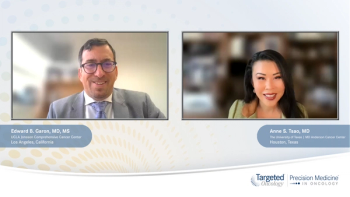
Anne S. Tsao, MD, and Edward B. Garon, MD, MS, conclude their discussion with a look to the future of TROP2 and associated targeted therapy approaches in non–small cell lung cancer.
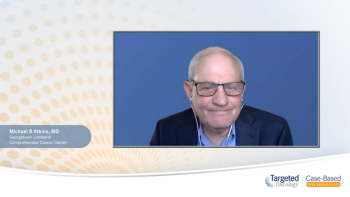
Dr Atkins discusses current unmet needs in the treatment landscape for metastatic melanoma and provides an overview of some of the treatments currently under investigation that show promise.
Insights about second-line treatment options for metastatic melanoma and discusses available data for treatment sequencing.
Immune-related adverse events are often a sign treatment is working. Dr Atkins discusses potential adverse events and how he counsels patients about them.
An expert perspective on how to best treat a patient diagnosed with stage IV BRAF-mutated melanoma.
Dr Atkins shares his approach to first-line treatment and reviews data regarding treatment sequencing from the DREAMseq Trial.
An overview of treatments for metastatic melanoma, including data updates regarding combination options.
Michael B Atkins, MD, shares insights on the prognosis of patient’s diagnosed with advanced melanoma and discusses the value of BRAF mutation testing.

Naval G. Daver, MD, discusses the unmet needs that still exist in the treatment of acute myeloid leukemia.

Firas B. Badin, MD, discusses the improvements seen with repotrectinib compared with first-generation ROS1-targeting tyrosine kinase inhibitors for patients with advanced ROS1-positive non–small cell lung cancer.
Leticia Nogueira, PhD, MPH, discusses the vulnerabilities and hazards that patients with cancer experience due to climate change.
Naval G. Daver, MD, discusses how stem cell transplants factor into the current treatment landscape of acute myeloid leukemia.
Leticia Nogueira, PhD, MPH, discusses the cancer risks that fossil fuel consumption and climate change present.
Josh Weitz, MD, discusses how to balance cost-savings and efficiency while maximizing patient satisfaction in his medical practice.
Joshua Richter, MD, talks about the barriers to diversity in oncology clinical trials.
Thoracic oncologists discuss the progress made and unmet needs that remain in the non–small cell lung cancer treatment space.
Medical oncologists discuss where antibody-drug conjugates fit in the overall non–small cell lung cancer treatment landscape and review the ongoing EVOKE-01 and EVOKE-03 clinical trials.
Naval Daver, MD, discusses the evolution in the treatment of acute myeloid leukemia for both older and younger patient populations.
Jonathan W. Riess, MD, medical director of thoracic oncology, University of California, Davis Comprehensive Cancer Center, discusses the phase 1b FAVOUR trial of furmonertinib in patients with advanced non–small cell lung cancer harboring EGFR Exon20 insertion mutations.
Manmeet Ahluwalia, MD, discusses the progress and initiatives of the Cancer Moonshot program.

Susan Bal, MD, discusses novel targets for relapsed/refractory multiple myeloma at the 2023 Annual Meeting.
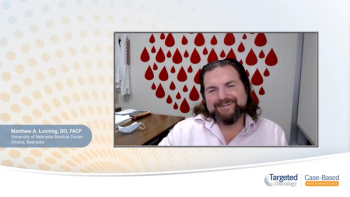
Dr. Lunning explores the FDA-approved CD3- and CD20-targeting bispecifics in relapsed/refractory DLBCL, highlighting their potential impact on heavily pretreated patients.
A deep dive into treatment sequencing strategies in R/R DLBCL, sharing insights from clinical data and recently approved novel therapies.
Expert shares clinical perspectives and treatment considerations regarding use of later lines of therapy for patients with R/R diffuse large B-cell lymphoma.
In an interview with Targeted Oncology, Joshua Richter, MD, discusses how community oncologists can help manage disparities in diversity in clinical trials.