
Anil Parwani, MD, PhD, discusses how the use of artificial intelligence technology can be integrated into the current workflow of pathologists.
Anil Parwani, MD, PhD, discusses how the use of artificial intelligence technology can be integrated into the current workflow of pathologists.

Elizabeth Franzmann, MD, discusses findings of a study exploring a novel method of testing recurrence of head and neck cancer.

Experts discuss factors influencing the choice between luspatercept and erythropoiesis-stimulating agents (ESAs) for initial anemia treatment, considerations for transitioning patients from ESAs to luspatercept, optimal timing for such transitions, and the clinical benefits of luspatercept dose titration as evidenced by real-world data presented at EHA 2024.
Clinicians discuss personalized approaches to initiating and adjusting luspatercept dosing, considering individual patient responses and tolerability, while also examining insights from the MAXILUS study, which explored starting treatment at the maximum approved dose.
Ira Zackon, MD, explains how clinicians can ensure clinical trial patient populations are more inclusive and minorities are better represented.
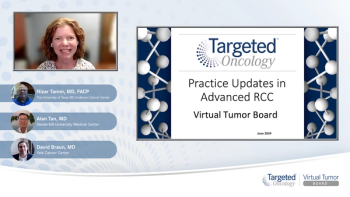
Renal cell carcinoma specialists continue analyzing the case of a 61-year-old patient with indolent metastatic clear cell RCC, evaluating available therapeutic options, discussing disease progression, and addressing recent changes in treatment guidelines.
Medical experts explore dose reduction strategies, alternative therapies, and clinical pearls for optimizing health outcomes in renal cell carcinoma patients treated with immune checkpoint inhibitor and tyrosine kinase inhibitor combinations.
Jamie Koprivnikar, MD, provides key takeaways for optimizing anemia management in patients with lower-risk MDS, highlighting unmet needs in treating anemia and improving patient outcomes.
An expert on the treatment of patients with myelodysplastic syndromes provides clinical insights on dosing practices and considerations for luspatercept.
Jamie Koprivnikar, MD, discusses factors that signal a need to transition a patient with lower-risk MDS from an ESA to another therapy.
Highlighting recent data from a post hoc analysis from the COMMANDS trial, a hematologist-oncologist offers insights on important factors to consider when assessing quality of life in patients with MDS.
Jamie Koprivnikar, MD, discusses how findings from the COMMANDS trial can be used to inform treatment decisions for patients based on serum EPO levels and the presence or absence of ring sideroblasts.
Focusing on molecular prognostic models in LR-MDS, Jamie Koprivnikar, MD, shares insights gleaned from the COMMANDS trial on how mutational burden impacts response.
A hematologist-oncologist provides expert perspectives on the development and implementation of the IPSS-M as a clinical-molecular prognostic model in lower-risk MDS.
Jamie L. Koprivnikar, MD, presents a case of a 70-year-old man with SF3B1+ MDS with ring sideroblasts and discusses the approach to initial therapy in patients with lower-risk MDS who may have moderate-to-severe anemia.

Kenneth Shain, MD, PhD, discusses the rationale for giving chimeric antigen receptor (CAR) T-cell therapy in earlier lines of therapy for relapsed/refractory (R/R) multiple myeloma.

Jeff Sharman, MD, discusses findings from the ELEVATE-TN trial of acalabrutinib with or without obinutuzumab for the treatment of patients with treatment-naive chronic lymphocytic leukemia.

Solly Chedid, MD, shares insights on optimizing anemia management in patients with lower-risk MDS and outlines remaining unmet needs in treating anemia.
An expert on myelodysplastic syndromes reviews recent real-world data presented at EHA 2024 showing the clinical benefit of luspatercept dose titration.
Solly Chedid, MD, provides clinical insights on quality-of-life assessment practices for patients with MDS.
A hematologist-oncologist discusses the efficacy and safety findings from the COMMANDS trial and how they inform treatment selection.
Solly Chedid, MD, presents a patient case and provides clinical insights on approaching first-line therapy selection in patients with LR-MDS and moderate to severe anemia.
Mikkael A. Sekeres MD, MS, discusses transfusion independence rates with imetelstat in patients with low- to intermediate-1 risk myelodysplastic syndromes.
Anil Parwani, MD, PhD, professor of pathology at The Ohio State University Wexner Medical Center, discusses the artificial intelligence (AI) technology that is currently being used at his institution.
Aakash Desai, MD, MPH, discusses the ADRIATIC study in limited-stage small cell lung cancer.

Sangeetha Venugopal, MD, MS, discusses what she is most interested about regarding unmet needs in patients with AML.
In an interview with Targeted Oncology, Evandro D. Bezerra, MD, discusses real-world findings of brexucabtagene autoleucel in relapsed/refractory B-cell ALL.
Sangeetha Venugopal, MD, MS, discusses the evolving field of acute myeloid leukemia treatment.
Claire Saxton, MBA, discusses a study on the concept of social toxicity in patients with acute myeloid leukemia.