Zev A. Wainberg, MD, discusses the impact of the COVID-19 on the colorectal cancer field specifically in terms of clinical trial research.
Zev A. Wainberg, MD, discusses the impact of the COVID-19 on the colorectal cancer field specifically in terms of clinical trial research.

John L. Marshall, MD, discusses factors to consider when prescribing third line therapy for colorectal cancer in a discussion with Targeted Oncology.
Tanios S. Bekaii-Saab, MD, discusses genetic testing and emerging precision medicine strategies in the field of colorectal cancer.
Ecaterina E. Ileana Dumbrava, MD, provides background information on a phase 1/2 study of the agent alone and in combination with an immune checkpoint inhibitor in patients with advanced HER2-expressing solid tumors.

Halle Moore, MD, discusses the results of the IBIS-II DCIS trial of anastrozole versus tamoxifen after 12 years of follow-up for postmenopausal patients with locally excised ductal carcinoma in situ.
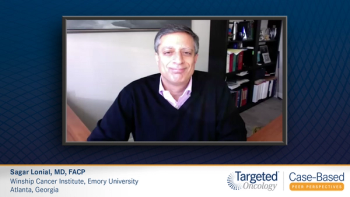
Sagar Lonial, MD, FACP, summarizes current challenges and his hopes for the future concerning the treatment of multiple myeloma.
Sagar Lonial, MD, FACP, focuses on the treatment of multiple myeloma during the COVID-19 pandemic, discussing the standard of care with anti-CD38 monoclonal antibodies and daratumumab.
Sagar Lonial, MD, FACP, explains the importance of daratumumab/lenalidomide/low-dose dexamethasone (DRd) in several key areas, including progression-free survival versus common standard-of-care regimens in the PEGASUS trial, toxicities, and how active patients fare.
Sagar Lonial, MD, FACP, discusses the efficacy data from the phase 3 MAIA study, as well as the role of daratumumab when treating newly diagnosed patients with multiple myeloma.
Sagar Lonial, MD, FACP, highlights first-line therapies available for transplant-ineligible newly diagnosed multiple myeloma, with special considerations regarding comorbidities.
Sagar Lonial, MD, FACP, summarizes a case concerning a 78-year-old man with multiple myeloma, including initial impressions and prognosis at diagnosis.
Sagar Lonial, MD, FACP, presents a case of a 78-year-old man with multiple myeloma and discusses the many facets of treatment for multiple myeloma in the elderly population.
Brian Hill, MD, reviews unmet needs and future directions in the management of mantle cell lymphoma.
Brian Hill, MD, reviews the role of CAR T-cell therapy in mantle cell lymphoma.
Brian Hill, MD, reviews strategies for mitigating toxicities associated with CAR T-cell therapy.
Brian Hill, MD, reviews practice-changing data from the ZUMA-2 trial in patients with relapsed/refractory mantle cell lymphoma.
Brian Hill, MD, reviews second-line treatment options for patients with relapsed/refractory mantle cell lymphoma.
Brian Hill, MD, reviews frontline treatment options for patients with mantle cell lymphoma.
Brian Hill, MD, reviews the case of a 73-year-old man with mantle cell lymphoma.
Brian Hill, MD, reviews the case of a 73-year-old man with mantle cell lymphoma and discusses the latest data and treatment approaches.
Andrew Wei, MBBS, PhD, discusses the results from the phase 3 QUAZAR AML-001 Maintenance Trial of CC-486 for patients with acute myeloid leukemia in the first remission after intensive chemotherapy.

Jesus G. Berdeja, MD, discusses the findings from the phase 2 results of ciltacabtagene autoleucel as treatment of patients with relapsed/refractory multiple myeloma in the CARTITUDE-1 study.
Anne Chiang, MD, associate professor, Medical Oncology, Yale School of Medicine, discusses hard-to-treat lung cancer and how due to recent lung cancer innovations and treatment options, the tumor is becoming increasingly heterogeneous.

Amitkumar Mehta, MD, discusses the toxicity profile of parsaclisib in the phase 2 CITADEL-205 clinical trial of relapsed/refractory mantle cell lymphoma.
Steven Sherman, MD, FACE, provides closing thoughts on unmet needs and future directions for the treatment of patients with RAI-refractory DTC.
Approaching patient education of RAI-refractory DTC therapy with lenvatinib, fostering open communication between patients and providers, and monitoring medication adherence.
An expert endocrinologist perspective on managing the toxicities associated with lenvatinib when treating RAI-refractory DTC and the role of dose reduction and interruption.
A review of a multicenter phase 2 study evaluating the safety and efficacy of lenvatinib starting doses in RAI-refractory DTC.
A review of the phase 3 SELECT trial examining the use of lenvatinib for the treatment of RAI-refractory DTC and the management of adverse events.
Steven Sherman, MD, FACE, provides an overview of the history and evolution of treating patients with RAI [radioactive iodine]–refractory differentiated thyroid cancer [DTC].