
Melissa M. Hardesty, MD, discusses the challenges faced within the community setting in regard to the treatment landscape for advanced ovarian cancer.
Melissa M. Hardesty, MD, discusses the challenges faced within the community setting in regard to the treatment landscape for advanced ovarian cancer.

Joseph M. Curry, MD, discusses the introduction of immune checkpoint inhibitors for the treatment of patients with head and neck cancers.
Kevin Kalinsky, MD, MS, discussed selective estrogen receptor downregulators being explored for the treatment of breast cancer clinical trials.

Yuliya Mikheeva, MD, discusses the phase 2 ANAPLAST-NEO study for patients with anaplastic thyroid cancer.

Bishoy M. Faltas, MD, discusses the significance of studying the response of tumor tissue to mutation-targeted agents in urothelial cancer.

Marcin Kortylewski, PhD, discusses research demonstrating blocking STAT3 in acute myeloid leukemia (AML) cells.

Jesus Berdeja, MD, shares factors oncologists in the community should consider when referring patients for chimeric antigen receptorT-cell therapy with the newly approved agent ciltacabtagene autoleucel.

John Mascarenhas, MD, provides advice to oncologists on the use of pacritinib to treatment patients with myelofibrosis and severe thrombocytopenia.
John Mascarenhas, MD, discusses the mechanism of action of pacritinib and how it differs from ruxolitinib and fedratinib.

Solange Peters, MD, PhD, discusses the design of the CheckMate743 study of doublet immunotherapy for patients with malignant pleural mesothelioma.

Shana Wingo, MD, discusses the benefits of working with AON as a community oncology practice and for the patients.

Eric Pujade-Lauraine, MD, discusses the differences in testing for homologous recombination repair deficiency in patients with ovarian cancer throughout countries.
Closing out his discussion on advanced endometrial carcinoma, Michael Birrer, MD, PhD, shares his hope for future treatment advances.
Expert perspectives on Study 309/KEYNOTE-775, which combined pembrolizumab with lenvatinib in patients with advanced endometrial carcinoma.
Insight on the optimal sequencing of therapy in patients with advanced endometrial cancer based on MMR and MSI status.
Michael Birrer, MD, PhD, considers the role of pembrolizumab in advanced endometrial cancer given results from KEYNOTE-158.

Bishoy M. Faltas, MD, discusses the current use of genomic testing to guide urothelial cancer treatment.
A broad look at the systemic and targeted therapies available for patients diagnosed with advanced endometrial carcinoma.
Focused discussion on risk factors that may drive endometrial cancer followed by advice on optimal diagnostic work-up.
Expert perspectives on the work-up and management of a 70-year-old woman who is diagnosed with advanced endometrial carcinoma.

Jorge Nieva, MD, explains how international drug developers should approach the approval application process after a biologics license application for sintilimab plus chemotherapy for the treatment of nonsquamous non–small cell lung cancer was not successful.

Ronald L. Paquette, MD, discusses characteristics of myelodysplastic syndrome and how they may impact a patient’s success in undergoing stem cell transplant.
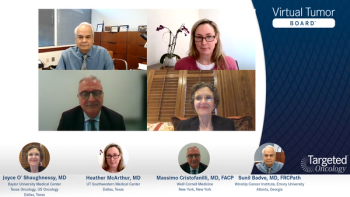
Heather McArthur, MD; Massimo Cristofanilli, MD, FACP; Sunil Badve, MD, FRCPath; and Joyce O’Shaughnessy, MD, share insight on applying data presented from the monarchE study and the use of adjuvant abemaciclib in clinical practice for high-risk, HR+ early breast cancer.

Sunil Badve, MD, FRCPath, and Heather McArthur, MD, evaluate best practices around Ki67 assessment when approaching treatment for HR+ early breast cancer.

Joyce O’ Shaughnessy, MD; Sunil Badve, MD, FRCPath; and Massimo Cristofanilli, MD, FACP, consider the role of adjuvant abemaciclib plus endocrine therapy for the treatment of patients with high-risk, node-positive, HR+ early breast cancer.

Heather McArthur, MD; Massimo Cristofanilli, MD, FACP; Sunil Badve, MD, FRCPath; and Joyce O’ Shaughnessy, MD, review the study design and clinical implications from the monarchE study for high-risk, HR+ early breast cancer.
Experts in breast cancer review the case of a 54-year-old postmenopausal woman with stage IIB, high-risk, HR+ early-stage breast cancer and discuss factors to consider when assessing risk for systemic occurrence.

Sumanta K. Pal, MD, explains what gastrointestinal cancer research needs to focus on in the near future.

Steven M. Albelda, MD, discusses introduction of chimeric antigen receptor T-cell therapy in the solid tumor space.

Thomas Marron, PhD, MD, discusses the end points of an exploratory study which examines the use of cemiplimab in hepatocellular carcinoma.