



BREAST CANCER
Latest News
Latest Videos




CME Content





























More News

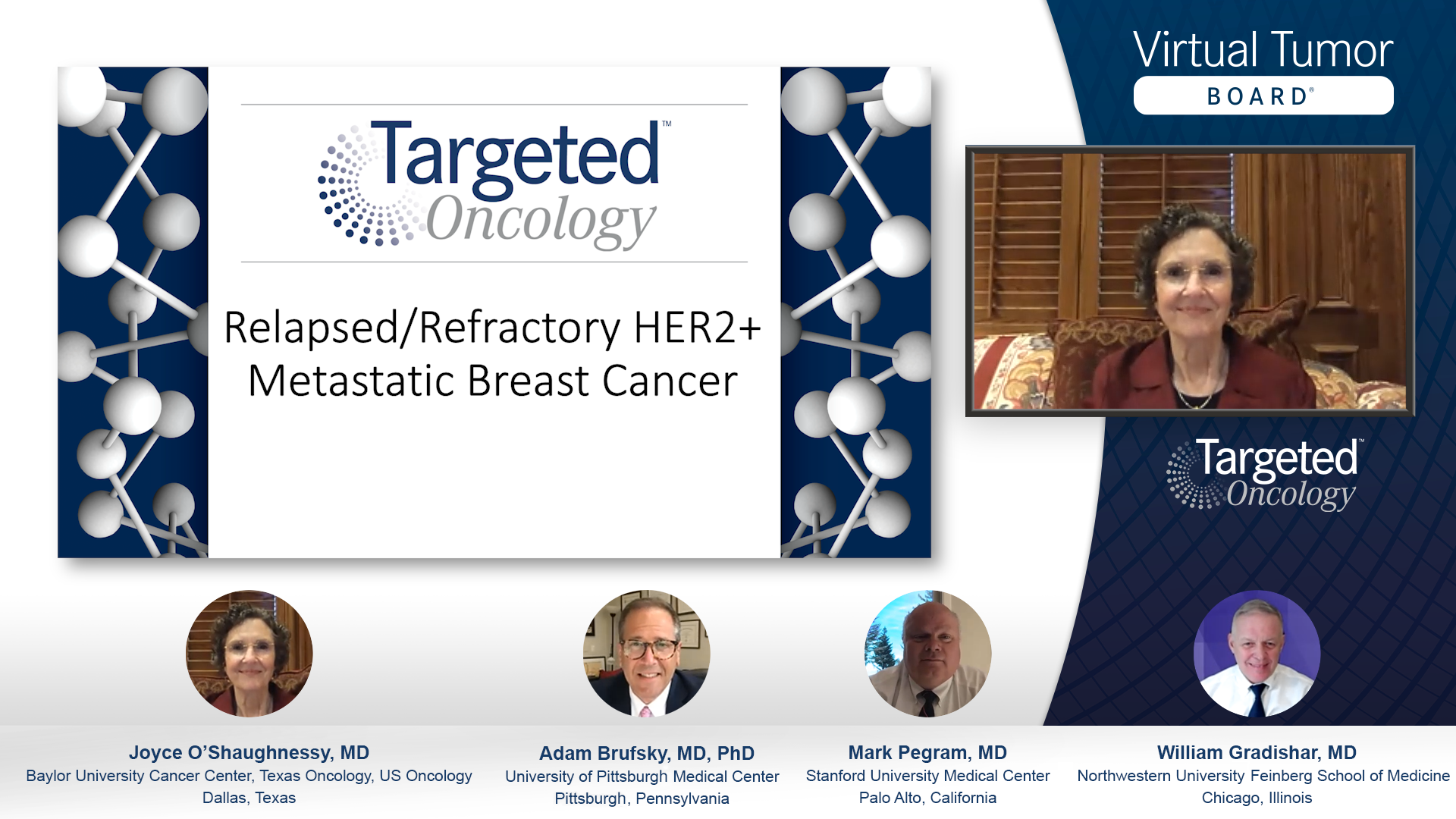
The experts discuss a case presentation of a 63-year-old woman with relapsed HER2+ metastatic breast cancer and discuss rate of relapse in this patient population.
Experts in breast cancer review clinical cases, discuss individualized treatment options and key clinical trials.

The FDA has granted 2 breakthrough device designations to the molecular residual disease test, Signatera.

As the understanding of genetic risk factors in breast cancer continues to grow, professional organizations have sought to provide specific recommendations for genetic testing that would prevent overtesting yet still diagnose as many mutations as possible in patients.
Clinical development of the oral chemotherapy agent, tesetaxel is being discontinued as the treatment of metastatic breast cancer, colorectal cancer, and other solid tumors after the FDA provided feedback on a pre-New Drug Application.
The novel combined immunotherapy CRX100 has been dosed in the first patient with refractory solid tumors in a phase 1, open-label, dose-escalation study.

Adam M. Brufsky, MD, PhD, discusses the use of neoadjuvant therapy for patients with triple–negative breast cancer.
The FDA has issued a complete response letter to Athenex, Inc, regarding the New Drug Application for oral paclitaxel in combination with encequidar for the treatment of metastatic breast cancer. The FDA stated that the application review process has been completed, but the NDA is not ready for approval due to safety and efficacy concerns.
Can treatment with inhibitors of cyclindependent kinases 4 and 6 be optimized for patients with breast cancer? This remains an open question 6 years after the first approval of a CDK4/6 inhibitor, palbociclib.
Patients with BRCA-mutated high-risk HER2-negative early breast cancer demonstrated a superior invasive disease-free survival when compared with placebo in the phase 3 OlympiA trial.
In a 10 to 0 vote, the FDA’s Oncology Drug Advisory Committee did not support the approval of pembrolizumab (Keytruda) in combination with chemotherapy as neoadjuvant therapy for high-risk, early-stage triple-negative breast cancer.
Final analysis of data on HER2-positive disease presented at the 2020 San Antonio Breast Cancer Symposium from experts in the field of breast oncology.
Experts in breast oncology discuss the evolving role of trastuzumab deruxtecan for metastatic HER2-positive breast cancer.
Hatem Soliman, MD, reviews statistically significant data from the PERTAIN study, presented at the 2020 San Antonio Breast Cancer Symposium.
Experts in breast oncology discuss their real-world experience with trastuzumab emtansine (T-DM1) for patients with advanced HER2-positive breast cancer.
Analysis from the ALTTO (BIG 2-06) trial and the relationship between a short or long disease-free interval and overall survival.
Updated findings on the use of neratinib for HER2+ breast cancer from the 2020 SABCS Virtual Symposium.
Updated findings on the use of neratinib for HER2+ breast cancer from the 2020 SABCS Virtual Symposium.
A discussion on the importance of prognostic tools for early stage breast cancer.
Hatem Soliman, MD, discusses data presented at the 2020 SABCS for patients with HER2-enriched subtypes that showed benefit from CDK4/6 inhibition.
Andrew Seidman, MD, provides insight on clinical sequencing for patients with advanced HER2-positive breast cancer.
Experts in breast oncology discuss the evolving landscape in early stage and metastatic HER2-positive breast cancer.

Halle Moore, MD, discusses the results of the IBIS-II DCIS trial of anastrozole versus tamoxifen after 12 years of follow-up for postmenopausal patients with locally excised ductal carcinoma in situ.
The virtual 38th Annual Miami Breast Cancer Conference®, hosted by Physicians’ Education Resource®, LLC will feature presentations from industry thought leaders on innovations in the arena of breast cancer treatment, including topics about systemic therapy and beyond.
In an interview with Targeted Oncology, Senthil Damodaran, MD, PhD, discussed the need for an ESR1-targeted agent for the postmenopausal women with ESR1-positive, locally advanced or metastatic ER-positive/HER2-negative breast cancer.