Articles by Rohit Gosain, MD
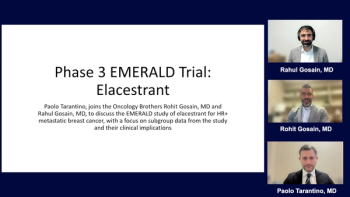
Along with the Oncology Brothers, Paolo Tarantino, MD, discusses what has been learned about the safety profile of elacestrant and shares clinical pearls for adverse event management, aimed at helping patients remain on therapy while maximizing their quality of life.
Along with the Oncology Brothers, Paolo Tarantino, MD, discusses the post -hoc subgroup analysis from the EMERALD study (SABCS 2023), which examined outcomes in patients with ESR1 mutations (ESR1m) who had been on CDK4/6 inhibitors (CDK4/6i) plus endocrine therapy for 12 months or longer, and shares her his perspectives on how these findings may influence the use of elacestrant in ER+/HER2–- metastatic breast cancer (MBC) and impact clinical practice for community oncologists.
Along with the Oncology Brothers, Paolo Tarantino, MD, elaborates on results from an analysis of data from the EMERALD study that were reported at the San Antonio Breast Cancer Symposium (SABCS) 2022. This analysis identified duration of prior CDK4/6 inhibitor therapy as a potential surrogate marker for endocrine sensitivity, and discusses how these findings could help guide patient selection for elacestrant.
Along with the Oncology Brothers, Paolo Tarantino, MD, discusses how ESR1 mutations are commonly observed in hormone receptor-positive breast cancer after prolonged endocrine therapy, and emphasizes the importance of molecular testing for ESR1 mutations at both the initial diagnosis of MBC and at each subsequent progression using liquid biopsy assays.
Along with the Oncology Brothers, Paolo Tarantino, MD, explores how ESR1 mutations frequently co-occur with other molecular alterations and the importance of maximizing endocrine-based therapy before moving on to antibody-drug conjugates or chemotherapy.
Along with the Oncology Brothers, Paolo Tarantino, MD, provides an overview of the phase 3 EMERALD study that evaluated the efficacy of elacestrant as a second-line treatment for ER+, HER2- MBC, particularly in patients with tumors harboring an ESR1 mutation.

Panelists give an overview of the LAURA trial, highlighting its objectives, methodologies, and key findings related to chronic spontaneous urticaria management.
Panelists provide an overview of the MARIPOSA trial, focusing on its aims, design, and significant results in the context of chronic spontaneous urticaria treatment.
Panelists provide an overview of the ADRIATIC study, highlighting its objectives, design, and significant results in the context of chronic spontaneous urticaria management.
Panelists give an overview of the MARIPOSA-2 trial, detailing its objectives, study design, and notable outcomes related to chronic spontaneous urticaria management.

Panelists discuss how NICHE-2 trial updates offer valuable insights into the role of minimal residual disease assessment in guiding neoadjuvant immunotherapy for colorectal cancer patients.
Panelists discuss how updates from the POD1UM-303/InterAACT2 trial presented at European Society for Medical Oncology Congress (ESMO) 2024 shed light on retifanlimab’s potential role in advancing treatment options for anal cancer patients.
Panelists discuss how KEYNOTE-811's study design and key findings presented at the European Society for Medical Oncology (ESMO) Congress 2024 demonstrate the potential impact of pembrolizumab plus trastuzumab and chemotherapy in HER2-positive gastric cancer treatment.
Panelists discuss how LEAP-012 trial results show promising progression-free survival, while anticipating further data on overall survival outcomes.
Panelists discuss how final thoughts emphasize the importance of ongoing research, collaborative care, and adapting treatment strategies to improve patient outcomes in the evolving therapy landscape.
Panelists discuss how surgical perspectives on durvalumab emphasize its role in enhancing patient outcomes, informing surgical decision-making, and integrating immunotherapy into comprehensive treatment plans.
Panelists discuss how considerations for treatment approach encompass patient-specific factors, treatment modalities, and the integration of emerging therapies to optimize outcomes in clinical practice.
Panelists discuss how the results and outcomes of the AEGEAN trial reveal significant findings regarding the treatment’s effectiveness and safety, shaping future approaches in patient care and management.
Panelists discuss how the importance of AEGEAN approval lies in its potential to enhance patient treatment options, paving the way for improved outcomes and informing clinical practice in the field.
Panelists discuss how the AEGEAN trial provides critical insights into the efficacy and safety of new therapeutic approaches, highlighting its design, key findings, and implications for future treatment strategies.

Panelists discuss how the CONTACT-02 study results reveal final overall survival data for patients with liver or bone metastases, providing crucial insights into treatment efficacy for these specific metastatic sites.
Panelists discuss how the EORTC-GUCG 1333 (PEACE-3) trial, presented at ESMO 2024, illuminates key findings regarding the study population and primary endpoints in genitourinary cancer research.
Panelists discuss how the combination of Tivozanib plus Nivolumab from the TiNivo-2 study, along with other data presented at ESMO 2024, shows potential for improving outcomes in certain cancer treatments.
Panelists discuss how overall survival and event-free survival data presented at ESMO 2024 demonstrate promising outcomes in cancer treatment.
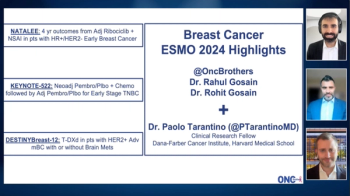
Panelists discuss how ESMO 2024 presented important updates on primary end points and progression-free survival data from recent clinical studies.
Panelists discuss how updates from KEYNOTE-522 at ESMO 2024 revealed important data on overall survival and event-free survival outcomes.
Panelists discuss how the NATALEE study at ESMO 2024 presented updates on primary, secondary, and exploratory end points for evaluating a new cancer treatment.
Panelists discuss where and when sequencing axatilimab becomes appropriate within the clinical setting, as well as safety precautions associated with the drug.
Panelists discuss what the AGAVE-201 study displayed.
Panelists give an overview of chronic graft-vs-host disease, its history of treatment, how it is handled in the modern day, and the study design of AGAVE-201.