Panelists discuss how recent updates in progression free survival data complement secondary endpoints of overall survival, overall response rates, and duration of response to provide a comprehensive picture of treatment efficacy.
Panelists discuss how recent updates in progression free survival data complement secondary endpoints of overall survival, overall response rates, and duration of response to provide a comprehensive picture of treatment efficacy.
Panelists discuss how the latest progression-free survival, overall survival, and overall response rate data presented at ASCO 2025 demonstrate significant advancements in treatment efficacy across multiple tumor types.
Panelists discuss how incorporating both neoadjuvant and adjuvant treatment approaches into clinical trial designs has shown promising improvements in event-free survival outcomes across multiple cancer types.
Panelists discuss how recent clinical data presented at ASCO 2025 showed varying results across primary endpoints including overall survival, progression-free survival, efficacy measures, and safety profiles, with key opinion leaders highlighting implications for current treatment paradigms.
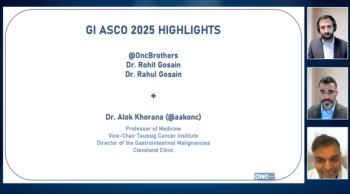
Experts discuss an overview of the STARTER-NET study, emphasizing its goals, key outcomes, and potential impact on clinical practice.
Experts discuss an overview of the ALASCCA study, highlighting its objectives, results, and clinical implications.
Experts discuss the CheckMate 8HW study, focusing on its design, key findings, and impact on treatment strategies.
Experts discuss an overview of the BREAKWATER study, highlighting its key objectives, findings, and implications.
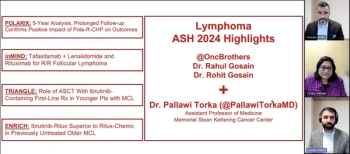
Panelists discuss the ENRICH study, focusing on the efficacy and safety of enzalutamide in combination with standard therapies for metastatic castration-resistant prostate cancer and its potential to improve progression-free survival.
Panelists discuss the TRIANGLE study, examining the efficacy and safety of the combination of rituximab, lenalidomide, and chemotherapy in treating high-risk diffuse large B-cell lymphoma and its potential to improve patient outcomes.
Panelists discuss the inMIND study, exploring the efficacy and safety of mindetuximab for the treatment of relapsed or refractory non-Hodgkin lymphoma and its potential impact on future therapeutic strategies.
Panelists discuss the findings from the POLARIX study, focusing on the efficacy and safety of polatuzumab vedotin in combination with rituximab and chemotherapy for untreated diffuse large B-cell lymphoma.
Panelists discuss the PATINA study, examining the role of palbociclib in combination with letrozole as a first-line treatment for hormone receptor–positive, HER2-negative breast cancer, and its impact on progression-free survival.
Panelists discuss the findings from the DESTINY-Breast12 study, focusing on the efficacy and safety of trastuzumab deruxtecan in patients with HER2-low breast cancer and its potential to expand treatment options for this subgroup.
Panelists discuss the results and implications of the DESTINY-Breast06 study, highlighting the efficacy of trastuzumab deruxtecan in patients with HER2-positive breast cancer previously treated with multiple lines of therapy.

Experts examine the potential role of chimeric antigen receptor (CAR) T-cell therapy in chronic lymphocytic leukemia treatment, incorporating new evidence presented at the 66th American Society of Hematology Annual Meeting and Exposition 2024.
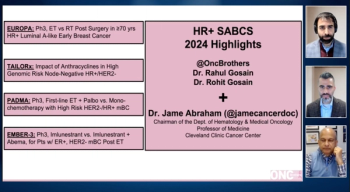
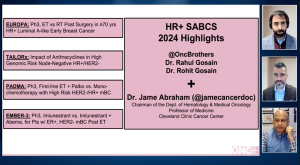
Panelists provide an overview of the EMBER-3 trial and its key findings.
Panelists provide an overview of the PADMA trial and its key findings.
Panelists provide an overview of the TAILORx trial and its key findings.
Panelists provide an overview of the EUROPA trial and its key findings.
Experts discuss the comparative efficacy of sonrotoclax plus zanubrutinib vs venetoclax in chronic lymphocytic leukemia treatment based on updates presented at the 66th American Society of Hematology Annual Meeting and Exposition 2024.
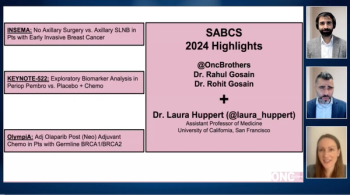
Panelists discuss the OlympiA trial, evaluating adjuvant olaparib post-neoadjuvant chemotherapy in patients with germline BRCA1/BRCA2 mutations and high-risk HER2-negative breast cancer, and its impact on treatment outcomes.
Panelists discuss the exploratory biomarker analysis from the KEYNOTE-522 trial, comparing perioperative pembrolizumab versus placebo plus chemotherapy in early-stage breast cancer, and its implications for treatment strategies.
Panelists discuss the INSEMA trial, comparing no axillary surgery versus axillary sentinel lymph node biopsy (SLNB) in patients with early invasive breast cancer, exploring the implications for treatment decisions and patient outcomes.
Experts examine both overall survival outcomes and independent review committee–assessed progression-free survival data from the AMPLIFY trial.
Experts review the 5-year results of the phase 3 SEQUOIA trial evaluating treatment options for previously untreated chronic lymphocytic leukemia and small lymphocytic lymphoma at the 66th American Society of Hematology Annual Meeting and Exposition 2024.
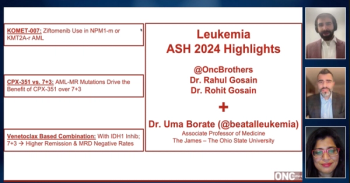
With the Oncology Brothers, Uma Borate, MD, discusses how the combination of venetoclax with an IDH1 inhibitor and 7+3 chemotherapy leads to higher remission rates and MRD negativity in IDH1-mutated AML, offering a promising treatment option for these patients.
With the Oncology Brothers, Uma Borate, MD, discusses how CPX-351 demonstrates superior efficacy over 7+3 chemotherapy in treating acute myeloid leukemia with mutations in measurable residual disease (AML-MR) by specifically targeting the genetic mutations driving the disease, leading to improved patient outcomes.
With the Oncology Brothers, Uma Borate, MD, discusses how ziftomenib is showing promising results as a targeted therapy for NPM1-mutated and KMT2A-rearranged acute myeloid leukemia (AML) in the ongoing KOMET-007 trial, offering potential new treatment options for this challenging patient population.
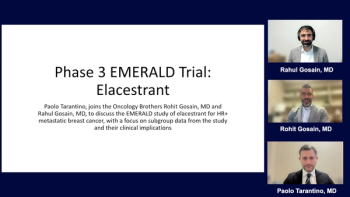
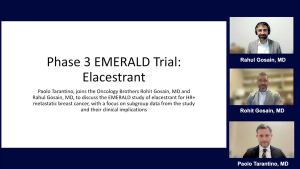
Along with the Oncology Brothers, Paolo Tarantino, MD, discusses ongoing studies investigating oral selective estrogen receptor degraders, including trials exploring use of elacestrant in combination with other therapies.
October 7th 2024

December 20th 2024
October 10th 2024
November 25th 2024
November 25th 2024
January 15th 2025