
David S. Hong, MD, discusses which disease subgroups may benefit from treatment with larotrectinib.
David S. Hong, MD, discusses which disease subgroups may benefit from treatment with larotrectinib.
David S. Hong, MD, discusses updated findings from an analysis of 3 trials which ultimately led to the approval of larotrectinib for patients with solid tumors who harbor an NTRK fusion.
David S. Hong, MD, discusses larotrectinib and its mechanism of action.

David S. Hong, MD, discusses what he sees for the future of the NTRK inhibitor larotrectinib.
David Hong, MD, explains why larotrectinib may be chosen over other TRK inhibitors for the treatment of NTRK fusion-positive lung cancer.

David S. Hong, MD, discusses the data supporting the use of larotrectinib for the treatment of TRK fusion-positive lung tumors. He also explains the difference between larotrectinib another FDA-approved TRK inhibitor, entrectinib.

In this companion article, David S. Hong, MD, considers the safety and efficacy of the first-generation TRK inhibitor larotrectinib and discusses how acquired resistance may affect research into second-generation agents.

In the third video interview of the series, David S. Hong, MD, from the University of Texas MD Anderson Cancer Center discusses the safety and efficacy of first-generation TRK inhibitors and reflects on challenges affecting next-generation TRK inhibitors including research into mechanisms of treatment resistance.
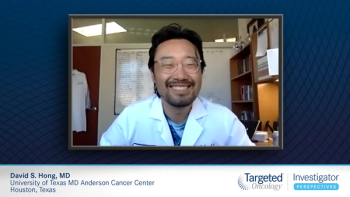
David S. Hong, MD, of The University of Texas MD Anderson Cancer Center, shares his enthusiasm for ongoing research efforts to optimize treatment for patients with advanced solid tumors who harbor NTRK gene fusions.
Important takeaways from recent safety and efficacy data presented on the use of larotrectinib as treatment for advanced differentiated and anaplastic thyroid cancers with NTRK gene fusions.
Dr David S. Hong reacts to updated survival data associated with the use of larotrectinib as treatment for TRK fusion–positive non–small cell lung cancer.
The significance of recent data exploring larotrectinib, a TRK inhibitor, in a subset of patients with TRK fusion–positive tumors with CNS (central nervous system) metastasis.
David S. Hong, MD, of The University of Texas MD Anderson Cancer Center, discusses the availability of TRK inhibitors to treat advanced TRK fusion-positive solid tumors, highlighting their safety and efficacy.
Current preferences for testing patients with advanced solid tumors for NTRK gene fusions to help guide therapy based on treatment advances for TRK fusion-positive solid tumors.
David S. Hong, MD, of the University of Texas MD Anderson Cancer Center, reacts to the growing interest around identifying NTRK gene fusions in various solid tumor types and treating appropriate patients with oral TRK inhibitors.

David S. Hong, MD, discusses updated data with larotrectinib (Vitrakvi) in <em>TRK</em> fusion-positive solid tumors at the ESMO Congress 2019.
David S. Hong, MD, discusses the potential for other TRK inhibitors in the treatment landscape for patients with thyroid cancer after the approval of larotrectinib.
<p>David S. Hong, MD, discusses the results from the phase II innovaTV 201 trial looking at the antibody-drug conjugate tisotumab vedotin in patients with metastatic or recurrent cervical cancer.</p>

September 29th 2019
March 25th 2021
March 25th 2021