Commentary|Articles|April 17, 2026
Understanding Holding vs Bridging Therapy for CAR T in Multiple Myeloma
Author(s)Targeted Oncology Staff
Fact checked by: Jonah Feldman
Listen
0:00 / 0:00
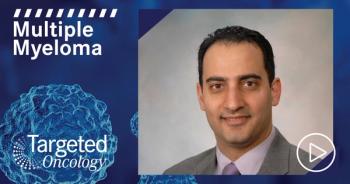
During a live event, Binod Dhakal, MD, discussed the rationale for choosing therapy given before CAR T-cell infusion in multiple myeloma.
Chimeric antigen receptor (CAR) T-cell therapy is the most efficacious approach for many patients with relapsed/refractory multiple myeloma, but it currently comes with 2 periods of delay before administration: first, the time after disease progression is confirmed but before patients undergo apheresis, and second, a period while the CAR T cells are being manufactured from the patient’s cells. Treatment before apheresis is known as holding therapy, whereas afterward it is considered bridging therapy.
During a live Case-Based Roundtable event in Salt Lake City, Utah, Binod Dhakal, MD, associate professor of medicine at the Medical College of Wisconsin, described the rationale for holding and bridging therapies and the considerations that determine why particular therapies may be preferred or avoided to ensure that patients get the best outcomes with CAR T-cell therapy.
Targeted Oncology: How are holding and bridging therapy before CAR T distinguished?
Binod Dhakal, MD: When you talk about CAR T-cell therapy, the patient needs to wait before they get to the CAR T center, so they need to have some [holding] therapy. [If] the patient has aggressive relapse, they need to start something. You want to start something that doesn't compromise the T-cell quality, because the T-cell quality is the key. If you have poor T-cell quality, they don't have good quality [CAR] T cells. There are a lot of out-of-specification products or manufacturing failure, so then all their efforts will go in vain.
Once [you] collect the T cells, you need to do something, because, again, there is a lag time about 4 to 6 weeks or even longer.1 Sometimes you will need do something, because if you don't do something, the patient has a higher disease burden, and we know that disease burden correlates to both safety and efficacy. If you look at the literature, every disease spectrum, you can clearly see that if you have high disease burden…you're not going to do well with the CAR T. The best patient for the CAR T is somebody with the lowest disease burden. That used to not be the thought process before. They used to think that we need some disease for the CAR T to work, but later on, that whole theory has been proven wrong when patients with minimal residual disease–positive or even small amount of disease are having long-term benefits. So clearly, bridging became very important after studies showing that both safety and efficacy are important.2
What are the priorities for selecting holding and bridging therapy?
Before apheresis, you want to control the disease but don't want to jeopardize the CAR T. After apheresis, while you're waiting, you want to do something to control the disease or debulk the disease. And it definitely [must be] different from the lymphodepleting chemotherapy, and you want to give something that doesn't compromise the safety of the CAR T.
So for the holding therapy, you…don't want the impact of this therapy to compromise the T cells. …In holding therapy, for example, you cannot use bendamustine or things like it; they can be toxic to the T cells.3 Then, you also want to have a washout before you go for the CAR T—at least a 2-week washout is more or less a conventional way that would give enough time for the therapy effect to go away. And since you are using B-cell maturation antigen [BCMA]–CAR T, you want to avoid the BCMA therapy for bridging, because that compromises antigen availability for the CAR T.
What are the recommended bridging therapy options?
If you have a low tumor burden, you can use a triplet option, and you can even use the bispecific antibodies. Forhigh tumor burden, the consideration is a quadruplet regimen: immunomodulatory drug [IMID], proteasome inhibitor [PI], monoclonal antibody, or selinexor [Xpovio] for a few more cycles. Additional considerations of selection: because of the novel mechanism of action, [you can use] a selinexor-based regimen because there is a different pathway, or talquetamab [Talvey] targets a different antigen, GPRC5D; it may be a good option in heavily treated patients, for example. In patients with anorexia or failure to thrive, you can try a BCMA-based regimen, but you need a longer washout, of course. Carfilzomib [Kyprolis] should be avoided in patients with cardiac comorbidities, and patients with translocation 11;14 could consider venetoclax [Venclexta]; off-label use can be considered. In somebody with translocation 11;14, that I have done as well.
DISCLOSURES: Dhakal previously reported being a member of advisory boards for Janssen Pharmaceuticals, Bristol Myers Squibb, Kite Pharma, Arcellx, Sanofi, Pfizer, Karyopharm, Menarini, Genentech, and Legend Biotech, and received consulting fees from Genentech, Pfizer, and Legend.
REFERENCES
1. Costa LJ, Banerjee R, Mian H, et al. International myeloma working group immunotherapy committee recommendation on sequencing immunotherapy for treatment of multiple myeloma. Leukemia. 2025;39(3):543-554. doi:10.1038/s41375-024-02482-6
2. Ventin M, Cattaneo G, Maggs L, Arya S, Wang X, Ferrone CR. Implications of high tumor burden on chimeric antigen receptor t-cell immunotherapy: a review. JAMA Oncol. 2024;10(1):115-121. doi:10.1001/jamaoncol.2023.4504
3. Ailawadhi S, Anderson LD Jr, Dhakal B, Shune L, Sborov DW, Hansen DK. Optimizing selection of bridging therapies prior to car-t therapy administration for multiple myeloma: clinical pearls from an expert roundtable. Clin Lymphoma Myeloma Leuk. 2026;26(2):85-93. doi:10.1016/j.clml.2025.08.005
Related Content
Advertisement