Commentary|Articles|August 15, 2025
Managing Chemotherapy-Induced Neutropenia in SCLC
Author(s)Targeted Oncology Staff
Fact checked by: Dylann Bailey
Listen
0:00 / 0:00
During a live event, Misty D. Shields, MD, PhD, discussed using G-CSF and trilaciclib to mitigate chemotherapy-induced neutropenia in SCLC.
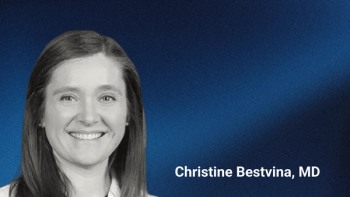
Small cell lung cancer (SCLC) is often treated with chemoimmunotherapy, which can cause neutropenia for patients. At a live Case-Based Roundtable event in Texas, Misty D. Shields, MD, PhD, an assistant professor of clinical medicine and translational medical oncologist at Indiana University School of Medicine, discussed treatments to help with this issue. Shields reviewed the use of granulocyte colony–stimulating factor (G-CSF) for high-risk patients and the CDK4/6 inhibitor trilaciclib (Cosela) to protect bone marrow during treatment.
CASE SUMMARY
- A 41-year-old woman presented to the emergency department with coughing, chest pain, and dyspnea.
- Medical history: Thyroidectomy 5 years ago due to thyroid papillary carcinoma (T2N0M0), with subsequent long-term maintenance therapy with levothyroxine, follow-up examinations during this period revealed no particular abnormalities; otherwise healthy
- No history of smoking
- Physical examination: thyroid deficiency, otherwise unremarkable
- Chest CT showed 1.5 cm × 1 cm mass on the right pleural side, associated with pleural thickening and adhesion, and scattered satellite lesions; a minimal right pleural effusion; several mediastinal lymph nodes (largest measuring 1 cm × 1.8 cm; pericardial effusion); no evident anomalies in the left thoracic cavity
- Fine-needle aspiration biopsy of the tumor confirmed SCLC.
- Imaging showed no signs of distant metastasis.
- Diagnosis: ES-SCLC (T4N2M1)
- ECOG performance status: 1
- Carboplatin/etoposide/durvalumab [Imfinzi] was initiated,
- Two weeks after receiving the first cycle, she called the office to report chest pain and productive cough, with a fever of 100° to 101° Fahrenheit over the past 24 hours.
- Lab work, imaging, and blood/sputum cultures confirmed febrile neutropenia (absolute neutrophil count [ANC], 100) with sepsis in the presence of pneumonia.
Targeted Oncology: What are some ways to handle the adverse events for this patient with SCLC?
Misty D. Shields, MD, PhD: Keeping in frame of this patient case, we are thinking about G-CSF for chemotherapy-induced neutropenia. She had an ANC of 100, she has febrile neutropenia. When we think about this, pulling information on this mechanism of action, we're effectively having chemotherapy bomb going off in the bone marrow, hitting all of our hemopoietic stem cell and progenitor cells. G-CSF is that recovery of stimulating with growth factor after the exposure of chemotherapy. With any chemotherapy we prescribe, if it has a 20% or greater febrile neutropenia risk, we are automatically prescribing G-CSF with our cycle 1. We have those patients who are intermediate risk, but if we have other risk factors, then we might be prescribing it with cycle 1.But if it's less than 10%, we're holding off and we're waiting and seeing how patients do.1
What are some other medications you consider for chemotherapy-induced neutropenia?
Trilaciclib is a selective CDK4/6 inhibitor. It is similar to what we know of all of our breast cancer drugs, palbociclib [Ibrance], abemaciclib [Verzenio], and ribociclib [Kisqali]. It's a CDK4/6 inhibitor, halting the cells and cell cycle arrest at G1 so that they cannot continue to go through cell cycle progression with G1/S, G2, etc. It is effectively stopping cells and arresting them in G1, and so the idea is that you would prevent the [hemopoietic] stem cells, basically all of our bone marrow cells, from being exposed to chemotherapy. It's given 30 minutes prior, as a premedication, to all of the rest of your chemotherapies, carboplatin, etoposide, and immunotherapy.2-4
It's given at the same time as your premedications, and then you wait and then give the rest. The idea is that you've frozen your bone marrow cells while you're administering chemotherapy. It has a short half-life, and so it wears off. The stem cells can continue to divide, and they've not been exposed or integrated with chemotherapy, and they continue onward. The reason that works in SCLC is that it is p53 and retinoblastoma [Rb] deficient, so you don't have those cell cycle checkpoints that all the other cells in the rest of the body have. The disease continues to divide and do everything it's going to do because it is p53 and Rb immune. It continues to divide and does not affect the efficacy of the chemotherapy in SCLC.
How does this drug differ from the other CDK4/6 inhibitors?
I think they have slightly different half-lives. And the difference is, with all your CDK4/6 inhibitors in breast cancer, you have on and off weeks, so it's that continuous administration of the drug that has a different effect on breast cancer than it does here. I think that between the half-life and the continuous use of it, that's why it's more effective in this setting as an intravenous medication to be quickly administered, [with] quick uptake in the bone marrow cells, and then it wears off quickly. You don't get to replenish those bone marrow cells. It's the red cells, white cells, and platelets that are being affected, all those progenitor cells in the bone marrow.
We're freezing the bone marrow cells vs killing them and then trying to stimulate growth of more. With that, you're freezing your reserve and letting the chemotherapy pass by, and then the freeze wears off and it allows them to come back effectively and continue to be functional.
DISCLOSURES: Shields has previously reported membership on advisory committees, review panels, board membership, etc, with AstraZeneca (relationship has ended) and Jazz Pharmaceuticals (relationship has ended), and speakers’ bureau with Jazz Pharmaceuticals (relationship has ended).
References:
1. Blayney DW, Schwartzberg L. Chemotherapy-induced neutropenia and emerging agents for prevention and treatment: A review. Cancer Treat Rev. 2022;109:102427. doi:10.1016/j.ctrv.2022.102427
2. Weiss JM, Csoszi T, Maglakelidze M, et al. Myelopreservation with the CDK4/6 inhibitor trilaciclib in patients with small-cell lung cancer receiving first-line chemotherapy: a phase Ib/randomized phase II trial. Ann Oncol. 2019;30(10):1613-1621. doi:10.1093/annonc/mdz278
3. He S, Roberts PJ, Sorrentino JA, et al. Transient CDK4/6 inhibition protects hematopoietic stem cells from chemotherapy-induced exhaustion. Sci Transl Med. 2017;9(387):eaal3986. doi:10.1126/scitranslmed.aal3986
4. Bisi JE, Sorrentino JA, Roberts PJ, Tavares FX, Strum JC. Preclinical characterization of G1T28: a novel CDK4/6 inhibitor for reduction of chemotherapy-induced myelosuppression. Mol Cancer Ther. 2016;15(5):783-793. doi:10.1158/1535-7163.MCT-15-0775
Related Content
Advertisement